
When most people picture a Stoic, they picture a bearded Roman. The historical record disagrees with the picture.
The Roman Stoic teacher Musonius Rufus, the man who trained Epictetus, argued in a surviving lecture that women should study philosophy for the simplest possible reason: they have the same rational nature as men, so they have the same capacity for virtue. You can read the whole lecture, "That women too should study philosophy". It is two thousand years old and it is not subtle about its conclusion.
And the record backs him up. Some of the most complete demonstrations of Stoic practice we have, not Stoic theory but practice, come from women. Most of them never get named in the popular books.
This article is the missing cast list: the ancient exemplars, the scholars who carried the texts to us, and the modern voices doing the most interesting work right now.
The ancient exemplars
Arria Major (d. 42 CE)
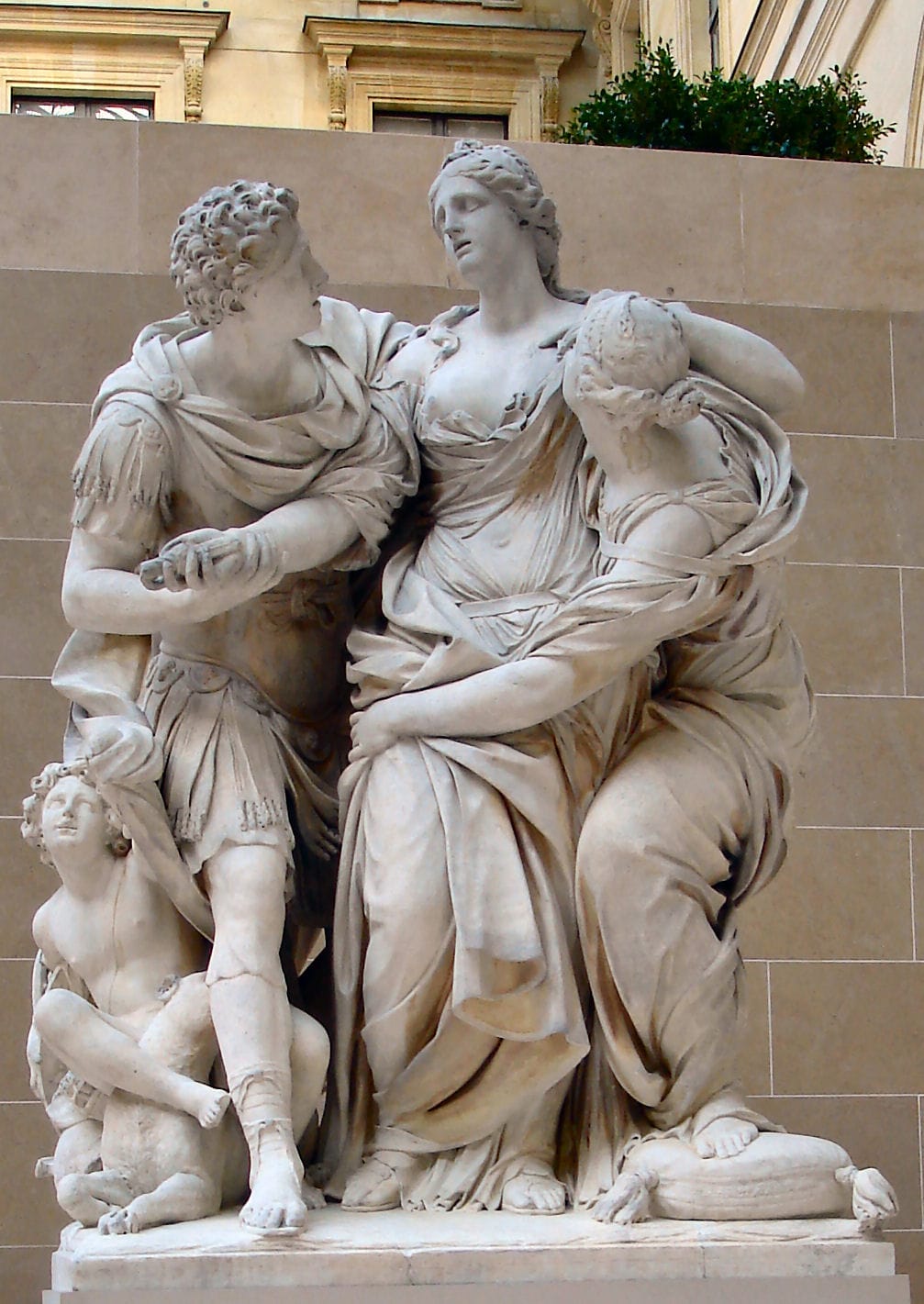
Her husband, Caecina Paetus, was condemned to death by forced suicide and could not bring himself to do it. Arria took the dagger, stabbed herself first, handed it back to him and said: "Paete, non dolet." Paetus, it doesn't hurt.
Pliny the Younger, who recorded the story in Letters 3.16 (Attalus translation), makes a point that matters more than the famous line: the deeds she was less known for were, in his view, even greater. She had earlier hidden her own son's death from her dying husband, grieving in private so that her grief would not kill him. That is the discipline of assent under a load most of us will never carry.
Fannia (d. c. 103 CE)
The backbone of what historians call the "Stoic opposition" to the emperors. Daughter of Thrasea, wife of Helvidius, she followed her husband into exile twice, then commissioned a biography of him knowing it would bring punishment, and accepted exile a third time for it. Pliny again, Letters 7.19 (source): "What chastity, what sanctity, what dignity, what constancy!"
Porcia Catonis (c. 73–42 BCE)
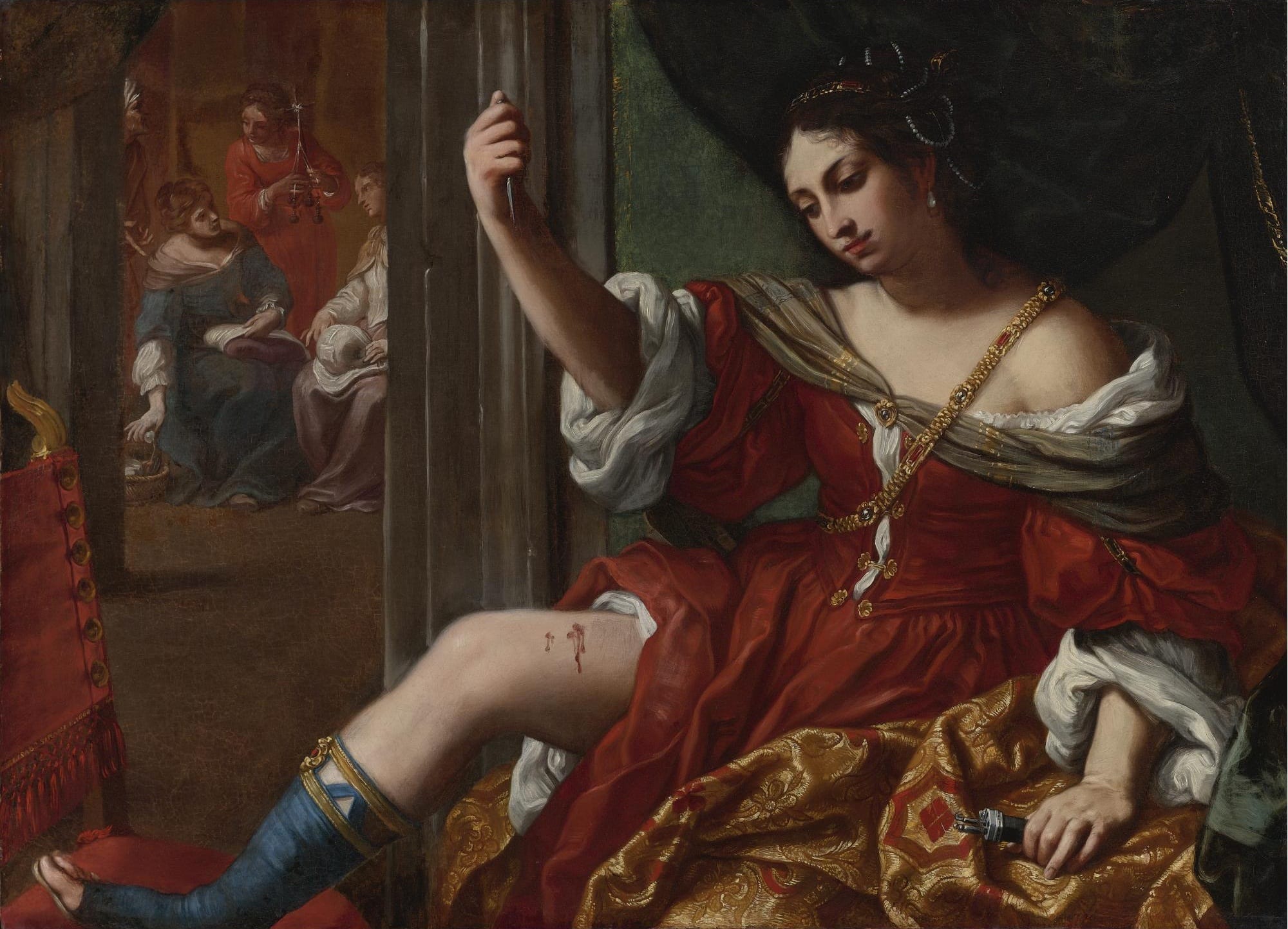
Raised in the house of Cato, married to Brutus. The sources show her wounding her own thigh to prove to Brutus she could be trusted with the conspiracy: if she could keep that secret under pain, she could keep his. The more famous "swallowing hot coals" death scene is debated and may be symbolic; Donald Robertson's overview covers the evidence honestly. I have kept the flag visible rather than retelling the legend as fact.
Cornificia (160–212 CE)
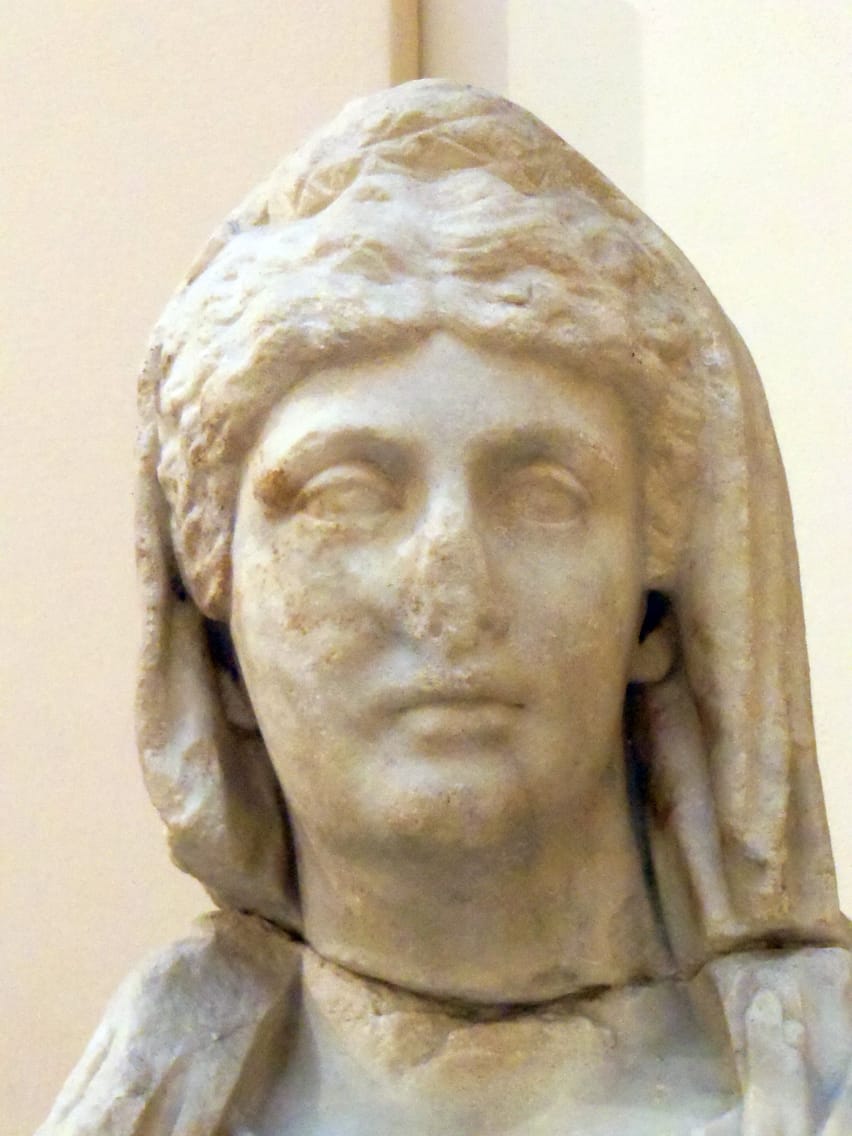
Marcus Aurelius's daughter. Ordered to die under Caracalla, she was told she could choose the manner of it. She is recorded (via the epitome of Cassius Dio, Book 78) addressing her own soul: "Poor, unhappy soul of mine, imprisoned in a vile body, fare forth, be freed, show them that you are Marcus' daughter, whether they will or no." Then she opened her veins.
Her father wrote a private notebook about meeting death well. His daughter, two generations on, performed it.
The transmitters
The reason you can read Epictetus in English at all traces substantially to one woman.
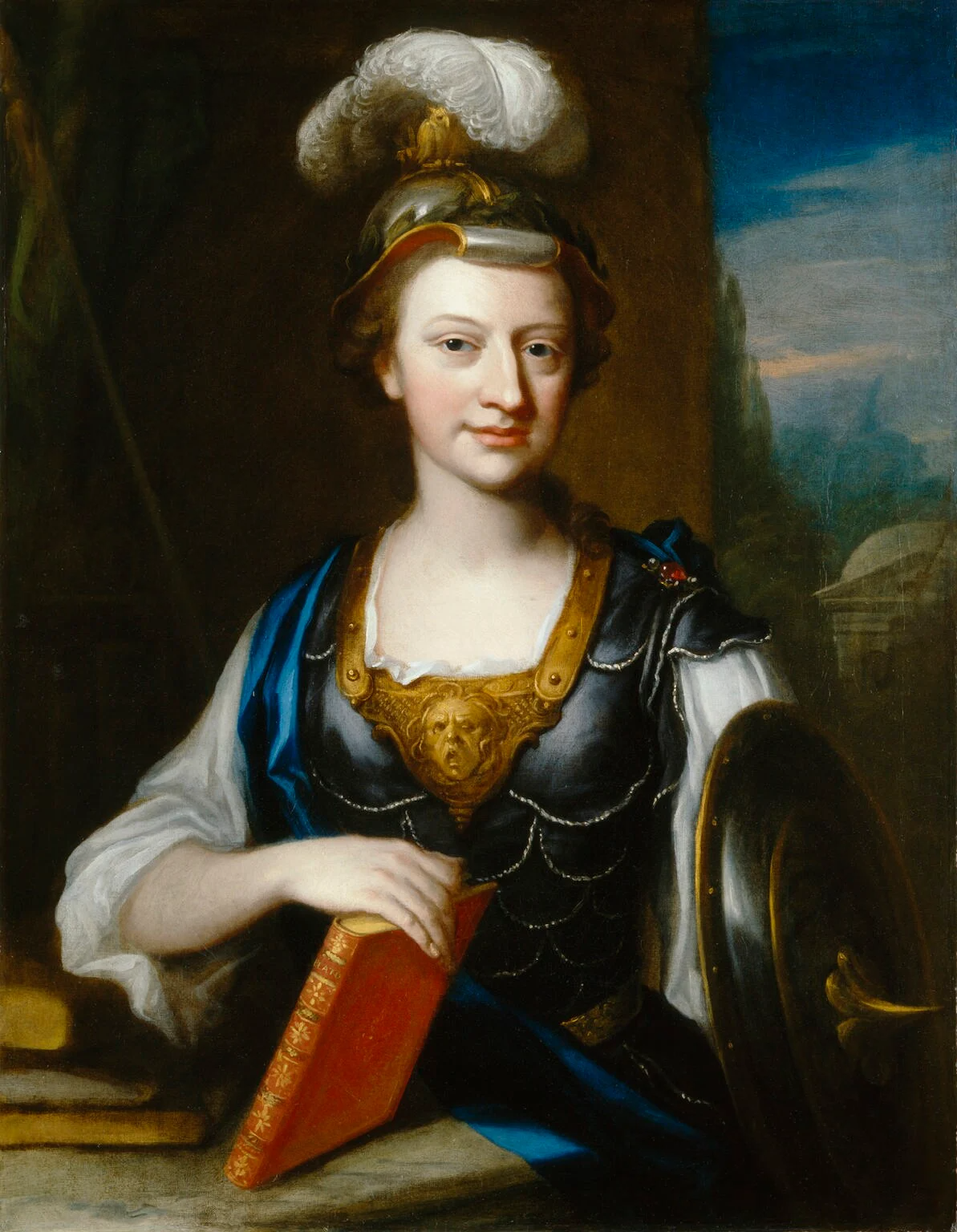
Elizabeth Carter (1717–1806) published the first full English translation of Epictetus in 1758: the Discourses, the Enchiridion, and the fragments (catalogue record). Virginia Woolf later saluted her in A Room of One's Own as "the valiant old woman who tied a bell to her bedstead in order that she might wake early and learn Greek."
Mary Wollstonecraft (1759–1797) was not a Stoic, but in A Vindication of the Rights of Woman (1792) she lands the same argument Musonius made seventeen centuries earlier:
"If women are by nature inferior to men, their virtues must be the same in quality, if not in degree, or virtue is a relative idea; consequently, their conduct should be founded on the same principles, and have the same aim." (source)
Virtue does not come in a men's cut. That is a Stoic premise, stated by a feminist philosopher.
The modern voices
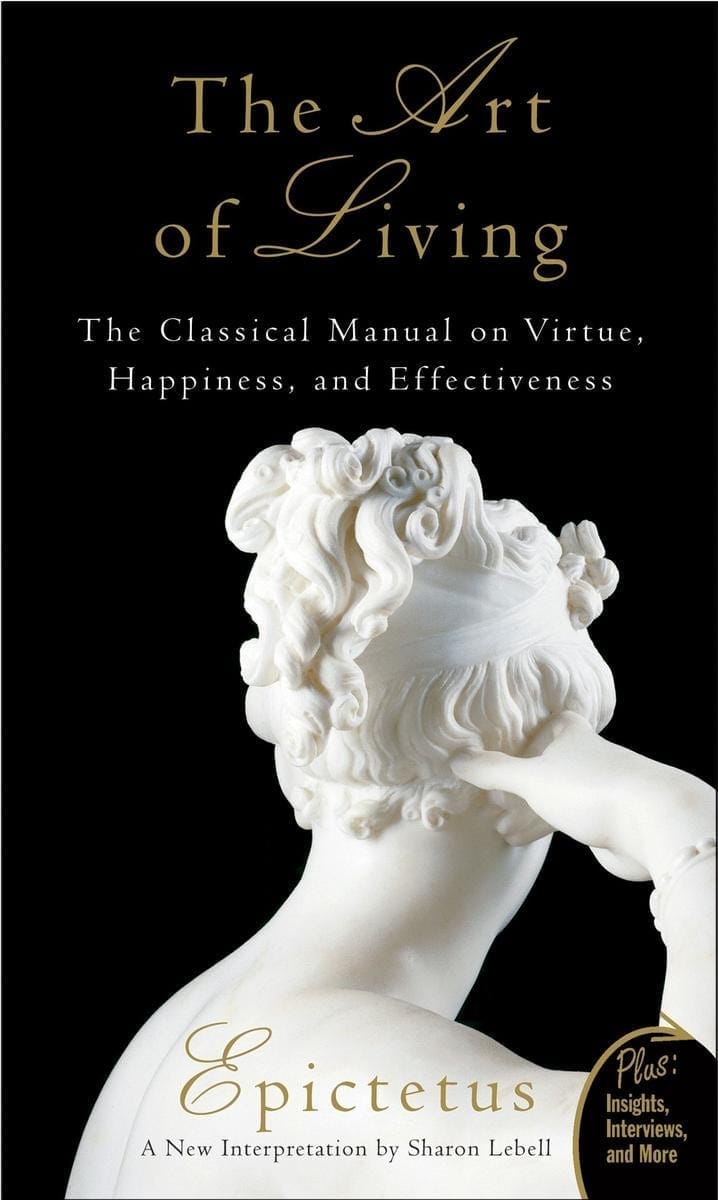
Sharon Lebell made Epictetus readable for a mass audience with The Art of Living (1995), decades before the current Stoicism boom. Her essay "Women don't need Stoicism, Stoicism needs women" argues for a more adaptive, evolving Stoicism, and the title alone earns the click.

Nancy Sherman, in Stoic Wisdom (2021), corrects the lone-wolf reading of the philosophy: "Stoicism, whether ancient or modern, sees social supports and not just inner strength as critical to how we surmount rather than succumb to adversity." Given that Marcus wrote "We are made for co-operation, like feet, like hands, like eyelids", she has the texts on her side.

Emily Wilson, translator and Seneca biographer, has described in interview using Epictetus's "indifferent things" frame to keep perspective, and finding that reading Seneca cheers her up in difficult patches. A working classicist who uses the tools is rarer than you would think.
For more contemporary work, see Brittany Polat (Stoicare and Tranquility Parenting) and Eve Riches (Modern Stoicism team).
A 7-day practice drawn from these lives
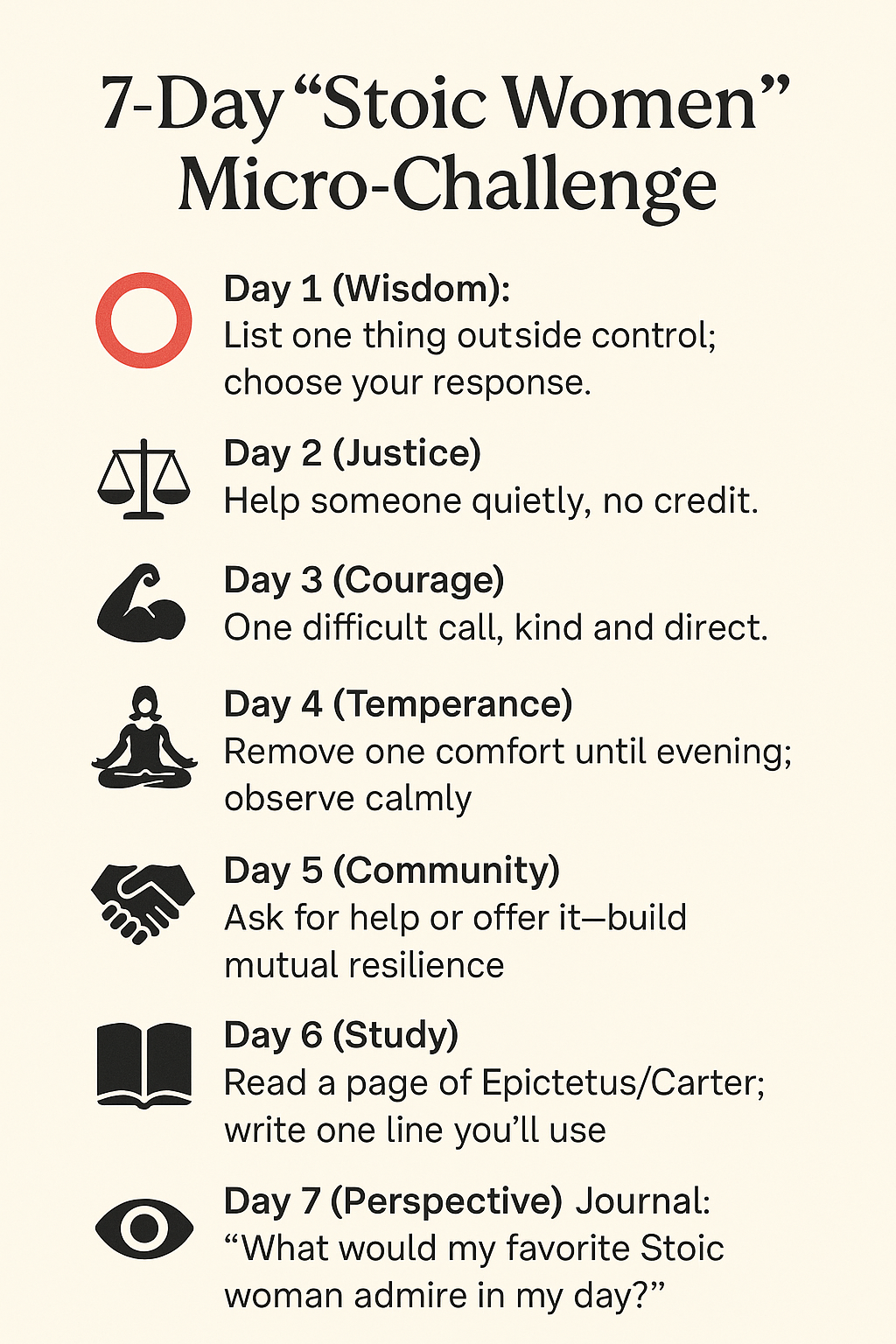
One small exercise per day, each anchored to one of the women above.
- Wisdom (Arria): name one thing today that is outside your control. Choose your response to it in advance.
- Justice (Fannia): help someone quietly. No credit, no mention.
- Courage (Porcia): make the one difficult call you have been avoiding. Kind and direct.
- Temperance (Carter): remove one comfort until evening. Notice what happens, without commentary.
- Community (Sherman): ask for help with something real, or offer it. Resilience is social.
- Study (Wollstonecraft): read one page of Epictetus. Write down a single line you will actually use.
- Perspective (Cornificia): journal on one question: what would the woman you most admire on this list make of how you spent today?
People also ask
Were there female Stoic philosophers in antiquity?
Yes. Ancient sources praise Arria, Fannia, Porcia and Cornificia, and Musonius Rufus explicitly argued women should study philosophy. The practice is well attested even though no written works by ancient female Stoics survive.
Is "stoic woman" just a stiff-upper-lip trope?
No. Stoicism aims at healthy emotion and social virtue, not suppression. Nancy Sherman's work on social supports in resilience is the best modern corrective.
Who kept Stoicism alive for modern readers?
Elizabeth Carter put Epictetus into English in 1758. Sharon Lebell brought him to a popular audience in 1995. Emily Wilson continues the translation tradition today.
Attribution and accuracy note: Bios draw from classical texts (Pliny, Cassius Dio) via modern translations and reputable scholarship. Legends like Porcia's "hot coals" death are debated and flagged as such. The aim is to capture the Stoic spirit, meaning fortitude, clarity and service, without overselling the literal details.
Sources and further reading
Musonius Rufus, Lecture III: full text · Pliny the Younger, Letters 3.16 (Arria): Attalus · Pliny, Letters 7.19 (Fannia): Attalus · Cassius Dio, Epit. 78.16.6a (Cornificia), Loeb trans. Cary: LacusCurtius · Elizabeth Carter's Epictetus (1758): HathiTrust · Wollstonecraft, Vindication, Ch. II: Wikisource · Lebell: Modern Stoicism essay · Sherman, Stoic Wisdom: Goodreads · Woolf, A Room of One's Own: full text · Porcia debate: Robertson · Emily Wilson interview: Daily Stoic
If the 7-day practice above appeals to you, the 7-Day Stoic Challenge is the guided version: one audio lesson and one exercise per day, free.