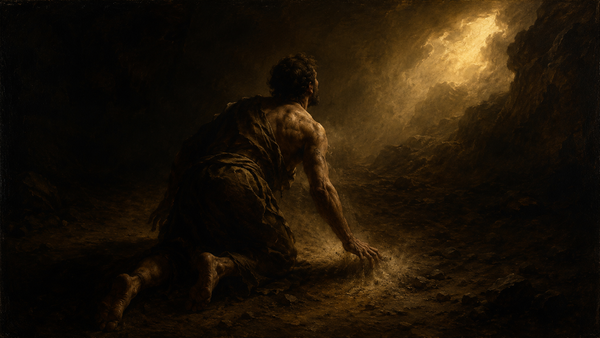
When I was eighteen, a bandmate held a knife to my throat while I drove us home from practice. He was drunk on vodka and valium, slurring threats from the back seat on a dark road in the Welsh valleys. I got the door open and ran.
I was a genuine victim that night. I say that first because any honest piece about the victim mentality has to start there: real victims exist, and telling someone in the middle of real harm to check their mindset is useless and a bit cruel.
The victim mentality is a different thing. It's what happens when the powerlessness of one terrible night moves in and starts running the ordinary ones. Every setback becomes evidence. The job market, the ex, the weather, the referee. Life is happening to you, and there is nothing to be done.
The Stoics, and later Nietzsche, spent a lot of ink on exactly this trap. Here is what they offer.
Listen to the podcast version:
What is the victim mentality?
It's the standing belief that your suffering is caused entirely by things outside you, and that nothing inside you can move the needle. Not a response to one event. A lens on all of them.
The tell is what happens to complaints. A complaint that leads to an action is just communication. A complaint that leads to another complaint is the mentality feeding itself.
Why Seneca is worth hearing on this
Seneca advised Nero, watched Rome's politics chew people up, was exiled to Corsica on a charge most historians think was invented, and was eventually ordered to kill himself by the emperor he'd tutored. If anyone earned the right to a victim story, it was him. Nero, if you want the full horror, gets his own article here.
Instead his letters keep circling one argument: events don't reach the inner self unless judgement lets them in. In his letters he points out that we suffer more often in imagination than in reality (Letter 13), and in On Providence he argues that difficulty trains the mind the way labour trains the body.
The line everyone quotes in this territory, "it's not what happens to you, but how you react that matters," is actually a paraphrase of Epictetus, chapter 5 of the Enchiridion, though Seneca would have signed it. It survives because it locates the one lever you always hold.
Where the mentality comes from
Nobody chooses it. As children we solved discomfort by broadcasting it. Cry, and someone comes. Complain, and something changes. That strategy worked for years, which is exactly why it's so hard to drop.
Adult life quietly withdraws the deal. The broadcasting continues, the rescue doesn't, and the gap gets filed as more evidence that the world is against you.
Nietzsche and amor fati
Nietzsche pushed further than the Stoics. Acceptance wasn't enough for him. His phrase amor fati, love of fate, is the demand that you want your life as it actually happened, including the parts that hurt. In Ecce Homo he calls it his formula for greatness in a human being:
"...that one wants nothing to be different, not forward, not backward, not in all eternity. Not merely bear what is necessary, still less conceal it. But love it." (Ecce Homo)
His better-known maxim, that what does not kill me makes me stronger, comes from Twilight of the Idols. It gets printed on gym walls now, which would probably have amused him. The serious version is the amor fati one.
I find Nietzsche's demand harder than anything in Seneca. Loving the knife night is beyond me. What I can do is want the person it made me, and that turns out to be enough to close the victim story.
What to actually do
Ask what the event is, minus your judgement of it. Losing a job is a fact. "This has ruined me" is a verdict, and verdicts can be reopened. This is the Stoic move: separate the event from the story before the story sets.
Take responsibility for the response only. Not for the event. If someone harmed you, that's on them. What happens in you from tomorrow morning onward is the part with your name on it.
Reflect at the end of the day. Seneca reviewed each evening: what did I do badly, what did I do well, what would I do differently? I close my days with a version of this, and the point is not self-blame. It's noticing where I still had a hand on the wheel.
Try "Good". Jocko Willink's practice: when the setback lands, say "Good" and find the one thing it frees you to do. Missed the opportunity? Good. More time to prepare. It sounds silly until you watch it interrupt a spiral in real time.
Be grateful past the easy stuff. Gratitude for the good things is pleasant. Gratitude aimed at a difficulty, asking what it trained in you, is the version that dismantles victimhood. That's amor fati as a daily practice rather than a slogan.
Where this leaves you
None of this argues that the world is fair. Seneca died on Nero's order; the philosophy didn't save him from that. What it saved him from was spending his life as the character things merely happened to.
Some days I manage it. Some days I'm back to blaming the referee. The practice is noticing which day it is.