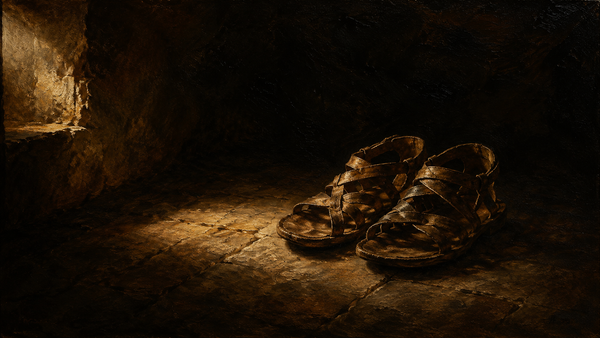
A guided meditation on loss, and why imagining the worst might be the strangest gratitude practice the ancient world produced.
I used to walk right past my legs.
Not literally. I walked on them, ran on them, trained on them, paced around the flat on them while thinking about other things. I just never noticed them. They were infrastructure. Invisible, assumed, unthanked.
The Stoics had a name for the practice that fixes this, and it is about two thousand years old.
Premeditatio malorum: the premeditation of adversity
The exercise is simple to describe. You deliberately imagine losing something you value. Your health, your mobility, a person you love. Not as idle worry, but as a controlled rehearsal, done on purpose, with an end point.
The Stoics used it for two reasons. First, preparation. Seneca wrote that "he robs present ills of their power who has perceived their coming beforehand", and its converse, that "what is quite unlooked for is more crushing in its effect" (Letters to Lucilius). The blow you have rehearsed lands on a braced body. Second, and this is the part people miss, gratitude. When you vividly imagine the loss and then open your eyes to find the thing still there, you get a few minutes of seeing your own life the way an outsider would. The legs stop being infrastructure.
Marcus Aurelius opens Book 2 of the Meditations with his version:
"When you wake up in the morning, tell yourself: The people I deal with today will be meddling, ungrateful, arrogant, dishonest, jealous, and surly... But I have seen the beauty of good, and the ugliness of evil, and have recognized that the wrongdoer has a nature related to my own."
He was not being gloomy. He was loading the day's difficulties into memory before they arrived, so that none of them would have the advantage of surprise.
I have written a fuller piece on premeditatio malorum if you want the theory. This episode is the practice.
Why I recorded this as a meditation
I read about this exercise for years before it did anything to me. Understood it, agreed with it, quoted it. Felt nothing.
The shift came when I stopped treating it as an idea and ran it as a full visualisation: eyes closed, a car crash, the crunch, the hospital, the diagnosis, six months in a cast. Not pleasant. But when I opened my eyes and walked to the kitchen, the walking itself felt like a small miracle. That effect does not come from reading a paragraph about hedonic adaptation. It comes from the body briefly believing the loss.
So I recorded the version I wish someone had guided me through. Twelve minutes. It grounds you in the present, walks you through a sudden loss and its ripple effects, asks what you would actually draw on if it happened, and then hands you back your unbroken life.
Listen to the guided meditation
Find a quiet spot. Do not run this one while driving, for reasons that will become obvious.
The practice
A few notes on doing this well, because it is possible to do it badly.
Once a week or even once a month is enough. This is a strong spice. Daily morbid rehearsal stops being Stoicism and starts being rumination, and the Stoics were explicit that the exercise should end in the present, with what you have, not in the imagined future, with what you fear.
It works best when you have gone numb to your own life. The "I'll be happy when..." mood is the signal I use.
Afterwards, write for five minutes. What did I notice I take for granted? What would I actually cope with, and with what? What can I appreciate today, specifically, by name? The specificity matters. "My health" does nothing. "My legs, on the stairs, carrying the laundry" does.
And the micro-version, for between sessions: mid-walk, spend ten seconds imagining the walking gone. It sounds dark. The effect is the opposite.
One caution. Some people hear "imagine the worst" and file it under negative thinking. Pessimism concludes that things will go wrong and stops there. This practice assumes things could go wrong, prepares for it, and then turns around to look properly at everything currently going right. Where pessimism ends in paralysis, premeditatio is designed to end in gratitude. If you finish the meditation feeling worse about your life rather than more awake inside it, ease off the frequency.
I am still not good at this, for what it is worth. The noticing fades after a day or two and the legs go back to being invisible. That is the case for the repetition, I think. It is a practice, not a cure.
If you found this useful, play the meditation above properly, once, this week. And if you want to build a daily Stoic practice from the ground up, the 7-Day Stoic Challenge is free: one audio lesson and one exercise a day for a week.