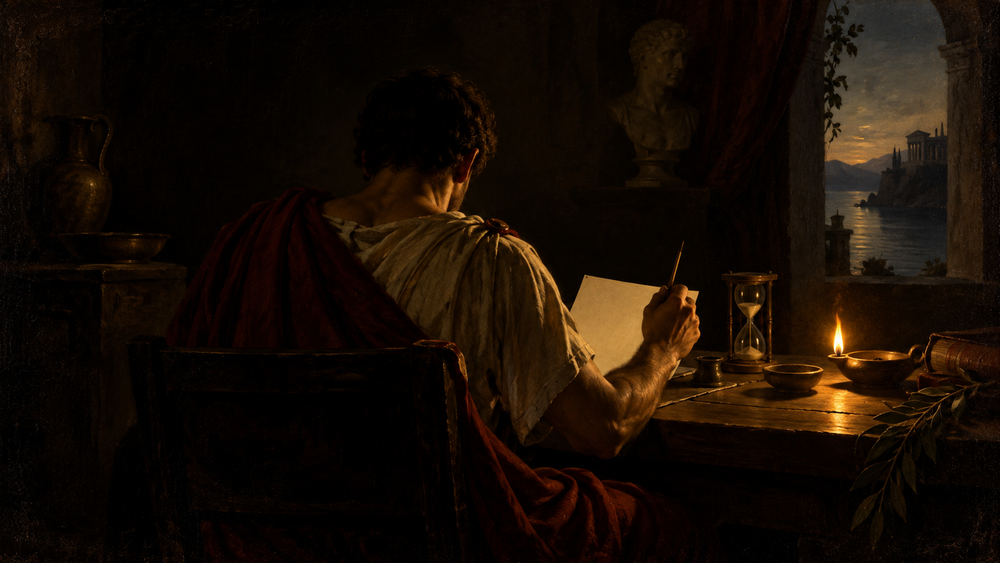
Most Seneca quotes online come without a source, and a fair number of them are not Seneca. Every quote below is copied from the letters he wrote to his friend Lucilius, with the letter and section number so you can check it yourself. The translation is Richard Mott Gummere's, from the Loeb edition, which is in the public domain. Seneca wrote the letters late in life, and most of them are about one practical problem: how to live well with the time, fear and money you actually have.
There is a short section on the famous fakes at the end.
Seneca on time
The collection opens with time, and he keeps coming back to it.
"Nothing, Lucilius, is ours, except time."
Letters 1.3
"...set yourself free for your own sake; gather and save your time, which till lately has been forced from you, or filched away, or has merely slipped from your hands."
Letters 1.1
"...the largest portion of our life passes while we are doing ill, a goodly share while we are doing nothing, and the whole while we are doing that which is not to the purpose."
Letters 1.1
"And yet time is the one loan which even a grateful recipient cannot repay."
Letters 1.3
"Let us postpone nothing. Let us balance life's account every day."
Letters 101.7
He treats time like money in a ledger. People guard their savings and give their hours away without noticing. His fix is simple and slightly uncomfortable: notice.
Seneca on fear and worry
"There are more things, Lucilius, likely to frighten us than there are to crush us; we suffer more often in imagination than in reality."
Letters 13.4
"Cease to hope," he says, "and you will cease to fear."
Letters 5.7, quoting the Stoic Hecato
"Just as the same chain fastens the prisoner and the soldier who guards him, so hope and fear, dissimilar as they are, keep step together; fear follows hope."
Letters 5.7
The first line is one of the few famous Seneca quotes that holds up. We have a separate page on what "we suffer more in imagination than in reality" actually means.
Seneca on a restless mind
"The primary indication, to my thinking, of a well-ordered mind is a man's ability to remain in one place and linger in his own company."
Letters 2.1
"You need a change of soul rather than a change of climate."
Letters 28.1
"Do you ask why such flight does not help you? It is because you flee along with yourself."
Letters 28.2
"The complaint is too deep-seated to be cured by a journey."
Letters 104.18
Seneca on reading and learning
"Everywhere means nowhere."
Letters 2.2
"You must linger among a limited number of master thinkers, and digest their works, if you would derive ideas which shall win firm hold in your mind."
Letters 2.2
"The process is mutual; for men learn while they teach."
Letters 7.8
"Philosophy is no trick to catch the public; it is not devised for show. It is a matter, not of words, but of facts."
Letters 16.3
Seneca on friendship
"When friendship is settled, you must trust; before friendship is formed, you must pass judgment."
Letters 3.2
"Associate with those who will make a better man of you. Welcome those whom you yourself can improve."
Letters 7.8
Seneca on money and enough
"It is not the man who has too little, but the man who craves more, that is poor."
Letters 2.6
"Do you ask what is the proper limit to wealth? It is, first, to have what is necessary, and, second, to have what is enough."
Letters 2.6
"Set aside a certain number of days, during which you shall be content with the scantiest and cheapest fare, with coarse and rough dress, saying to yourself the while: 'Is this the condition that I feared?'"
Letters 18.5
That last one is an exercise you can actually do. A few days of living cheaply on purpose shows you how much of the fear of losing comfort is imagined.
Seneca on death
"What man can you show me who places any value on his time, who reckons the worth of each day, who understands that he is dying daily?"
Letters 1.2
"He who has learned to die has unlearned slavery; he is above any external power, or, at any rate, he is beyond it."
Letters 26.10
"You will die, not because you are ill, but because you are alive; even when you have been cured, the same end awaits you."
Letters 78.6
Seneca on direction and fate
"Our plans miscarry because they have no aim. When a man does not know what harbour he is making for, no wind is the right wind."
Letters 71.3
"That which you cannot reform, it is best to endure..."
Letters 107.9
"Aye, the willing soul Fate leads, but the unwilling drags along."
Letters 107.11, Seneca's translation of lines by the earlier Stoic Cleanthes
Famous "Seneca quotes" to be careful with
"Luck is what happens when preparation meets opportunity" is not in Seneca. We traced where it comes from in this source check.
"We suffer more in imagination than in reality" is genuine, from Letter 13, and the fuller sentence above is worth using instead of the short version.
A good rule: if a Seneca quote has no letter or book number attached, be suspicious of it. If you want to check a line before you share it, our Stoic quote source audit lists the common fakes. For quotes from all the Stoics, start with the Stoic quotes guide.
One way to use these
Pick one line and carry it for a week instead of collecting twenty. Letter 1 is a good start: each evening, ask where the day's time actually went. It follows his own advice in Letter 2: linger with a few ideas until they change what you do.
Sources
Seneca, Moral Letters to Lucilius (Epistulae Morales), translated by Richard Mott Gummere, Loeb Classical Library, 1917 to 1925. Letters 1, 2, 3, 5, 7, 13, 16, 18, 26, 28, 71, 78, 101, 104 and 107. Section numbers follow the Gummere edition.
If you want structured practice, the 7-Day Stoic Challenge is free. Nine audio lessons and a 42-page workbook.