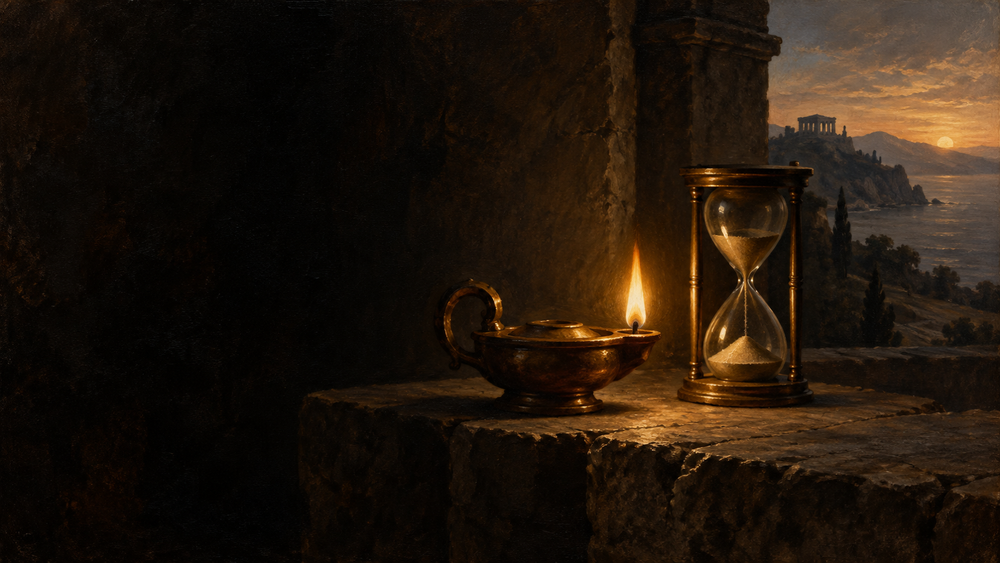
The Stoics kept returning to one idea: the present is the only part of your life you actually have. The past is fixed and the future is not yet yours, so the moment in front of you is where every real choice sits. Marcus Aurelius reminded himself of this again and again in his notebook. Seneca warned that putting life off is the biggest way to waste it. Epictetus told his students to stop waiting for tomorrow. Below are 21 of their lines on the present moment, each checked word for word against a public-domain translation, with the work and section so you can read them in context.
Many of these lines sit close to the Stoic practice of remembering death, because a short life is what makes the present precious. For that side of it, see our guide to memento mori. This page stays with the present itself.
Marcus Aurelius on the present moment
Marcus wrote the Meditations as private notes to himself. The present comes up so often that it reads like a habit he was trying to build.
no man loses any other life than this which he now lives, nor lives any other than this which he now loses.
Marcus Aurelius, Meditations 2.14 (trans. George Long)
For the present is the only thing of which a man can be deprived, if it is true that this is the only thing which he has, and that a man cannot lose a thing if he has it not.
Marcus Aurelius, Meditations 2.14 (trans. George Long)
bear in mind that every man lives only this present time, which is an indivisible point, and that all the rest of his life is either past or it is uncertain.
Marcus Aurelius, Meditations 3.10 (trans. George Long)
See that thou secure this present time to thyself
Marcus Aurelius, Meditations 8.44 (trans. George Long)
Let not future things disturb thee, for thou wilt come to them, if it shall be necessary, having with thee the same reason which now thou usest for present things.
Marcus Aurelius, Meditations 7.8 (trans. George Long)
One of his most practical notes is about scale. Most of what weighs on us is the whole future piled up at once. Taken one moment at a time, it shrinks:
remember that neither the future nor the past pains thee, but only the present. But this is reduced to a very little, if thou only circumscribest it
Marcus Aurelius, Meditations 8.36 (trans. George Long)
In a word, thy life is short. Thou must turn to profit the present by the aid of reason and justice.
Marcus Aurelius, Meditations 4.26 (trans. George Long)
And thou wilt give thyself relief, if thou doest every act of thy life as if it were the last
Marcus Aurelius, Meditations 2.5 (trans. George Long)
Wipe out the imagination. Stop the pulling of the strings. Confine thyself to the present.
Marcus Aurelius, Meditations 7.29 (trans. George Long)
take no notice of all the past, and trust the future to providence, and direct the present only conformably to piety and justice.
Marcus Aurelius, Meditations 12.1 (trans. George Long)
every man lives the present time only, and loses only this.
Marcus Aurelius, Meditations 12.26 (trans. George Long)
Seneca on the present moment
Seneca came at the same idea from the other direction. His target was postponement: the habit of treating today as a waiting room for a better life that starts later.
Nothing, Lucilius, is ours, except time.
Seneca, Letters 1.3 (trans. Richard M. Gummere)
hold every hour in your grasp. Lay hold of to-day's task, and you will not need to depend so much upon to-morrow's. While we are postponing, life speeds by.
Seneca, Letters 1.2 (trans. Richard M. Gummere)
postponement is the greatest waste of life: it wrings day after day from us, and takes away the present by promising something hereafter
Seneca, On the Shortness of Life 9 (trans. Aubrey Stewart)
everything future is uncertain: live now straightaway.
Seneca, On the Shortness of Life 9 (trans. Aubrey Stewart)
Life is divided into three parts: that which has been, that which is, and that which is to come: of these three stages, that which we are passing through is brief, that which we are about to pass is uncertain, and that which we have passed is certain
Seneca, On the Shortness of Life 10 (trans. Aubrey Stewart)
Those men lead the shortest and unhappiest lives who forget the past, neglect the present, and dread the future
Seneca, On the Shortness of Life 16 (trans. Aubrey Stewart)
every day ought to be regulated as if it closed the series, as if it rounded out and completed our existence.
Seneca, Letters 12.8 (trans. Richard M. Gummere)
One who daily puts the finishing touches to his life is never in want of time.
Seneca, Letters 101.8 (trans. Richard M. Gummere)
Epictetus on the present moment
Epictetus was a teacher, and his version is the most direct. Stop saying you will start tomorrow.
If it is profitable to-morrow, much more so is it to-day
Epictetus, Discourses 4.12 (trans. P. E. Matheson), on paying attention
remember that the hour of struggle is come, the Olympic contest is here and you may put off no longer
Epictetus, Enchiridion 51 (trans. P. E. Matheson)
One way to use these
- Shrink the problem. When everything feels like too much, do what Marcus suggests in Meditations 8.36. Ask what, in this exact moment, you cannot bear. The honest answer is usually nothing.
- Catch yourself waiting. Seneca's warning in On the Shortness of Life 9 is about waiting for life to start. Notice the phrase "once things calm down" and pick one thing you can do today instead.
- Come back to what is in front of you. "Confine thyself to the present" (Meditations 7.29). When your mind runs ahead, name three things you can see, hear or feel right now, then return to the task.
- Finish the day. Seneca's idea in Letters 12.8 is to close each day as if it completed your life. Before bed, ask whether anything important is left unsaid or undone, and deal with it if you can.
For more sourced lines on every theme, see the main collection of Stoic quotes.
Sources
- Marcus Aurelius, Meditations 2.5, 2.14, 3.10, 4.26, 7.8, 7.29, 8.36, 8.44, 12.1, 12.26, trans. George Long (1862).
- Seneca, Letters 1.2, 1.3, 12.8, 101.8, trans. Richard M. Gummere (Loeb, 1917 to 1925); On the Shortness of Life 9, 10, 16, trans. Aubrey Stewart (1889).
- Epictetus, Discourses 4.12 and Enchiridion 51, trans. P. E. Matheson (1916).
If you want structured practice, the 7-Day Stoic Challenge is free. Nine audio lessons and a 42-page workbook.