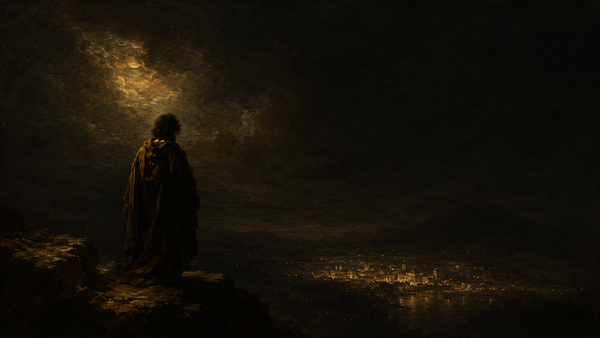
"Take a bird's-eye view of the world, as seen from above: its numerous gatherings and ceremonies, many voyages in calm and storm... Reflect also on the life lived long ago by other men, and the life that shall be lived after you are gone."
Marcus Aurelius, Meditations 9.30
Parts of the Meditations were written in an army camp on the Danube frontier, between plague reports and casualty lists. In the middle of all that, the most powerful man alive kept writing himself the same reminder: get above it. Look down. See how small this is.
That reminder has a name now. The view from above: a short mental exercise where you picture yourself, then your street, then your city, then the whole planet, from higher and higher up, until the thing that was gripping you returns to its actual size.
I use it as a reset. It takes two minutes in the short form and twenty in the full form, and both are below.
What the exercise is
You visualise your life from above, in the third person, and keep widening the frame. Marcus again:
"How tiny a fragment of boundless and abysmal time has been appointed to each man!... And on how tiny a clod of the whole Earth do you crawl!" (Meditations 12.32)
The Stoics connected this to their physics. If nature is one continuous whole, then seeing yourself as a small piece of it is simple accuracy. The exercise trains what they called magnanimity, greatness of soul: the capacity to stay above turbulence because you have seen how far up above goes.
Pierre Hadot, the historian who did more than anyone to recover these practices, treated the view from above as one of the core exercises of ancient philosophy, not a footnote to it.
What it does for you
An interview with Donald Robertson on the power of "The View from Above"
The benefits list, without the padding, is short.
It shrinks the ego. From five hundred feet, the promotion you didn't get and the argument you nearly won look identical: small. Marcus called himself a mere turn of a screw in the machine (Meditations 10.17), and he ran the machine.
It softens you towards other people. From above, everyone below is doing the same things: travelling, marrying, arguing, burying. It is hard to hold a grudge against someone you're watching from orbit.
And it calms the body down. The psychologist Igor Grossmann's work on self-distancing found that viewing your situation from a third-person perspective improves reasoning and emotional balance. Astronauts report a stronger version, the overview effect. Carl Sagan built the Pale Blue Dot around the same move. The Stoics got there without leaving the ground.
The skeptical question is whether this is just avoidance dressed as philosophy. It isn't, and the difference is what happens next: avoidance leaves the problem unexamined, the view from above returns you to it with the emotional volume turned down. You still answer the email. You just answer it as someone who has seen the Earth from space.
How to practise it, step by step
A guided contemplation you can practice
Sit somewhere quiet. Twenty minutes for the full version. Spend about a minute at each altitude:
- Yourself. Float above your own body. Notice what you were just thinking and feeling, as if it belonged to someone you know well.
- Your room. Widen to your surroundings and the objects in them.
- Your building. One roof among many.
- Your street. Neighbours, dogs, traffic, other people's mornings.
- Your city. Thousands of lives running in parallel, each one as loud from the inside as yours.
- Your country. Borders that look important and aren't visible.
- Earth. The tiny clod, as Marcus put it. Weather systems, night side, day side.
- The cosmos. Keep going until your problem is somewhere below the resolution of the image.
Then come back down the same way, slowly, and open your eyes.
If your mind wanders, that's fine. Watch the stray thought from above too. For a stressful moment in the middle of a day, run the two-minute version: yourself, your city, the Earth, back.
The lineage
Marcus practised versions of this through war and plague. Cicero's Dream of Scipio shows Scipio looking down on Earth from the heavens and realising how small Roman fame is against the scale of the cosmos. Two thousand years later Sagan pointed a camera back from Voyager and made the same argument with a photograph.
Making it stick
Attach the short version to a trigger you already have. Mine is the moment I notice I've reread the same stressful message three times. That's the cue to go up.
Marcus closes book 12 with the instruction to do what your nature requires and bear what universal nature brings (Meditations 12.32). The view from above is how you remember there is a universal nature at all. From ground level it's easy to forget.
If you want this as a daily structure rather than a one-off read, the guided version above pairs well with my free 7-day Stoic challenge, which builds one perspective practice per day.