
Enchiridion Chapter 2 / 53
I am making my way through each lesson in the Stoic philosopher Epictetus' handbook.
I want to expand and simplify the teachings for modern readers.
In the first chapter, we looked at the Dichotomy of Control, the Stoic sorting system for deciding what to give our energy to.
Building on that, this post examines how Epictetus thought we should approach both desire and aversion as a practising Stoic.
Is it true that desire causes suffering?
I/ Desire and Aversion: Root of Suffering
There are some things that we desire to move towards and some things that we desire to move away from.
Put simply: when we want to move towards something or possess it, we desire it. When the opposite is true, we feel aversion.
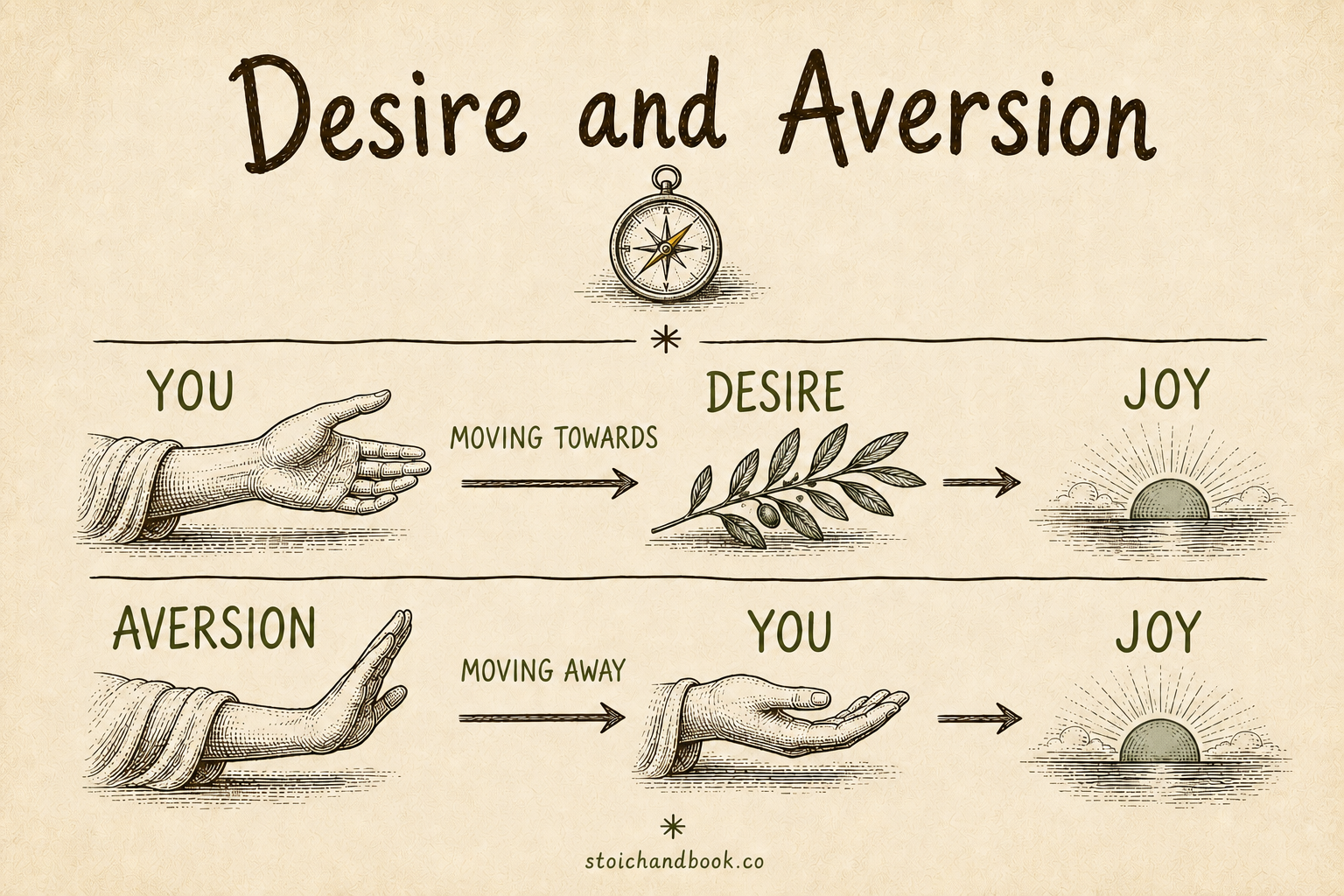
Desire causes suffering just as much as aversion, and this is often why they are called "the root of all suffering."
If we fail to get what we desire or we experience that which we want to avoid, we become miserable.
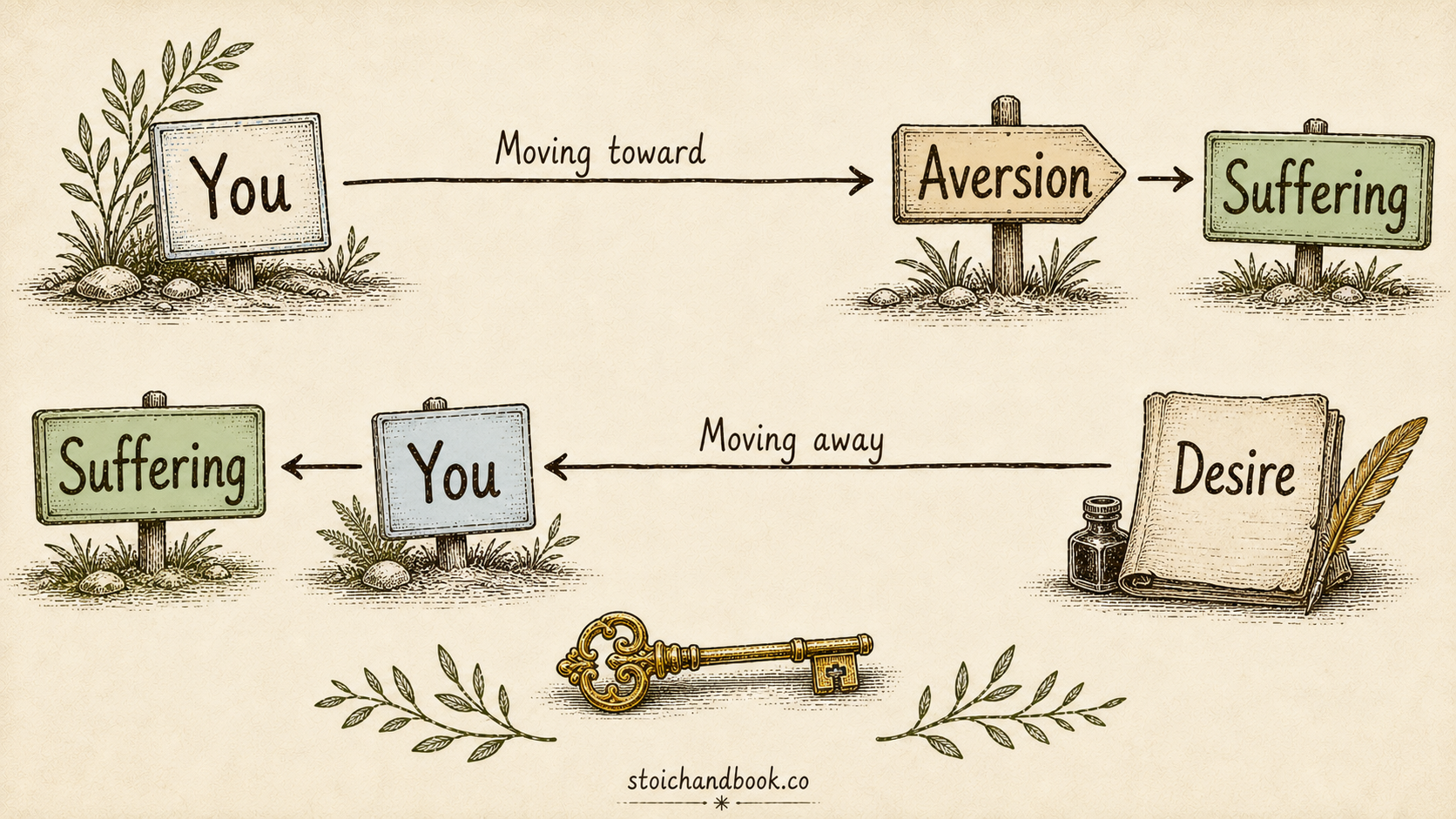
The problem is that externals are largely out of our direct control, so we will inevitably suffer when we don’t get what we want.
So as a practising Stoic, we have to ask:
If desire and aversion cause suffering, but desire and aversion are part of human nature, how can we protect ourselves from misery?
To answer it, we’ll look at aversion and desire separately.
II/ Working With Aversion
We feel aversion to things because we believe that not avoiding them will make us miserable. The problem is that most of us, untrained in Stoicism, do not have an accurate sense of what actually brings contentment.
Sometimes we desire things that cause us misery, and sometimes we avoid things that would make us happier.
As a starting point for working with aversion, we should only seek to avoid or change things that are within our control, which we saw in Chapter One: our judgements, impulses, desires, aversions and mental faculties, the internal things.
We should not try to avoid things outside our control: the body, our possessions, our reputation, the external things.
What does this mean in practical terms?
It is foolish to try to avoid a situation you know you cannot control. It is wise to work on your judgements, impulses, desires, aversions and mental faculties to reduce unnecessary suffering.
If you are desperate to avoid external misfortune, illness, low status, death, you are setting yourself up for unhappiness. For things outside our control, we are better off accepting them and handling them with wisdom.
If we want to live well, the secret is to avoid thinking and acting poorly, and to accept the world, as far as we can’t control it, just as it is.
Being in our control doesn't automatically mean a thing should be avoided. We have to use discernment to work out what is both within our control and good for our well-being.
Example: we might fear public spaces (agoraphobia) and seek to avoid them. It’s within our control to stay indoors, but is that way of living good for our long-term happiness and wisdom? No. The better approach is to accept the world and other people (externals) as they are, and instead to work on the irrational thinking and reconfigure our goals (internal).
In short:
- We should learn to actively desire whatever reality is beyond our control, because the alternative is to suffer in vain.
- Where the things we dislike are within our control, we can change them.
- Our ultimate desire should be to attain wisdom, which may paradoxically include the taming or transmutation of desire itself.
III/ Working With Desire
While you are training to become a Stoic, drop desire as far as you can for the foreseeable future.
Desire is powerful, and it can lead the untrained mind towards misery.
We can be made miserable by not getting what we want. We can also be made miserable by getting it, if the desire ran contrary to wisdom.
You might get something you desire, but in attaining it the balance of your life is disrupted. How many privileged people, who frequently get what they want, still experience anger, impatience, sadness, frustration and nihilism?
For now, don’t fantasise about the things you want. Don’t build a big wish list of possessions and scheme up clever plans to get them. Just drop desire as best you can.
Instead, learn to desire what you already have, and you will always be content.
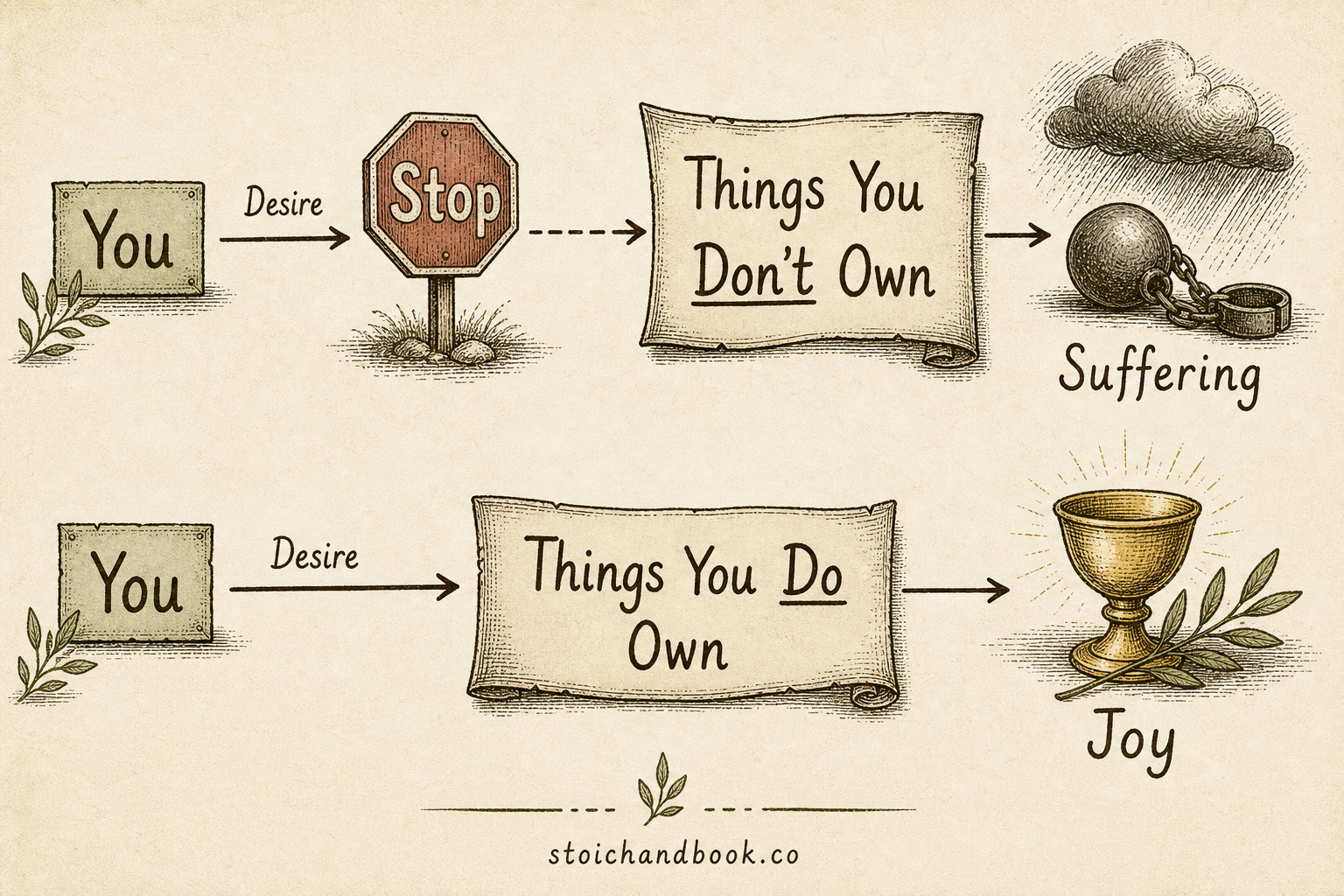
In the flow of life, when opportunities arise, answer them with a yes or a no, and don’t think too far ahead. Whenever you do act on a desire, do it with self-discipline and calm.
ENCHIRIDION CHAPTER TWO, EPICTETUS, TRANSLATION BY ROBERT DOBBIN:
[1] The faculty of desire purports to aim at securing what you want, while aversion purports to shield you from what you don’t. If you fail in your desire, you are unfortunate, if you experience what you would rather avoid you are unhappy. So direct aversion only towards things that are under your control and alien to your nature, and you will not fall victim to any of the things that you dislike. But if your resentment is directed at illness, death or poverty, you are headed for disappointment.
[2] Remove it from anything not in our power to control, and direct it instead toward things contrary to our nature that we do control. As for desire, suspend it completely for now. Because if you desire something outside your control, you are bound to be disappointed; and even things we do control, which under other circumstances would be deserving of our desire, are not yet within our power to attain. Restrict yourself to choice and refusal; and exercise them carefully, with discipline and detachment.