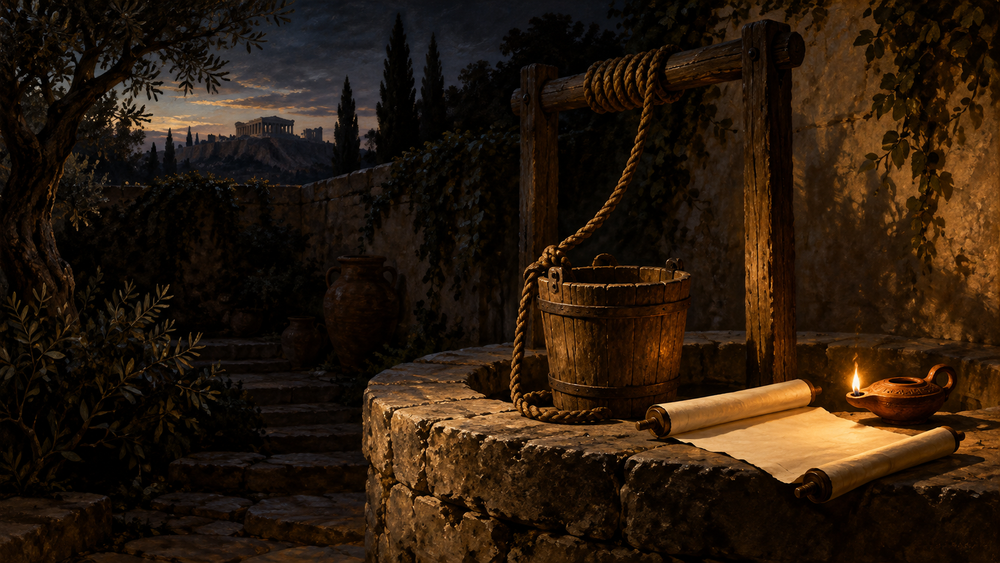
Cleanthes (klee-AN-theez) of Assos (AS-os) was the second head of the Stoic school, the man who took charge after Zeno and kept it going. He is remembered for two things. He drew water in gardens at night to pay for his philosophy, and he wrote the Hymn to Zeus, usually described as the only complete text to survive from the first generation of Stoics. Epictetus liked a few of its lines so much that he told his students to keep them close at hand.
Who was Cleanthes?
Our main source for his life is Diogenes Laertius, who wrote in the third century CE, more than four centuries after Cleanthes died. Treat the details below as tradition rather than biography. Diogenes opens plainly: “Cleanthes, son of Phanias, was a native of Assos.” He adds that Cleanthes “was at first a pugilist”, which means a boxer, and arrived in Athens “as some people say, with four drachmas only”. There he met Zeno and “studied philosophy right nobly”. Cleanthes lived from around 330 to 232 BCE.
The Stoic school he joined was young. Zeno had founded it in Athens a generation earlier, and you can read about the man himself in Zeno of Citium.
The water-carrier
Money was short, and the tradition makes a feature of it. Diogenes writes: “Thus, while by night he used to draw water in gardens, by day he exercised himself in arguments: hence the nickname Phreantles or Welllifter was given him.” Phreantles (fray-ANT-leez) is the water-drawer, and the name stuck.
One story has him brought into court to explain “how so sturdy a fellow as he made his living”. He was acquitted after producing the gardener whose garden he watered and the woman who sold him the meal he crushed. When Antigonus asked why he was drawing water, Cleanthes is said to have answered: “Is drawing water all I do? What? Do I not dig?” He also made a point of his independence. Showing his acquaintances a handful of small coins, he said: “Cleanthes could even maintain a second Cleanthes, if he liked.”
Paper cost money too. Diogenes says “he wrote down Zeno’s lectures on oyster-shells and the blade-bones of oxen through lack of money to buy paper”.
Seneca used him as an example in Letter 44, where he argues that nobody is shut out of philosophy by birth. His list of people who made themselves noble includes this: “Cleanthes worked at a well and served as a hired man watering a garden.”
Slow, steady and hard to offend
Diogenes does not flatter him: “He had industry, but no natural aptitude for physics, and was extraordinarily slow.” The other pupils called him the ass. Cleanthes is reported to have told them “he alone was strong enough to carry the load of Zeno”. Zeno himself, according to Diogenes, compared Cleanthes to “hard waxen tablets which are difficult to write upon, but retain the characters written upon them”.
The anecdotes that survive are mostly about composure. Reproached with cowardice, he replied: “That is why I so seldom go wrong.” In the theatre the poet Sositheus (so-SITH-ee-us) delivered a line mocking him, and Cleanthes sat still. The audience was so struck that they applauded him and drove the poet off the stage. When Sositheus apologised, Cleanthes accepted it, saying that “when Dionysus and Heracles were ridiculed by the poets without getting angry, it would be absurd for him to be annoyed at casual abuse”.
A sceptic should note that these are the stories a school tells about its heroes. They are consistent with one another, and none can be checked against a second source.
How he died
Diogenes says Cleanthes had “severe inflammation of the gums” and, on his doctors’ advice, abstained from food for two days. The treatment worked and the doctors were ready to let him eat again. He refused, “declaring that he had already got too far on the road”, and went on fasting until he died. Diogenes gives his age as the same as Zeno’s, according to some authorities, and says he had spent nineteen years as Zeno’s pupil.
If any part of this story lands close to home, please talk to someone you trust or contact a local crisis service (in the UK, Samaritans are on 116 123).
The Hymn to Zeus
The hymn addresses Zeus as the rational order running through the universe, which is the Stoic idea of the Logos in poetic form. Cleanthes' other works, including titles such as Of Freedom, Of Envy and Of Friendship, survive only as names in Diogenes' list and as scattered fragments. The hymn can be read in scholarly translations and in the standard fragment collections, such as von Arnim's Stoicorum Veterum Fragmenta. This page does not reproduce it in full.
What most readers meet is the few lines Epictetus quotes. In the Enchiridion (the short handbook of his teaching), chapter 53, he says: “On every occasion we must have these thoughts at hand,” and gives them:
Lead me, O Zeus, and lead me, Destiny,
Whither ordainèd is by your decree.
I'll follow, doubting not, or if with will
Recreant I falter, I shall follow still.
(Cleanthes, quoted in Epictetus, Enchiridion 53, trans. Matheson)
He comes back to them in the Discourses. In 2.23 he describes the goal as being “able to say these lines with your whole heart”. In 4.4 he has just told a pupil that he must “will to avoid only those things which are within your control”, and then reaches for the verse: “But the saying of Cleanthes is ready to our need.” For a longer tour of that book, see the guide to Epictetus' Discourses.
Did Cleanthes say “fate leads the willing”?
You will often see “Fate leads the willing and drags the unwilling” credited to Cleanthes. The line is Latin, ducunt volentem fata, nolentem trahunt, and it comes from Seneca. In Letter 107 he introduces the hymn this way: “Let us address Jupiter, the pilot of this world-mass, as did our great Cleanthes in those most eloquent lines.” He then renders them into Latin himself, and ends with: “Aye, the willing soul Fate leads, but the unwilling drags along.”
That closing line is not in the Greek lines Epictetus preserves at Enchiridion 53. It is usually taken to be Seneca's addition, although that is still an open point. The safe way to credit it is as Seneca's Latin rendering of Cleanthes, with the famous last line possibly Seneca's own. To see how the letters read as a book, our guide to Letters from a Stoic is a good starting point.
Cleanthes and the Stoic argument about nature
Cleanthes did not simply repeat Zeno. The tradition has him in disagreement with his own pupil Chrysippus (krih-SIP-us), who later became one of the school's great systematisers. Seneca remarks that “Cleanthes and his pupil Chrysippus could not agree in defining the act of walking”, and uses it to make a point about independence. Elsewhere he teases students who only recite authorities: “This is the opinion of Cleanthes. But what is your own opinion?”
The sharpest disagreement concerns the Stoic goal of living in agreement with nature. Diogenes reports that Chrysippus took nature to mean both universal nature and human nature, “whereas Cleanthes takes the nature of the universe alone as that which should be followed, without adding the nature of the individual.”
One popular claim needs care here. You will read that Zeno gave the bare formula and Cleanthes added the words “with nature”. Diogenes does not report that split. He says Zeno was the first to designate the end as “life in agreement with nature”, and that Cleanthes also treated it in his work On Pleasure. The story that Cleanthes added it is traced to a later writer, Stobaeus, so it is better held as an open report than as settled fact.
What to take from him
The practical thing is small. Epictetus told people to keep those lines ready for any occasion, so try it in the next moment when something lands that you cannot change. Say the verse, or a plain version of your own, and then ask what part of the situation is still yours to act on.
A fair objection is that this turns Stoicism into a philosophy of giving up. The verse itself resists that reading. The speaker does not pretend to enjoy fate. They allow that they might falter and still say “Recreant I falter, I shall follow still”, which concedes that you may drag your feet and arrive at the same place. What the verse changes is how you go. The hymn also assumes a rational, divine order, and readers who do not share that assumption can still use the practical question, though that is a modern borrowing and not what Cleanthes claimed.
If you only read three things, make them Diogenes Laertius 7.168 to 176 for the life, Enchiridion 53 for the verse, and Seneca's Letter 107 for the Latin version and the argument about willingness.
If you want structured practice, the 7-Day Stoic Challenge is free. Nine audio lessons and a 42-page workbook.
Sources
Diogenes Laertius, Lives of Eminent Philosophers, Book 7, sections 37, 87 to 89 and 168 to 176, trans. R. D. Hicks (Loeb Classical Library, 1925). Epictetus, Enchiridion 53 and Discourses 2.23 and 4.4, trans. P. E. Matheson (Oxford, 1916). Seneca, Letters to Lucilius 33, 44, 107 and 113, trans. Richard Mott Gummere (Loeb Classical Library), quoted briefly. Diogenes wrote centuries after the events he describes, and the account of Cleanthes' life rests mainly on him.