The Discourses of Epictetus are the closest thing we have to sitting in a Stoic classroom. They are informal talks given by Epictetus, a former slave turned teacher, to students at his school in Nicopolis in Greece, written down by one of those students, Arrian. Four books survive. They are blunt, funny, repetitive and practical, and they are a main source for much of what people now call Stoic practice. This guide covers what the book is, what it teaches, the passages worth knowing and how to start reading it.
If you only want the best single lines, see our Epictetus quotes. This page is about the book itself.
What the book is
Epictetus wrote nothing himself. His student Arrian transcribed and published his informal lectures, and four of what were originally eight books survive: 95 chapters in all. They are thought to have been recorded at Nicopolis around 108 CE. Arrian also compiled the Enchiridion, or Handbook, a short digest of the same teaching. If the Enchiridion is the summary, the Discourses are the full lessons, with the arguments, the jokes and the students' objections left in. Our guide to the Enchiridion covers the shorter book.
Who Epictetus was
Epictetus lived from about 50 to about 135 CE. He was born enslaved in Hierapolis, in what is now Turkey, and was owned in Rome by a man called Epaphroditus. While still enslaved he studied with the Stoic teacher Musonius Rufus. He was later freed, and when the emperor Domitian expelled philosophers from Italy he moved to Nicopolis and opened his school there. He was lame, by his own account, and lived very simply.
That history is not background decoration. A man who had been someone else's property spent his life teaching that the one thing nobody can own is your own judgement, and it shows on almost every page.
What the Discourses teach
Some things are up to you, and some are not
The whole book starts here, in the very first chapter.
We must make the best of what is under our control, and take the rest as its nature is.
Epictetus, Discourses 1.1.17 (trans. W. A. Oldfather)
My leg you will fetter, but my moral purpose not even Zeus himself has power to overcome.
Epictetus, Discourses 1.1.23 (trans. W. A. Oldfather)
Freedom is internal
For Epictetus, freedom is the central subject. It does not come from getting what you want.
For freedom is secured not by the fulfilling of men's desires, but by the removal of desire.
Epictetus, Discourses 4.1 (trans. P. E. Matheson)
Our page of Epictetus quotes on freedom collects more of this.
Losses are smaller than they look
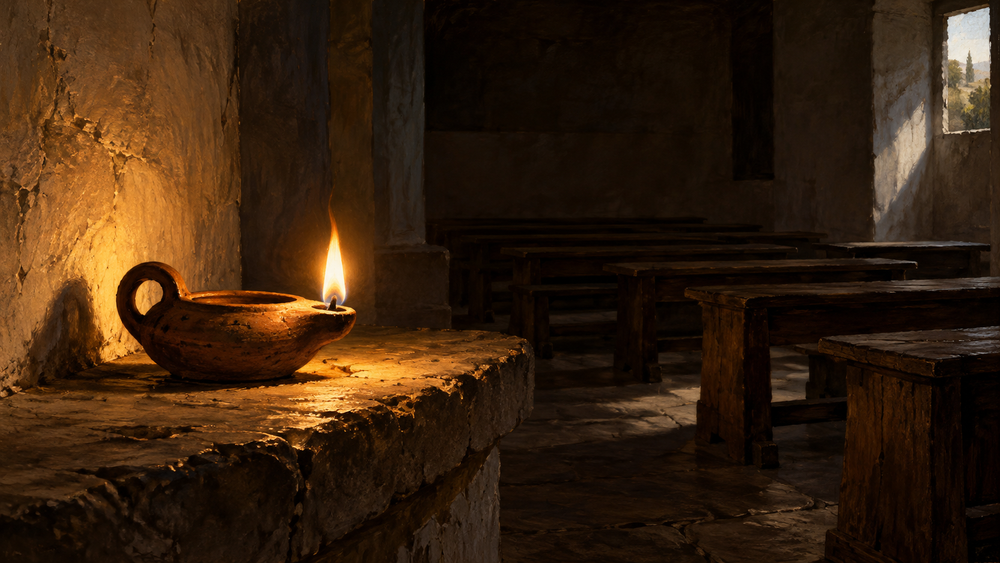
When his iron lamp was stolen, Epictetus decided to buy an earthenware one instead:
Indeed, a man loses only that which he already has.
Epictetus, Discourses 1.18.16 (trans. W. A. Oldfather)
Difficulty is training
It is difficulties that show what men are.
Epictetus, Discourses 1.24.1 (trans. W. A. Oldfather)
Philosophy starts with admitting you do not know
The beginning of philosophy with those who take it up as they should, and enter in, as it were, by the gate, is a consciousness of a man's own weakness and impotence with reference to the things of real consequence in life.
Epictetus, Discourses 2.11.1 (trans. W. A. Oldfather)
What is the first business of the philosopher? To cast away conceit: for it is impossible for a man to begin learning what he thinks he knows.
Epictetus, Discourses 2.17 (trans. P. E. Matheson)
You become what you practise
This is the most practical idea in the book, and the reason Stoicism can be trained rather than just understood.
Every habit and every faculty is confirmed and strengthened by the corresponding acts, the faculty of walking by walking, that of running by running.
Epictetus, Discourses 2.18 (trans. P. E. Matheson)
So generally if you wish to acquire a habit for anything, do the thing
Epictetus, Discourses 2.18 (trans. P. E. Matheson)
Philosophy should hurt a little
Epictetus had no time for students who wanted to be entertained.
The philosopher's school, sirs, is a physician's consulting-room. You must leave it in pain, not in pleasure
Epictetus, Discourses 3.23 (trans. P. E. Matheson)
Show me one who is sick and yet happy, in peril and yet happy, dying and yet happy, in exile and happy, in disgrace and happy.
Epictetus, Discourses 2.19 (trans. P. E. Matheson)
How to use it
- Read one chapter at a sitting. Each chapter is a single talk on a single question, often named in its title. Read it, then ask what it would change about tomorrow.
- Sort one problem. Take something bothering you and split it the way Discourses 1.1 does: what part of this is up to me, and what is not? Put your effort only into the first.
- Train one habit. Discourses 2.18 is a training manual in a single page. Pick one reaction you want to weaken, notice each time you feed it, and do something else instead.
- Expect it to sting. If a chapter makes you uncomfortable, Epictetus would say it is working (Discourses 3.23).
Where to start reading
The books are long and repeat themselves, so you do not need to read them straight through. Good places to start:
- Book 1, chapter 1, on what is and is not in our power. Everything else builds on it.
- Book 1, chapter 18, on not being angry with wrongdoers, including the stolen lamp.
- Book 1, chapter 24, on how to struggle against difficulties.
- Book 2, chapter 18, on how to fight against impressions and build habits.
- Book 3, chapter 23, on people who study philosophy for show.
- Book 4, chapter 1, on freedom, the longest chapter and the fullest statement of his ideas.
On translations: the two public-domain translations quoted here are W. A. Oldfather's Loeb (1925) and P. E. Matheson's (1916). Both are free to read online. Oldfather numbers each section, which makes passages easy to find. Matheson is complete but has no section numbers, which is why some citations on this page give only the chapter. If you start with the Enchiridion first, the Discourses will feel familiar.
Sources
- Epictetus, Discourses 1.1.17, 1.1.23, 1.18.16, 1.24.1, 2.11.1, trans. W. A. Oldfather (Loeb, 1925); 2.17, 2.18, 2.19, 3.23, 4.1, trans. P. E. Matheson (1916).
- Epictetus's life, Arrian and the survival of the books from our Codex figure note on Epictetus, drawing on A. A. Long's introduction and Photius, Bibliotheca codex 58.
If you want structured practice, the 7-Day Stoic Challenge is free. Nine audio lessons and a 42-page workbook.