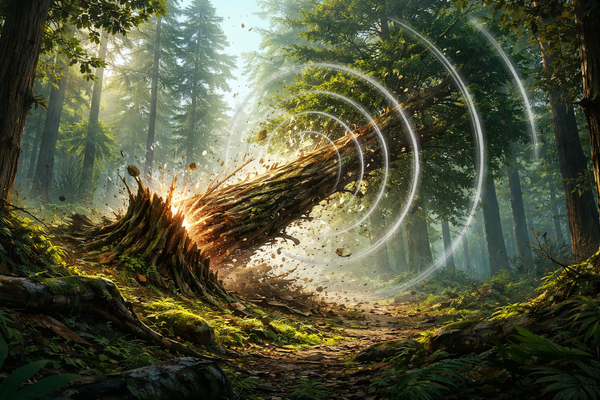
If a Tree Falls in a Forest Does It Make a Sound? (And Why This Ridiculous Question Actually Matters)
Here's a question that's been annoying philosophy students, quantum physicists, and stoned college kids for centuries:
If a tree falls in a forest and no one is around to hear it, does it make a sound?
Your first instinct is probably to roll your eyes. Of course it makes a sound, right? Trees don't give a damn whether we're watching. Physics doesn't wait for an audience. Sound waves don't check for attendance before vibrating through the air.
But hold on.
Because this seemingly absurd question—which traces back to 18th-century philosopher George Berkeley—isn't just philosophical navel-gazing. It's actually a mind-bending gateway into some of the deepest questions about reality, consciousness, and what it means to exist.
And weirdly enough, it's more relevant today than ever before. Because in our social media age where everything is performed for an audience, this ancient riddle has become our lived experience: If you did something amazing but no one saw it, did it really happen?
Let's dig in.
The Problem With Sound (It's Not What You Think)
Here's where this gets interesting.
The entire "if a tree falls in the forest" debate hinges on one sneaky little word: sound.
See, "sound" can mean two completely different things:
- Physical vibrations - Air pressure waves created when the tree crashes to the ground. These are measurable, objective, and exist whether anyone hears them or not.
- The experience of hearing - The subjective sensation that happens when those waves hit your eardrum, vibrate tiny bones in your ear, and get translated by your brain into what we call "sound."
Without a perceiver—no ears, no brain, no consciousness—you've got vibrations. But do you have sound?
This isn't just semantics. It's the difference between believing reality exists independently of observation (realism) and believing reality is fundamentally tied to consciousness (idealism).
And this is where shit gets philosophical.
💡 KEY INSIGHT
"Sound" has two completely different meanings:Physical vibrations (objective, always exist)The experience of hearing (subjective, requires a perceiver)
The entire debate hinges on which definition you use.
George Berkeley's Mind-Bending Claim
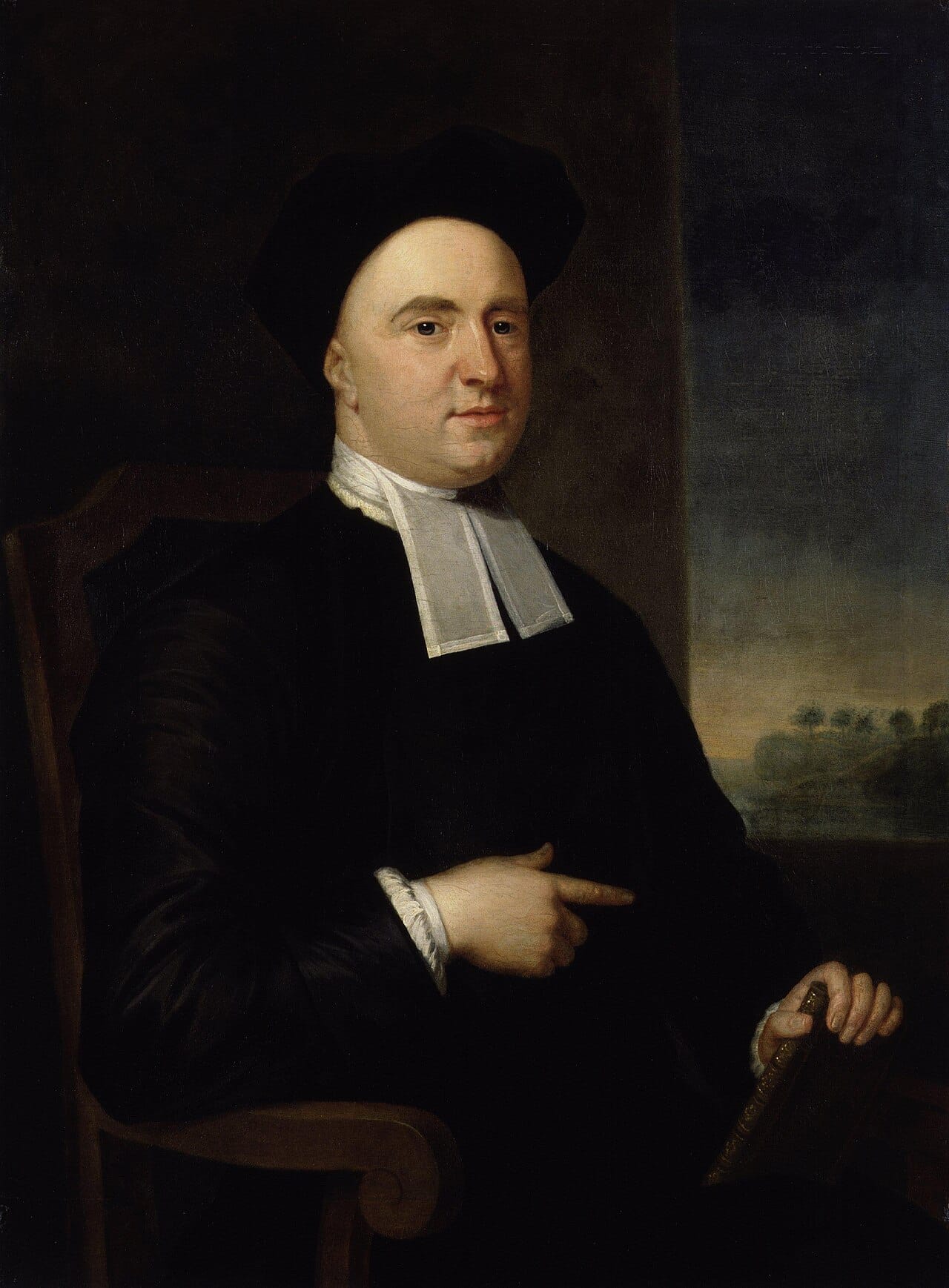
George Berkeley, the Irish philosopher who sparked this whole debate in 1710, wasn't messing around. His big idea was radical: objects only exist when they're perceived.
In his Treatise Concerning the Principles of Human Knowledge, Berkeley argued that houses, mountains, rivers—and yes, trees—exist only as ideas in the perceiver's mind. He coined the phrase "esse est percipi"—to be is to be perceived.
Which means: no observer, no reality.
This sounds insane at first. Like, obviously the tree exists even when I'm not looking at it, right?
But Berkeley would push back:
"How do you know? Have you ever experienced anything that wasn't being experienced by you? Everything you've ever known about reality has come through your perception. So how can you prove anything exists when nobody's perceiving it?"
It's the philosophical equivalent of "pics or it didn't happen."
🤔 BERKELEY'S CHALLENGE
"Have you ever experienced anything that wasn't being experienced by you? Everything you've ever known about reality has come through YOUR perception. So how can you prove anything exists when nobody's perceiving it?"
Try to answer this without using circular reasoning. I'll wait.
Now, I know what you're thinking: this is the kind of thing that makes people hate philosophy. But stick with me—because this question has echoed through centuries of thought, from Immanuel Kant to modern quantum mechanics, and it touches something profound about how we understand existence.
"To be is to be perceived." — George Berkeley
If a Tree Falls in the Woods: The Quantum Plot Twist
Fast forward a couple hundred years to the 20th century, when quantum physicists accidentally stumbled into the same philosophical quagmire.
In quantum mechanics, particles exist in a state of superposition—basically, they're in multiple states at once—until they're measured. The famous double-slit experiment showed that electrons behave like waves when unobserved, but collapse into particles when measured.
The observer literally changes the outcome.
Max Planck, the founder of quantum theory, put it bluntly: "I regard consciousness as fundamental. I regard matter as derivative from consciousness."
Sound familiar? It's Berkeley's idealism, dressed up in lab coats and particle accelerators.
So when physicists debate whether unobserved quantum events are "real," they're essentially asking: if a tree falls in the forest and nobody's there to collapse its wavefunction, does it make a sound?
The universe, it turns out, might be weirder than any philosophy professor dared to imagine.
CLICK TO EXPAND: Wait, explain the quantum stuff in simple terms
Here's the simplest version:
In quantum mechanics, tiny particles don't have fixed properties until you measure them. It's like Schrödinger's cat—the cat is both alive AND dead until you open the box.
In the double-slit experiment, scientists shot electrons through two slits. When they watched (measured), the electrons acted like particles and went through one slit or the other. When they didn't watch, the electrons acted like waves and somehow went through BOTH slits at once.
The act of observation literally changed reality.
So if a quantum tree falls in a quantum forest and nobody measures it... did it even fall? Or is it in a superposition of fallen and standing?
Physics is weird, man.
The Modern Version: Social Media and the Attention Economy
Here's where this ancient riddle becomes painfully relevant to our lives today.
Because in 2026, we're all living inside the tree-falling question.
Think about it:
- You cook an amazing meal, but you don't post it on Instagram. Did it happen?
- You hit a personal record at the gym, but nobody was there to witness it. Does it count?
- You have a profound realization about your life, but you don't write it down or tell anyone. Did you really learn anything?
We've collectively internalized Berkeley's idealism: existence requires an audience.
This isn't just philosophical—it's psychological. Studies show that people feel like their experiences are less valid when they can't share them. We've become addicted to external validation, to the dopamine hit of likes and comments that confirm: yes, this happened. You exist. We see you.
The tree-falling question has become our existential crisis: if nobody witnesses my life, am I really living it?
And here's the kicker: this isn't totally wrong.
⚠️ REALITY CHECK
Ask yourself: How many times this week did you do something amazing but felt like it "didn't count" because you didn't share it?
How many moments did you experience through your phone camera instead of your actual eyes?
You're living inside Berkeley's thought experiment.
The Case for Observation (Why Witnesses Actually Matter)
Look, I'm not saying you need to livestream your entire life to validate your existence.
But there's something real about the role of observation in creating meaning.
Consider:
Memory is social. Psychological research shows we remember events better when we share them with others. The act of telling a story—having someone bear witness—actually makes the memory more concrete, more real to us.
Identity is relational. You don't know who you are in a vacuum. You discover yourself through relationships, through how others reflect you back to yourself. The "tree" of your personality only makes a "sound" when it encounters other consciousnesses.
Achievement needs context. Sure, you climbed that mountain. But the meaning of that climb—the story you tell about your strength, your determination—emerges through the telling. Through being witnessed.
So maybe Berkeley was onto something. Maybe reality isn't just "out there" waiting to be discovered. Maybe it's co-created between observer and observed, between consciousness and world.
The Answer (Sort Of)
So, does the tree make a sound?
If sound means physical vibrations: Yes. The tree creates air pressure waves whether anyone hears them or not. Physics doesn't require an audience.
If sound means the experience of hearing: No. Without ears and a brain to process those vibrations, there's no sound as we subjectively know it—just waves in the air.
If sound means something that matters: That depends on what you value.
Here's my take: the tree creates vibrations regardless. But the meaning of those vibrations—the story we tell about the falling tree, the significance we assign to it—that only exists in the presence of consciousness.
Reality might be objective. But our experience of reality is always filtered through perception, interpretation, and meaning-making.
Which means the real question isn't "does the tree make a sound?"
The real question is: who decides what counts as real?
CLICK TO EXPAND: The Full Breakdown—Three Ways to Answer
THE SCIENTIFIC ANSWER:
- Physical vibrations occur regardless of observers
- Sound waves = objective phenomenon
- Measurable with instruments
- Verdict: Yes, it makes a sound (defined as vibrations)
THE PHILOSOPHICAL ANSWER:
- "Sound" requires the experience of hearing
- Experience requires consciousness
- No consciousness = no sound (only vibrations)
- Verdict: No, it doesn't make a sound (defined as experience)
THE PRACTICAL ANSWER:
- Physical reality exists independently
- But meaning is created by consciousness
- Vibrations happen; significance requires witness
- Verdict: Both are true, depending on what you care about
What This Means For Your Life (The Practical Bit)
Okay, enough abstract philosophy. What does this mean for you?
Here are three takeaways from the falling-tree debate:
1. You don't need an audience to be valid.
Your life has meaning independent of whether it's witnessed, liked, or validated by others. That meal you cooked? It was delicious whether Instagram saw it or not. That personal record? It counts because you experienced it.
Stop outsourcing your sense of reality to social media metrics.
2. But selective sharing creates deeper meaning.
There's also truth to the idea that sharing experiences—telling stories, being witnessed by people who matter—deepens their significance. The key is selective. Share with people who genuinely care, not with an algorithm optimizing for engagement.
3. Reality is more collaborative than you think.
You're not just a passive observer of an objective reality. You're actively participating in creating meaning, interpreting sensory data, constructing narratives. Which means you have more power than you realize to shape your experience of life.
Your interpretation matters. Your story matters. Your consciousness isn't just witnessing reality—it's helping to create it.
The Bottom Line
If a tree falls in the forest and no one is around to hear it, does it make a sound?
Maybe. Maybe not. Depends on what you mean by "sound."
But here's what I know for sure: you're not a tree. You're a conscious being capable of observation, interpretation, and meaning-making. And whether or not the universe requires an audience to exist, your life becomes richer when you stop performing for invisible crowds and start being fully present for the moments that matter.
Berkeley was right about one thing: perception shapes reality.
So the real question isn't whether unobserved events are real. The real question is: what are you choosing to pay attention to? Because whatever you perceive, interpret, and assign meaning to—that becomes your lived reality.
The tree might fall silently in the forest.
But your life? That's up to you to listen to.
Want to explore more mind-bending questions about consciousness, reality, and what it means to exist? Subscribe below to get philosophical insights delivered to your inbox—no academic jargon, just practical wisdom for navigating a weird universe.