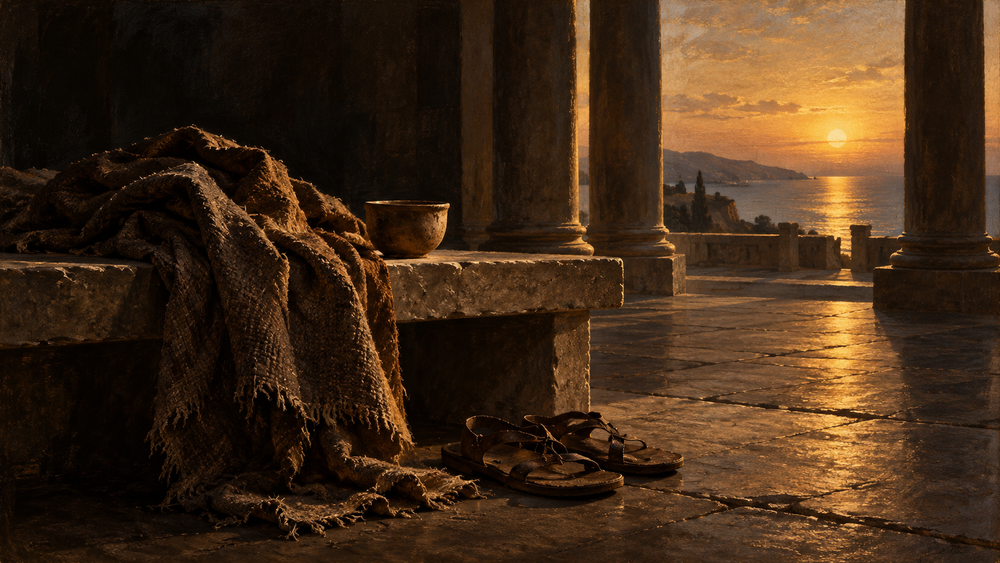
Musonius Rufus (moo-SOH-nee-us ROO-fus) was a Roman Stoic teacher of the first century CE, and the man who taught Epictetus. He wrote nothing himself. What we have is 21 lectures and 32 shorter fragments, written down by a student. They show a teacher who cared less about doctrine than about what a person eats, how they train, whom they marry and whether they act on what they say they believe.
Who was Musonius Rufus?
Gaius Musonius Rufus was born at Volsinii in central Italy and became the best-known Stoic teacher in Rome under Nero. His association with the Stoic Opposition, the thinkers who clashed with the emperors, made him a repeated target. He was exiled more than once. The best-known exile was to Gyaros, a bare island in the Aegean, around 65 CE, after the Pisonian conspiracy against Nero. Tacitus (Annals 15.71) says he and Verginius Flavus were driven out because of the renown of their teaching.
Philostratus, a later and more colourful source, says he found fresh water on Gyaros, farmed the stony ground, and had students crossing the sea to study with him (Life of Apollonius 4.46). Treat that as a story about how he was remembered rather than settled biography. Tacitus gives a sharper glimpse in Histories 3.81: during the civil war of 69 CE Musonius tried to preach peace to armed soldiers, and Tacitus calls it "untimely wisdom". The date of his death is unknown. Scholars estimate around 100 CE.
Why is he called the Roman Socrates?
The label is how he is usually introduced today, but the comparison is ancient. Origen, writing around 248 CE, set Socrates and Musonius side by side as models of a lived philosophy (Against Celsus 3.66). The parallel holds in two ways. Like Socrates, Musonius wrote nothing and is known through a student's record. And like Socrates, he put the weight on conduct: a philosopher is judged by how he lives, not by how well he argues.
What survives of his teaching
Musonius taught aloud. His student Lucius recorded 21 lectures, which survive in Greek because the anthologist Stobaeus copied them into his Anthology around the fifth century CE. The standard English translation is Cora Lutz's, published by Yale in 1947, and it is the version quoted on this page. A second translation by Cynthia King appeared in 2011. The lectures are short, the longest running to about 2,400 words in English.
One caution: because Lucius wrote the lectures down, we read Musonius through a student's notes. The wording is Lucius's report of the teacher, not a text Musonius polished himself.
Practice comes before talk
The idea he is best known for fits in a sentence. In Lecture 6 he says:
"Virtue, he said, is not simply theoretical knowledge, but it is practical application as well, just like the arts of medicine and music."
Musonius Rufus, Lecture 6, trans. Cora Lutz
In Lecture 5 he makes the case with a test. He asks a student to choose between two physicians, one who speaks brilliantly about medicine but has never treated a patient, and one who cannot speak well but has healed many. The student picks the experienced one. Musonius repeats the test with a ship's pilot and a musician, then turns it on self-control: is it better to be self-controlled, or to be able to say what self-control requires?
He does not throw theory away. He says theory comes first, because nothing is done well without it. His claim is narrower: practice has more power to move a person to act. In Lecture 1 he adds that a teacher should look for a few clear proofs rather than pile up many, which is a useful rule for anyone who reads philosophy instead of doing it.
Training the body: voluntary hardship
Musonius called training askēsis (ASK-eh-sis). He describes a person as a mixture of body and soul, so both need training. Some training belongs to the soul alone. The rest is shared, and it is the part people remember:
"cold, heat, thirst, hunger, meager rations, hard beds, avoidance of pleasures, and patience under suffering"
Musonius Rufus, Lecture 6, trans. Cora Lutz
His reason is that the body grows sturdy and the soul is schooled in courage by patience and in self-control by abstaining. Lecture 7 adds an argument from shame. People endure hardship for money, for fame and for lust, and acrobats risk their lives for small pay. If we accept effort for those ends, why not for the sake of becoming good? Lecture 19 applies the same spirit to daily life: clothing and shoes should work like armour, for protection and not display, and he says it is not good to be entirely without experience of cold and heat.
A sceptical note. These are the views of a Roman teacher, not a medical programme, and the lectures say nothing about how much cold or hunger is safe. Read them as a principle: practise small, deliberate, reversible discomforts. If you have a health condition, speak to a doctor before changing how you eat or exposing yourself to cold.
Women and philosophy
Lectures 3 and 4 are the most sustained surviving argument from the ancient world that women should study philosophy. His case starts from reason:
"Women as well as men, he said, have received from the gods the gift of reason"
Musonius Rufus, Lecture 3, trans. Cora Lutz
From there he argues that women have the same senses, the same natural inclination towards virtue, and the same need for self-control, justice and courage. In Lecture 4 he reasons that sons and daughters should receive the same education, since the virtues are the same for both.
The picture is more mixed than the headline. The benefits he lists for a woman who studies philosophy are largely domestic: she will run her household well, be a devoted wife and raise her children, and Lecture 3 adds that philosophy teaches a woman to be content with her lot and to work with her own hands. So he argues for equal education while keeping a conventional view of a woman's place. Both things are in the text.
Exile is not an evil
Lecture 9 is addressed to an exile who is complaining. Musonius answers that banishment takes away neither earth, air nor sun, and that true friends stay true. Then he asks:
"is not the universe the common fatherland of all men, as Socrates held?"
Musonius Rufus, Lecture 9, trans. Cora Lutz
He was exiled himself, which gives the lecture weight. It also shows how his pupil used him. In the Discourses Epictetus quotes "Rufus" more than once. In 1.1 he recalls Thrasea saying he would rather be killed today than banished tomorrow, and Rufus replying that if you choose death as the heavier of two misfortunes, the choice is folly. Then:
"But if as the lighter, who has given you the choice? Are you not willing to practise contentment with what has been given you?"
Epictetus, Discourses 1.1, trans. W. A. Oldfather
Epictetus also remembers how Rufus taught. In 3.23 he says:
"If you find leisure to praise me, my words are spoken in vain."
Epictetus, Discourses 3.23, trans. P. E. Matheson
That is the Musonius method in one line: a lecture is judged by what it changes in the listener. If you want to see where Epictetus took these ideas, our guide to the Discourses and the page on Epictetus quotes on freedom are good places to go next.
Food, clothing and work
Musonius treated the everyday as philosophy's real ground. In Lecture 18 he says self-control in eating and drinking is where temperance begins. He prefers cheap food to expensive and plants and dairy to meat, calling meat "a less civilized kind of food", and he claims it is heavy and dulls thinking. That last claim belongs to ancient physiology, not to nutrition science, so take the principle (eat for nourishment, not display) and leave the physiology.
Lecture 19 asks what good colonnades, painted walls and gold-decked rooms really do, and argues that money is better spent on people than on stone. Lecture 11 goes furthest. He suggests that a philosopher might earn his living from the soil, and that students would learn more watching their teacher work in the fields than listening to formal lectures in the city.
What to make of him
The strength of Musonius is that his claims can be tested. Practice beats talk, small hardships build steadiness, the same education suits every person who has reason. The limits are just as clear. We read him through a student's notes and a 1947 translation, some of his dietary claims are dated, and his picture of women's roles is of his time. A fair reading keeps the method and does not treat the details as law.
A small experiment
Take one belief you already hold in theory. For example, that a late dinner or a cold room is not a real harm. Then test it with one small action today and notice the gap between what you said you believed and what you felt. That gap is the lesson. Musonius would say it is also where the training starts.
If you want structured practice, the 7-Day Stoic Challenge is free. Nine audio lessons and a 42-page workbook.
Sources
Musonius Rufus, Lectures 1, 3, 4, 5, 6, 7, 9, 11, 18 and 19, trans. Cora E. Lutz, Musonius Rufus: The Roman Socrates (Yale Classical Studies 10, 1947). Epictetus, Discourses 1.1, trans. W. A. Oldfather (Loeb); Discourses 3.23, trans. P. E. Matheson. Tacitus, Annals 15.71 and Histories 3.81. Philostratus, Life of Apollonius of Tyana 4.46. Origen, Against Celsus 3.66. Second English translation of Musonius: Cynthia King (2011).