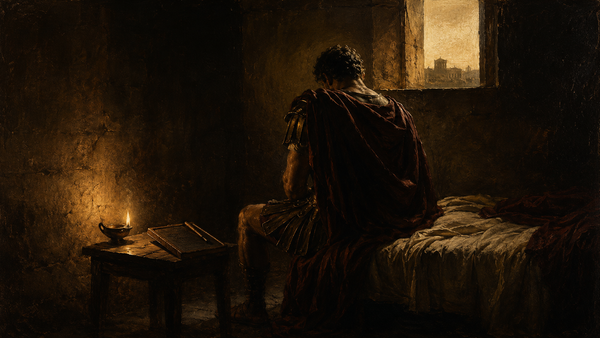
During the 170s of the common era, while ruling an empire and often away from Rome, Marcus Aurelius wrote notes to himself in Greek. What survived is not a public book. It is a private notebook, the Meditations, sentences a man wrote to remind himself how to live. This episode turns eight of those lines into a short guided morning practice you can repeat daily.
What this practice is
Eight lines drawn from the Meditations. Some are close to verbatim, others are rendered in modern English so they are repeatable in the mouth and the mind. Between each line there is a little silence. At the end, one quiet commitment for the day ahead.
Marcus wrote more than once about the difficulty of getting out of bed in the morning, and about the kind of person he was trying to be when he did. These were notes he wrote to himself. We are not the first to need them.
The eight lines
The practice draws on passages including, as spoken in the episode:
- Book 5 — the getting-out-of-bed passage: "I am rising to do the work of a human being."
- Book 2 — the morning reminder: the people I meet today may be ungrateful, arrogant, dishonest, jealous. But we were born to work together.
- Book 7 — confine yourself to the present.
- Book 2 — you could leave life right now. Let that determine what you do and say and think.
- Book 10 — waste no more time arguing about what a good person should be. Be one.
How to use it
Listen first thing, before you open your phone. After the eight lines, the practice ends the way Marcus prepared for his own day: picture one difficulty you actually expect today, then make one quiet if-this-then-I-will plan. One sentence. Keep it.
The lines tend to work better the more familiar they become, so this is built for repetition. Return to it tomorrow.
If you want the full architecture around a practice like this, my Stoic morning routine shows where a morning preparation sits in a complete day, and the summary of the Meditations gives the context for the notebook these lines come from.
Full transcript
Lightly edited for readability.
Good morning. Settle for a moment, feet on the floor, hands resting. Notice the weight of your body where it meets the ground.
During the 170s of the common era, while ruling an empire, and often away from Rome, Marcus Aurelius wrote notes to himself in Greek. What survived is not a public book. It is a private notebook. Reminders to himself, sentences to keep ready to hand. We don't know the exact form of his daily practice. What we know is that he wrote more than once about the difficulty of getting out of bed in the morning, and the kind of person he was trying to be when he did. So this is what we'll do: eight lines from the Meditations, then one quiet plan for the day.
First, the body. Three slow breaths. Breathe in for four and out for six. Again, in four, out six. One more, in and out, slowly. You've woken up. That, Marcus thought, was already a kind of privilege.
One. From Book 5, the getting out of bed passage. I am rising to do the work of a human being. Not the work of someone trying to be impressive, not the work of someone trying to win. The work of a human being.
Two. From Book 2, one of his best known morning reminders. The people I meet today may be ungrateful, arrogant, dishonest, jealous. But we were born to work together.
Three. From Book 5. Marcus, who could have anyone in the Empire killed, asked his own mind to stay open to being wrong. Most of us could try a little harder.
Lines four and five are spoken quietly against the silence in the recording — press play above to hear them in place.
Six. From Book 7. Confine yourself to the present.
Seven. From Book 2. This is the heavy one. You could leave life right now. Let that determine what you do and say and think. Not morbid. Clarifying. If today were the last, what would matter? What would fall away?
Eight. From Book 10, the line that lands hardest. Waste no more time arguing about what a good person should be. Be one.
Marcus did this next bit too. He rehearsed the day before it began. Picture one difficulty you actually expect today. A meeting, a conversation, a temptation you keep losing to. What would the version of you that took these eight lines seriously actually do? Make one quiet plan. If this happens, then I will. One sentence. Keep it. That's the practice.
Eight lines from a man who by all accounts had reasons to lose his temper every single day of his life, and tried in his notebook to remind himself not to.
Take a slow breath in. Out. Notice your hands, the weight of them. Go gently.
And if you'd like more from the Meditations, return to this track tomorrow. The lines tend to work better the more familiar they become.
Go deeper
If you want structured practice, the 7-Day Stoic Challenge is free. Nine audio lessons and a 42-page workbook.