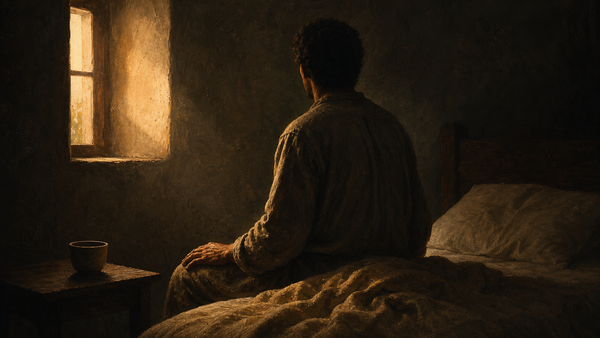
A Stoic morning gratitude practice can be simple: name one ordinary comfort, one person and one capacity you still have. Notice each one properly. Then, if it feels useful, imagine its absence for a few seconds before returning to the fact that it is here now.
The guided practice lasts about seven minutes. The full podcast episode is 9:08 because it begins with a historical announcement. The meditation starts at 2:32.
Listen while seated or lying down. Do not use the meditation while driving or doing anything that needs your full attention. Let your breathing stay easy rather than making it deeper. Stop if you feel light-headed or more distressed.
I recorded this in January 2026, before the Stoic Vault opened. The introduction describes the Vault as an unreleased project and announces a Monday and Friday podcast cadence. Both details belong to that moment, not the current offer or publishing schedule.
There is also one source correction worth making before you listen. The line in the recording beginning “When you arise in the morning” is not by Marcus Aurelius. It was written by Elbert Hubbard in the early twentieth century. Marcus gives us a better and more interesting model of gratitude in Book 1 of the Meditations.
What Stoic gratitude actually looks like
The Stoics did not leave us a fixed seven-minute gratitude meditation.
Marcus does, however, open the Meditations with an extended inventory of what he received from other people. He names family members, teachers and friends, then records the qualities and lessons each gave him. It is not a list of vague blessings. It is specific, relational and often demanding.
From Rusticus, Marcus says he learned to recognise that his character needed correction. From Sextus, kindness and the example of a household governed well. From Fronto, an understanding of the malice that can accompany power. Book 1 is gratitude with names and consequences.
That gives us a firmer ancient starting point than the false quote in the audio. Do not force a grateful mood. Look closely enough to name what was given and what it now asks of you.
Marcus's real morning instruction in Meditations 5.1 is different. When he does not want to get out of bed, he reminds himself that he is rising to do the work of a human being. That is a duty passage, not a sentimental line about the privilege of being alive.
The three-part morning practice
This meditation uses a modern structure. The three categories are mine, not an ancient Stoic formula.
1. An ordinary comfort
Start with something easy to miss because it usually works. The bed you slept in. Clean water. A warm room. The ability to make breakfast.
Keep it concrete. “My life” is too large to see. “The cup beside me and the person who made it” gives attention somewhere to land.
You do not need to feel a rush of warmth. Name the thing and stay with it for one breath.
2. A person
Bring one person to mind and make the gratitude specific.
What did they do? What quality did they model? What is different in your life because they were there?
This is closest to Marcus's Book 1 method. He does not merely announce that he is grateful for Rusticus. He records the correction, discipline and reading habits he learned from him.
Gratitude becomes more useful when it changes how you treat the person. If they are alive and contact is welcome, choose one ordinary act that would express the thanks.
3. A capacity you still have
Name something your body, mind or character lets you do today.
It might be walking to the kitchen, reading a page, asking for help, beginning again after a poor week or staying with a difficult conversation for ten seconds longer than before.
This is not a claim that health or ability is entirely up to you. It is a way of noticing a present capacity without treating it as permanent or deserved.
The optional loss contrast
The recording then uses a brief form of negative visualisation. You imagine the comfort, person or capacity absent, then return attention to its presence.
The ancient history is more complicated than the popular label suggests. Cicero reports the underlying premeditation argument from the Cyrenaics, and Seneca and Marcus use related forms of anticipating loss and difficulty. Negative visualisation is a modern name and gratitude-oriented adaptation.
The sharper method already has its own Handbook guide: Premeditatio Malorum: Stoic Negative Visualisation Without Spiralling.
In this morning practice, keep the contrast brief. A few seconds is enough. Do not build a detailed scene of illness, death or catastrophe.
Skip the loss step if it increases dread, rumination or grief. Return to the ordinary object in front of you, open your eyes and continue with the day. A gratitude practice is not improved by making it harder to leave.
What the recording gets right and wrong
The meditation's main move still holds up: attention tends to settle on what is missing, urgent or irritating. Deliberately noticing what is already present can correct that narrow frame for a moment.
The recording goes too far when it says your brain chemistry is already shifting. It supplies no measurement or source for that claim. The honest result is smaller. You directed attention towards three things and rehearsed noticing one more later in the day. Whether that changes your mood, behaviour or morning remains a question to observe.
The Seneca line in the audio is genuine, but its provenance matters. In Moral Letters 2, Seneca says he found the thought in Epicurus: the poor person is not the one with too little, but the one who craves more. Seneca approves and transmits the line. He does not originate it.
Epictetus also gives us a discipline of desire, but the recording's claim that he taught people to stop ignoring the gifts already in their hands is a modern paraphrase, not a locatable quotation.
A seven-day trace
If you want to test this rather than admire it, use the same three prompts for seven mornings.
Record only this:
- the ordinary comfort
- the person and what they gave
- the capacity you noticed
- one later moment when you remembered to look again
Do not score your gratitude or punish repeated answers. Repetition may be the evidence. Marcus spent an entire book returning to people whose influence remained active in him.
At the end of the week, ask one question: Did this change what I noticed or how I treated someone?
If the answer is no, that is useful. Keep the practice smaller, change the prompt or drop it.
For a broader start-of-day system, use The Stoic Morning Routine: 3, 9 and 20-Minute Versions. For the stronger loss-based exercise, use the premeditation guide rather than extending this gentle track.
Sources
- Marcus Aurelius, Meditations, Book 1
- Marcus Aurelius, Meditations 5.1
- Seneca, Moral Letters, Letter 2
- Cicero, Tusculan Disputations, Book 3
- Elbert Hubbard, primary 1914 magazine scan containing the
precious privilegeline
Full transcript
Lightly edited for readability.
This transcript records the January 2026 episode. Obvious speech-recognition errors have been corrected, but unsupported claims and old announcements have not been silently rewritten. Editorial corrections appear in square brackets.
0:18 | Historical announcement
Hello and welcome to The Stoic Handbook Podcast.
Just a quick announcement about a new publishing cadence that I am going to be exploring. I create different types of podcasts. Sometimes I do interviews, sometimes I do solo casts about a specific practice, sometimes I do deep-dive style workshops, and I also create meditations.
From now on, if fortune allows, I will be publishing theoretical content on Mondays. These will be things like interviews, workshops, deep dives and solo casts. Then on Fridays I will be publishing meditations so that each week you have both theory and practice.
I have been building something in the background for many months called the Stoic Vault. It is going to be my premium practice community for people who already kind of know Stoicism but want to spend more time training it so that they can practise in real life. There are tons of courses on there, meditations, weekly threads, discussions, a monthly life workshop and, more importantly, a chance to engage with other like-minded individuals, develop solid relationships and philosophical friendships, and speak to me about anything you are working on.
It is not released yet, but I will keep you up to date when it is. For now, let us do today's meditation.
[Editorial note: the Vault is now live and the publication cadence has changed. Use current public pages for current terms and schedules.]
2:32 | Arrive
Find a comfortable position, seated or lying down, and let your eyes close gently.
Take a slow, deep breath in through your nose and release it through your mouth with a soft sigh. Let that exhale carry any residue of sleep.
Again, breathe in fully and let go completely. One more time, in and out.
Allow your breath to return to its natural rhythm without forcing anything.
This morning we are going to practise something the ancient Stoics considered essential. This is not a form of positive thinking, but more a form of clear seeing.
The philosopher Epictetus taught that much of our suffering comes from wanting what we do not have and then ignoring what we do have. We end up chasing the next thing, forgetting the gifts already in our hands.
Gratitude for the Stoics was not about pretending everything is fine. It was about accuracy, noticing reality as it is, including the good that is easy to overlook.
Marcus Aurelius wrote in his private journal, “When you arise in the morning, think of what a precious privilege it is to be alive, to breathe, to think, to enjoy, to love.”
[Editorial correction: this line is by Elbert Hubbard, not Marcus Aurelius. Marcus's genuine morning passage at Meditations 5.1 is about rising to do the work of a human being. His clearest gratitude model is the named inventory in Book 1.]
This morning, let us take that advice.
3:50 | Three gratitudes
Bring to mind something simple you are grateful for. It does not need to be profound. It could be the bed you slept in, the warmth you experience in this moment or the fact that you woke up today at all.
Do not just name it. Try to feel it. Let the appreciation settle in your body.
Think of a person you are grateful for, someone who has shaped you, supported you or simply shown up when you needed them. Picture their face. Feel what they mean to you.
Finally, consider something about yourself you are grateful for, like a quality or skill, or something you have survived or accomplished. This is not arrogance. It is honest recognition. You have come through things and you are still here.
5:42 | Brief loss contrast
Already your brain chemistry is shifting. You are priming yourself today to notice what is right in the world rather than what is wrong.
[Editorial correction: the recording did not measure brain chemistry. A safer claim is that the practice deliberately redirects attention during the exercise.]
The Stoics had another practice that might seem strange at first, but it does supercharge gratitude. It is called negative visualisation, or premeditatio malorum.
Briefly, for just a moment, imagine these things were not in your life. The person you pictured, the simple comfort, the quality you possess. We do not want to create fear, but to break through the fog of taking these things for granted.
Seneca wrote that it is not the man who has too little who is poor, but the one who hankers after more.
[Editorial note: Seneca transmits this line in Moral Letters 2 and explicitly says he found the thought in Epicurus.]
When we briefly imagine loss, we can return to what we have with fresh eyes and see its value.
Release that visualisation and return to the simple fact that these things are in your life right now, today. Let this gratitude wash over you and make it deeper this time.
7:20 | Carry one act into the day
At some point today, maybe during a meal, a conversation or a quiet moment, pause and notice something good that you might have overlooked. Feel the same warmth of appreciation.
That is the practice. Not once in a meditation, but threaded through life. The Stoics did not just think about gratitude. They lived it daily and deliberately.
Take one more deep breath. Feel your body here, present and grounded.
When you are ready, wiggle your fingers and toes. Slowly open your eyes.
You have done something valuable this morning. You have remembered what matters.
Go well.
Go deeper
If you want structured practice, the 7-Day Stoic Challenge is free. Nine audio lessons and a 42-page workbook.