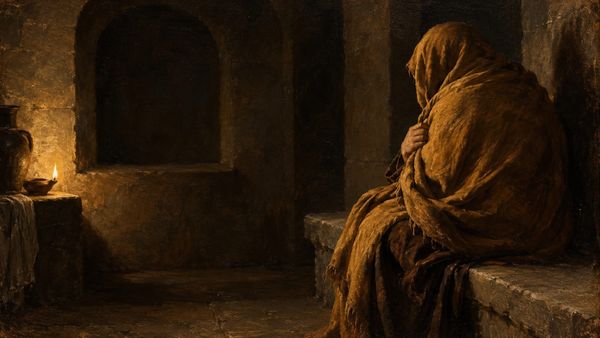
Some mornings, grief is there before you open your eyes. This gentle guided practice makes room for that weight, notices one source of warmth and asks for one small act of care in the next few hours. You can listen seated or lying down, without trying to manufacture a better mood.
Keep your breathing comfortable and unforced. You can keep your eyes open, skip the inward attention or stop. Listen somewhere safe, away from driving or other tasks that need your attention.
Let warmth sit beside the weight
The recording starts with the heaviness you already feel. It asks you to notice where that sits, then find something warm: the blanket, your hands, the breath moving. You don't have to make one feeling replace the other.
If paying attention to your body makes the morning harder, leave that part. Ordinary breathing is enough. There is no test to pass here, and no requirement to finish the recording.
This is a modern guided exercise inspired by Marcus Aurelius. His citadel image concerns the mind's capacity for reasoned judgement. Applying it to a grieving morning is an interpretation, not a grief protocol Marcus wrote. The citadel metaphor itself is ancient, even though “the inner citadel” is also used as a modern label for his philosophy.
Choose care small enough for this morning
The final question stays close to the next few hours. What is one kind thing you can do for yourself? The recording offers rest, food, fresh air or telling someone how you are. Pick what is possible. Asking another person for help counts.
Grief does not have to become a lesson or an achievement. Nor does feeling overwhelmed mean you have failed to use your mind properly. The audio's language about what “remains” is encouragement, not a claim that distress leaves everyone's capacity to choose untouched.
For the older texts and their limits, read Stoicism and grief. The guide to apatheia and feeling explores the difference between emotional steadiness and numbness.
Sources: the recording paraphrases Marcus Aurelius's Meditations. George Long's translation contains the citadel passage. The guided structure and the language about warmth are modern. For support beyond this exercise, the NHS grief guidance explains options when coping is difficult. This recording is not bereavement treatment.
Full transcript
Lightly edited for readability.
Some mornings the weight is there before you even open your eyes. Grief does that. Distress. Extreme stress. So does loss of other kinds. The job, the relationship, the version of your life you thought you were going to have. If that was your morning today, or you have mornings like that fairly regularly, this meditation is for you. Not gonna just ask you to feel better than you currently feel.
Okay. I would never ask that of you. So lie down or sit, whichever is easier. This one doesn't need you to be upright. Breathe in and just let go without any effort. Again, in and out. And by the way, if you're grieving, you may understand and resonate with the word loss, but loss can mean many things, even if you haven't lost a thing or a person.
Loss can be the loss of your happiness, the loss of yourself. Right? So we are not going to try and remove anything this morning. We're just gonna try and create a bit more space. Start with where the weight actually is. Scan slowly: chest, throat, the space behind the eyes, stomach. Find the place where it sits heaviest. Now, if you can, feel one thing that is simply warm: your breath moving, the blanket, your own hands, sunlight if there is any.
Hold both at once. The heaviness and the warmth. They can share the same body. Most mornings they do. If holding both is too much today, let the practice be just the breathing. That's enough. And you can come back to the rest another time. Marcus wrote that the mind, when it is free from disturbance, is a fortress, a place a person can retreat to and be untroubled.
That has been called the inner citadel, though that's the modern phrase for it, not his own. He did not mean a place where nothing hurts, he meant the part of you that keeps making choices even while it hurts. It survived this. It is still here, listening this morning. Ask yourself gently what is still mine? Not what was taken, but what remains. There will be less than there was.
One small intention. Let's keep it small. What will yours be? Not to heal, not to be over it, just one kind thing you will do for yourself in the next few hours. Could be rest, it could be food or air, telling one person the truth about how you are. Have a think about it. It's a thing that moves at its own pace.
One more breath. Move your fingers when you're ready, stretch if you think that helps, and open your eyes. You woke into something heavy, and you did this anyway. That's not nothing. Come back tomorrow, and this can be part of the routine until you no longer need it. Go gently.
Go deeper
If you want structured practice, the 7-Day Stoic Challenge is free. Nine audio lessons and a 42-page workbook.