Some mornings the day feels like too much before anything has happened. This short guided Stoic practice begins with Marcus Aurelius's own argument about getting out of bed. Choose one real reason to begin, bring one manageable obstacle to mind, and picture taking the first step without waiting for enthusiasm.
Practise in a position that suits you, with comfortable breathing. This is an invitation for an ordinary reluctant morning, not a demand to push through illness or exhaustion. Rest may be the right action today.
Find a reason small enough to use
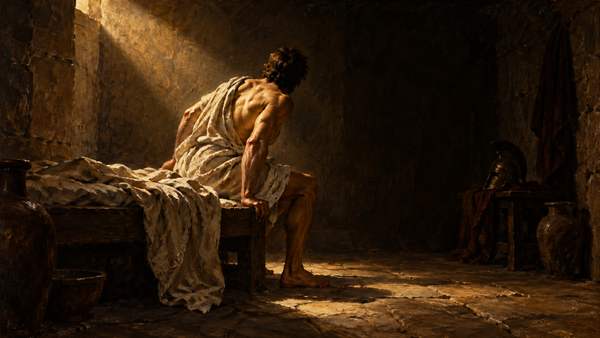
Marcus had to remind himself to get out of bed. There is something useful about finding that complaint in the private notes of a Roman emperor. The passage turns his attention towards the work of being human, including what he owes other people.
In the recording, I ask you to bring to mind something that would be worse if you did nothing today. It might be work you care about or a person who needs you. You don't have to turn it into a grand purpose. You need a reason you can use this morning.
The practice leaves room for reluctance. You can begin a manageable task while still wishing you didn't have to do it. That is a more modest thing to ask of yourself than becoming enthusiastic on command.
Picture the first action
Bring one thing you have been avoiding to mind. A conversation, perhaps, or a task that keeps moving to tomorrow. Picture yourself beginning it. Stay with that first action, rather than imagining a whole day of impressive productivity.
The blocked-road image in the recording is a modern paraphrase of Marcus's account of adapting to hindrances. It does not mean every obstacle is good for you, or that pressing on is always wise. Sometimes the sensible response is to change the task, ask for help or rest.
The closing encouragement also needs that room. I cannot know that you have faced harder mornings, or promise that this recording will change how you feel. Those lines remain in the transcript as spoken encouragement. Use the practice when it helps you choose a reasonable next action; you do not have to prove your character by overriding your limits.
For the text behind the practice, read the Marcus Aurelius Meditations summary. For a longer talk about getting started, see the three procrastination traps.
Source: Marcus Aurelius, Meditations, in George Long's translation. The waking-up passage concerns human work and social duties; it also acknowledges the need for rest. The obstacle passage concerns adapting one's response when action is hindered. The spoken wording is a paraphrase, and the guided exercise is a modern application.
Full transcript
Lightly edited for readability.
Some mornings you might have noticed you wake up and already the day feels like it's too much. Nothing has gone wrong, right? You've just woken up. But something is there. It's waiting. You can't find the part of yourself that you need to meet it. The motivation is gone. And that's what this morning practice is for.
So sit up if you can, spine tall, shoulders back. Even if inside you're not convinced, just for now I give you permission to go through the motions. Breathe in through the nose and out slowly. Again in and out.
Marcus Aurelius wrote a note to himself about this exact problem. He was emperor. He had every reason to get up, and still, at dawn, he had to argue with himself to leave the bed. His note went something like this: at dawn when you have trouble getting out of bed, tell yourself that you have to go to work as a human being.
Then he asks himself a question that does a lot of work. Were you made for this, he says, or for pleasure? Is this really what you were put here for, to lie warm under blankets?
Notice what he does not do. He does not tell himself the day will be enjoyable. He does not manufacture enthusiasm. He just reminds himself what he is for. That is the Stoic move. Motivation is a feeling and feelings come and go. Purpose is a decision, and it holds when the feeling does not.
So let's find yours. Not a grand one, but something that is true, that is real. Bring to mind something in your life that would be worse if you did nothing today. Maybe it is work you are building slowly. And today is one more brick. Maybe it is a person, someone who is easier for having you around. Maybe it is simply that you have decided what kind of person you are trying to become, and that person gets up.
Whatever came to mind, just hold it there for a second. Notice it is not exciting and it does not need to be.
Now, let's be real. Today, like most days, will have some friction in it, something you have been avoiding, maybe a conversation you would rather not have, a task that keeps sliding to tomorrow. Let one of those things come to mind now.
The blocked road forces a new road, and walking the new road is the new work. Your obstacle today is not the thing stopping the day from being good. It's the thing that today is made out of.
Picture yourself meeting it, not enjoying it, not winning easily, just walking towards it and beginning. You do not have to feel ready. Nobody does. You just have to start.
So take a breath in and let your spine lengthen a little. You've got up on harder mornings than today. I'm not trying to motivate you. It's a fact, right? If you look back at your track record, you'll know if it's true or not.
One more breath. If it helps, say this to yourself quietly. I know what I am for today. I will start before I feel ready.
Bring some movement back. Fingers, shoulders, jaw, and open your eyes when you're ready.
Nothing about today has changed, but you have. Slightly. And that's enough. Come back to this tomorrow, especially if tomorrow is another flat one. The practice works best on the mornings you least want to do it. Go well.
Go deeper
If you want structured practice, the 7-Day Stoic Challenge is free. Nine audio lessons and a 42-page workbook.