Most failures of Stoic practice are failures of timing.
You remember the Dichotomy of Control after the argument. You notice the story you were telling yourself after you have sent the message. You realise that an impression was only an impression once it has already become a judgement, an emotion and an action.
The Stoics had a name for the discipline that closes this gap: Prosochē.
Prosochē means attention. More specifically, it is the practice of paying continuous attention to your impressions, judgements and impulses while there is still time to examine them.
It is not blank-minded calm. It is not the suppression of emotion. It is not a trick for controlling everything that happens inside your head.
It is the practice of catching experience early enough to choose what happens next.
What does Prosochē mean?
The Greek word prosochē (προσοχή) means attention or vigilance. In Stoic practice, it describes a sustained readiness to notice what your mind is doing.
Pierre Hadot called it the fundamental Stoic spiritual attitude: a continuous vigilance and presence of mind. The word “spiritual” can sound mystical in modern English, but Hadot meant something practical. Ancient philosophy was not only a collection of beliefs. It was a way of training how you perceived, judged and acted.
For the Stoics, the important sequence looks like this:
- Something happens.
- An impression appears.
- You form a judgement about what it means.
- That judgement produces an impulse.
- You act.
Prosochē puts attention on this sequence, especially the movement from impression to judgement.
You do not decide whether the first impression appears. A sharp email arrives and your body tightens. Someone looks away while you are speaking and the thought “They do not respect me” appears. You remember a mistake and feel a wave of embarrassment.
The first movement is not a moral failure. The useful question is whether you immediately treat it as the whole truth.
Epictetus on attention
Book 4, chapter 12 of Epictetus’s Discourses is titled “On Attention”. Its warning is blunt: if you relax your attention, do not assume you can recover it whenever you choose.
Epictetus is not demanding perfect concentration. He is describing habit.
Every time you follow an impression without examining it, you rehearse inattention. Every time you pause long enough to test it, you rehearse attention. Neither repetition looks dramatic, but both make the next repetition easier.
This is why Prosochē is less like a single meditation session and more like keeping your hand near the controls throughout the day. Formal practice can train it, but ordinary life is where it matters.
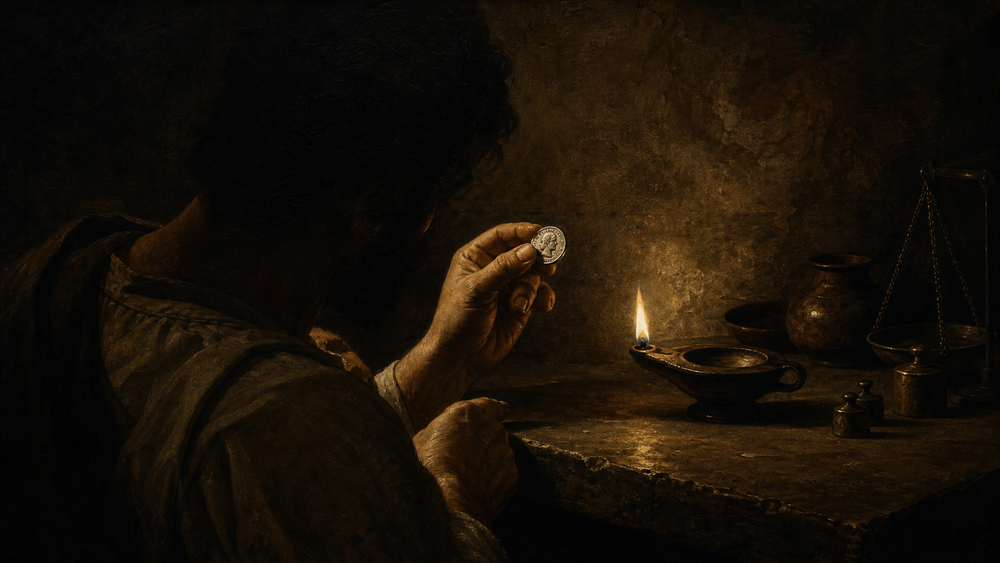
Epictetus gives us a better image in Discourses 1.20.7–10. The philosopher’s first task is to test and discriminate between impressions, just as an assayer tests a coin by sight, touch, smell and sound.
A money changer does not reject every coin. Nor does he accept every coin because it looks convincing. He learns what to inspect.
That is the work:
- What actually happened?
- What interpretation did I add?
- What value judgement is hidden inside that interpretation?
- What response is mine to choose?
There is a line sometimes attributed to Epictetus about keeping a steersman’s hand on the helm. It is not in the cited passage and should not be used as an Epictetus quotation. The coin tester is the genuine image, and it is more useful anyway.
Attention before assent
An impression can be vivid without being accurate.
Imagine that a colleague has not replied to your message.
The fact is simple: there is no reply yet.
The impression may be: “They are ignoring me.”
The judgement may become: “They do not respect me, and that is intolerable.”
The impulse may be to send a sharp follow-up, complain to someone else or spend the next hour rehearsing an argument.
Prosochē does not ask you to pretend that everything is fine. It asks you to separate the parts:
- Fact: no reply has arrived.
- Story: they are deliberately ignoring me.
- Value judgement: being ignored would be terrible or demeaning.
- Choice: wait, ask a neutral question, set a boundary or take another appropriate action.
The story may turn out to be correct. Attention is not compulsory optimism. Its purpose is to stop a plausible story from acquiring the authority of a proven fact.
This is closely related to prohairesis, your capacity to judge and choose. Prosochē is the attention that lets you notice when that capacity is being used.
Prosochē is not emotional suppression
People sometimes imagine a well-practised Stoic as someone who never has an unwanted thought or feeling.
That is emotional perfectionism dressed as philosophy.
The practical Stoic distinction is between what first appears and what you go on to endorse. You can feel the first surge of anxiety, anger or shame without treating it as a command. The aim is not to become emotionless. It is to become less obedient to every emotional interpretation.
This matters because attention can go wrong.
If you use Prosochē to patrol your mind for forbidden thoughts, you are no longer practising wise attention. You are rehearsing hypervigilance. If every emotional reaction becomes evidence that you have failed, the practice will make you more brittle rather than more free.
Good Prosochē is curious and discriminating. It notices. It tests. Then it returns to the task at hand.
Is Prosochē the same as mindfulness?
There is real overlap. Both practices can involve sustained attention, present-moment awareness and a less automatic relationship with thoughts.
But they are not interchangeable labels.
Prosochē belongs to a particular Stoic framework. You attend to impressions so you can judge them in relation to what is up to you, what is good or bad, and what kind of action fits the situation. The practice is tied to Stoic ethics, not merely to awareness itself.
You do not need to manufacture a rivalry between traditions. It is enough to say that similar attentional skills can serve different philosophical aims.
The seven-day Prosochē experiment
This is a Practice Lab experiment, not a promise that seven days will transform your character.
The question is narrow:
Can one small attention cue help you catch more judgements before you act on them?
Choose one recurring situation
Do not attempt continuous vigilance across your entire life. Pick one place where automatic judgements regularly cause trouble:
- opening email;
- reading messages from one group chat;
- entering a meeting;
- receiving criticism;
- getting stuck in traffic;
- noticing the urge to procrastinate.
Keep the situation the same for seven days.
Use the four-part coin test
When the chosen situation occurs, ask:
- What is the fact?
- What story appeared?
- What value judgement did I add?
- What response is mine to choose?
The whole rep should take between 20 and 60 seconds.
If writing helps, use four short lines. Do not turn each repetition into a journal essay. The aim is to catch the judgement while the choice is still live.
Record only two numbers
At the end of each day, record:
- Caught before: the number of times you noticed the judgement before acting on it.
- Caught after: the number of times you recognised it only after acting.
You can also mark missed day, but do not backfill imaginary data.
This is not a score of how Stoic you are. It is a crude measure of timing.
Keep the conclusion bounded
After seven days, ask:
- Did “caught before” become more common?
- Was one prompt more useful than the others?
- Did the practice change your action, or only your description of it?
- Did the logging make you more attentive or merely self-conscious?
- What else changed that week, such as sleep, workload or conflict?
A positive week does not prove that Prosochē works for everyone. A difficult week does not disprove the practice. You are looking for enough signal to decide whether this particular rep deserves another week.
Stop if attention becomes surveillance
Reduce or stop the experiment if it makes you compulsively monitor every thought, increases anxiety, or turns ordinary emotion into a constant self-assessment.
Return to the narrow cue, shorten the rep, or practise with professional support if attention itself has become distressing. Stoic training should improve your ability to respond to life. It should not make your inner life feel like a checkpoint.
The smallest useful version
If the full experiment feels cumbersome, use one sentence:
“That is an impression. What do I actually know?”
This does not solve the situation. It creates a small interval in which examination becomes possible.
That interval is the heart of Prosochē.
The Dichotomy of Control helps you decide where to put your effort. Prohairesis names the capacity through which you judge and choose. Prosochē is how you notice that a judgement is happening before the moment has passed.
For a broader menu of practices, use the Stoic exercises guide and Practice Lab. Choose the smallest rep that addresses a real problem, test it honestly, and keep only what survives contact with your life.
Frequently asked questions
How do you pronounce Prosochē?
A practical English approximation is “pro-so-KHAY”. Pronunciation varies with the Greek convention being used, so do not let it become a barrier to understanding the practice.
Did Marcus Aurelius practise Prosochē?
Marcus does not organise the Meditations as a manual under that Greek heading, but the notebooks repeatedly show the same kind of vigilance over impressions, value judgements and actions. Epictetus gives the clearest explicit treatment in Discourses 4.12.
Does Prosochē mean watching every thought?
No. Trying to monitor every mental event can become exhausting and counterproductive. Begin with one recurring situation and attend to the judgements that affect what you do.
What is the difference between Prosochē and prohairesis?
Prosochē is attention to what is happening in your mind. Prohairesis is your faculty of judgement and choice. The first helps you notice the second in use.
Sources and further reading
- Epictetus, Discourses, Book 4, chapter 12, “On Attention”, translated by George Long.
- Epictetus, Discourses, Book 1, chapter 20, translated by W. A. Oldfather, especially sections 7–10 on testing impressions as an assayer tests coins.
- Pierre Hadot, Philosophy as a Way of Life, translated by Michael Chase.