In December 2016 my dad came back from the hospital and told us there was an 80 per cent chance the tumour in his bowel was cancer.
I happened to be home for forty days before moving to Prague, and I happened to be deep in Stoic reading at the time. So I did the only useful thing I could think of. I sat with him and we sorted the situation into two piles: what was up to us, and what was not. The biopsy result was not up to us. His diet was. His sleep was. Whether he spent the next three weeks rehearsing his own funeral was, at least partly, up to him. He changed how he ate. He started meditating. The tumour turned out to be benign.
I wish I could tell you I handled the aftermath as well as he did. The months that followed gave me my own crop of death anxiety and hypochondria, including a couple of trips to A&E over nothing. The tool worked under pressure and then I dropped it the moment the pressure moved into my own body. That gap, between knowing this idea and living it, is what this article is about.
The idea itself is the first thing Epictetus teaches in the Enchiridion, and it is the closest thing Stoicism has to a foundation stone: the dichotomy of control.
It sorts everything you encounter into two piles: what is up to you (your judgements, your choices, your actions) and what is not (outcomes, other people, your reputation, your body). The whole of Stoic practice begins here, in refusing to spend a single ounce of worry on the second pile.
What Epictetus actually said
Epictetus opens the Enchiridion, his handbook for living, like this:
"Some things are within our power, while others are not. Within our power are opinion, motivation, desire, aversion, and, in a word, whatever is of our own doing; not within our power are our body, our property, reputation, office, and, in a word, whatever is not of our own doing."
Epictetus, Enchiridion 1, trans. Robin Hard
The Greek phrase behind "within our power" is eph' hēmin, "up to us". The claim is about causality, not magic. Your judgements, your impulses, your desires and aversions, your actions: these originate in you. Everything else, including your body, your reputation and every outcome you care about, is produced partly by forces that have never heard of you.
Epictetus was born a slave around 50 AD and spent his early life owned by another man. When he says your body is not fully yours, he is not being poetic. He had lived it. That biography is worth keeping in view whenever the dichotomy starts to sound like a productivity tip.
The two piles
| Within your control | Outside your control |
|---|---|
| Your judgements about events | Other people's opinions of you |
| Your impulses and responses | Your body's genetics, illness, ageing |
| Your desires and aversions | Wealth and possessions |
| Your effort and intentions | Status and reputation |
| Where you place your attention | Outcomes, results, prizes |
The right-hand column is not a list of things that don't matter. Your health matters. Your reputation matters. The Stoic claim is narrower and stranger: these things are not yours, because they can be taken from you without your consent. Anything that can be taken without your consent makes a poor foundation for your peace of mind.
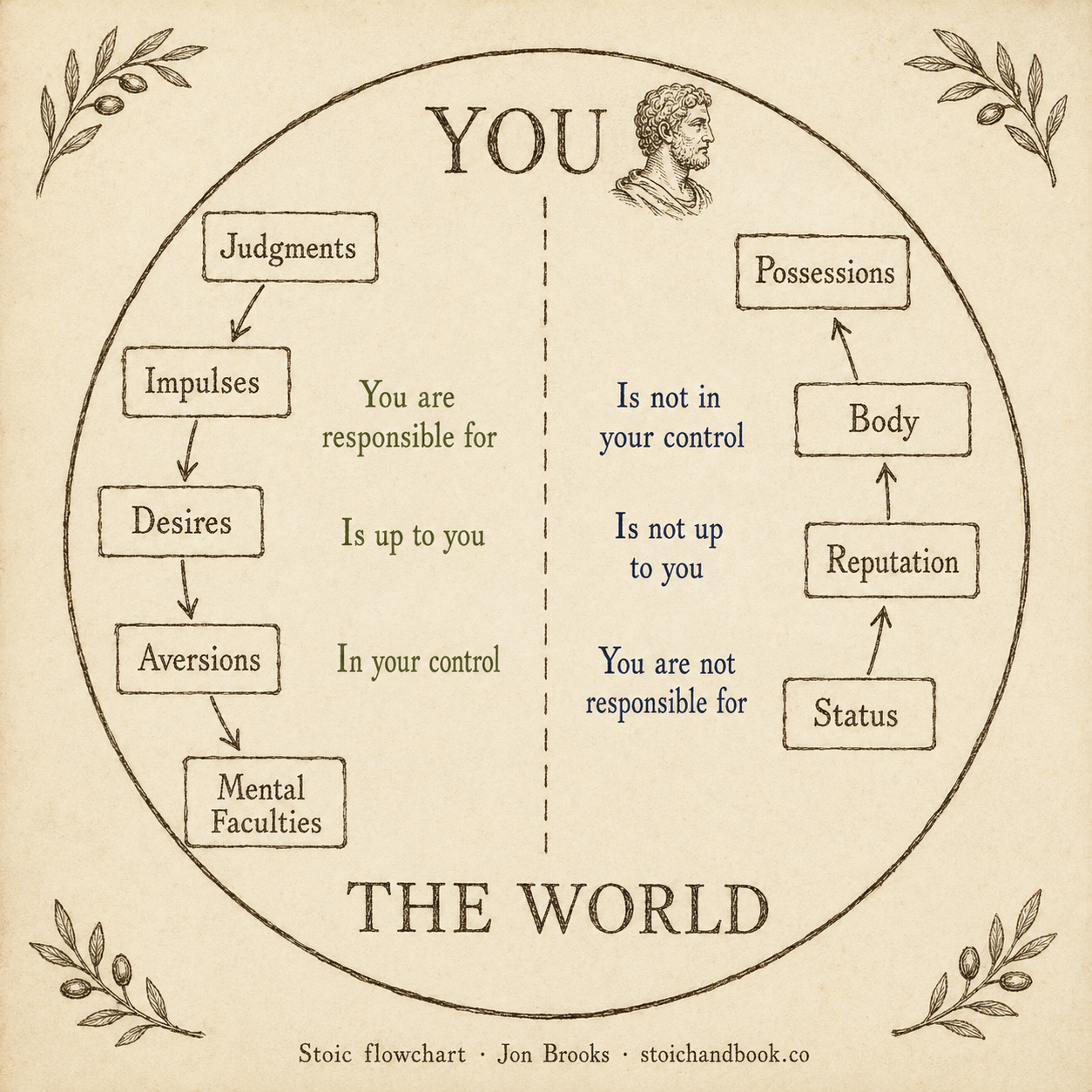
So the practice is one of repeated sorting. The criticism arrives, the diagnosis arrives, the traffic jam arrives, and each time you ask the same question: which pile?
Doesn't effort partially control outcomes? The trichotomy debate
The modern Stoic writer William B. Irvine argues the dichotomy should really be a trichotomy: things you fully control, things you can't control at all, and a middle category of things you partially control, like your health or a tennis match. You can read his case in A Guide to the Good Life.
I understand the appeal, but I think the original two-pile version is the better tool, and I think Epictetus would say the middle category is a confusion. Take the tennis match. What you call "partial control" is really two separate things glued together: your training and effort (fully yours) and the result (not yours, because your opponent, the weather and luck all get a vote). The trichotomy keeps your peace of mind shackled to outcomes while letting you feel philosophical about it. The dichotomy makes the cut cleanly: do everything in your power to win, and hold the result lightly, because it was never in your power.
Internalise the goal. "Play the best match I can" is up to you. "Win" is not. Same court, same effort, completely different relationship to the scoreboard.
The honest criticisms
It's too simplistic. Modern psychology shows our thoughts are pushed around by hormones, trauma and biases we never chose. True. But the Stoics never claimed perfect control of the inner world; they claimed it is the only place where practice pays. You cannot train the weather. You can, slowly and imperfectly, train your responses. Twenty minutes on the mats at my BJJ gym makes the same point: you do not control what your opponent does, and yet training changes what you do next. Nobody calls that simplistic.
It promotes passivity. If you accept what you can't control, why try to change anything? But look at where the dichotomy actually directs your energy: towards action, specifically the action that is yours to take. You cannot control a corrupt system; you can control whether you organise, vote, write and show up. What you drop is not the work. What you drop is the inner demand that the universe guarantee results.
It's just CBT in a toga. Almost the reverse. Cognitive behavioural therapy descends directly from this idea; Albert Ellis and Aaron Beck both acknowledged the Stoic lineage. When CBT teaches you that your interpretation of an event, not the event, drives the emotion, that is Enchiridion 5 with a clinical licence.
It ignores that we need each other. Marcus Aurelius, the most socially burdened Stoic who ever lived, wrote that we were born to work together. The dichotomy is not a hermit's tool. It is what lets you show up for other people without needing them to behave.
How to practise it
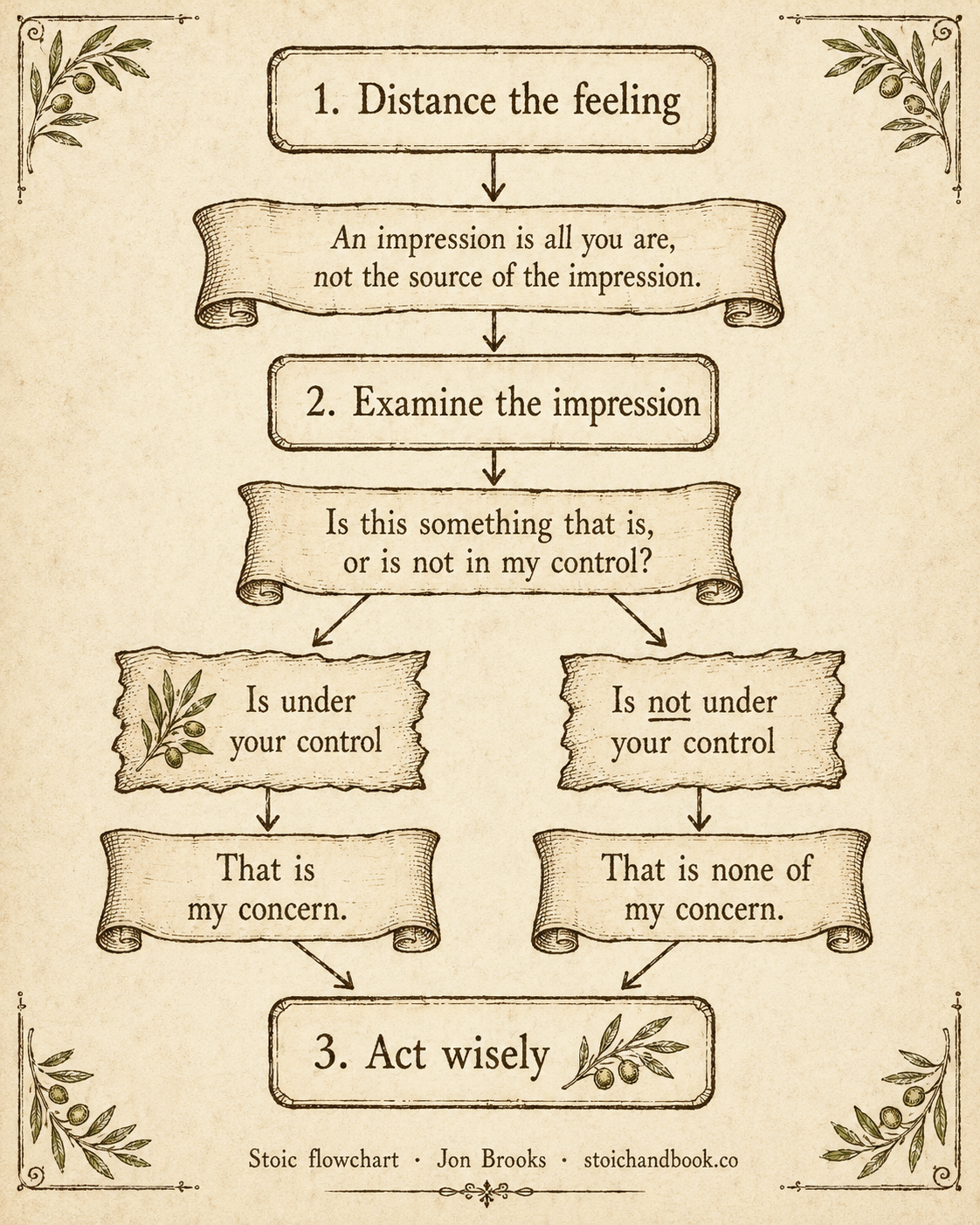
Three steps. They take seconds once they're drilled, but they have to be drilled.
Step 1: separate the event from your impression of it. Stuck in traffic, the stress you feel is not coming from the cars. It is coming from your judgement about the cars. Epictetus's instruction is to say to the impression: "you are an impression, and not at all the thing you appear to be."
Step 2: ask the sorting question. Is this, or any part of this, up to me? Be strict. The interview preparation is yours. The interviewer's decision is not. The conversation with your partner is yours. Their feelings are not.
Step 3: act on your pile, release the other one. For whatever landed in your pile, act, properly and promptly. For everything else, Epictetus gives the exact phrase to be ready with: "Then it's none of my concern." Said inwardly, it is less callous and more liberating than it reads.
A concrete week of this looks unglamorous. Work stress: pour yourself into the tasks, drop the deadline anxiety it was never your job to carry. An argument: choose your words carefully, let go of scripting their reply. Health: train and eat like it matters, because it does, while accepting that bodies follow their own laws. The practice is not feeling nothing. The practice is putting your full weight only where you actually have footing.
Reading about Stoicism is the easy part.
The free 7-Day Stoic Challenge gives you one short audio lesson and one exercise a day for a week. By day seven you'll have trained more than most people who have only read about it.
Start the challengeCommon questions
What is the dichotomy of control?
A Stoic principle from Epictetus dividing everything into what is up to us (judgements, desires, actions) and what is not (events, outcomes, other people). Peace of mind comes from investing only in the first category.
Is the dichotomy of control the same as the Serenity Prayer?
They rhyme. "Grant me the serenity to accept the things I cannot change, courage to change the things I can" is the same sorting move. Epictetus got there seventeen centuries earlier and added a training method.
How do I apply it when something is genuinely awful?
The dichotomy does not ask you to call awful things fine. It asks you, inside the awful thing, to find the part that is still yours: your next action, your attention, what you say to the people around you. Everything in my dad's diagnosis stayed serious. The sorting just told us where to spend the energy.
What are the best Epictetus quotes on this?
"Make the best use of what is in your power, and take the rest as it happens." And the closing instruction of Enchiridion 1: "If it's not one of the things that you control, be ready with the reaction, 'Then it's none of my concern.'"
Watch the practice in action
The dichotomy of control is one of those ideas that lands differently when you see someone walk through it rather than read about it. I made a video this week breaking down the three mistakes most people make with this concept, plus the three skills you can actually train: sorting, releasing, and responding.
If the article has given you the framework, the video gives you the practice. I share the exact exercises I use myself: the two shelves, the set-it-down practice, and the question I ask when I notice I'm holding on too tight.
If you want to go further still, I've put together a free 10-day training on the dichotomy of control inside The Stoic Vault. It's the same material I use with my coaching clients. Short daily practices, one skill at a time, designed to actually move the needle rather than give you more theory.
The 10-Day Dichotomy of Control Course
The Stoics weren't promising freedom from difficulty. They were promising freedom inside difficulty. But it will give you something to practise, which is more than another reading of the Enchiridion will.
Going deeper
The primary texts are free: Epictetus's Enchiridion and Discourses and Marcus Aurelius's Meditations at Project Gutenberg, Seneca's letters at The Internet Classics Archive. For the scholarly view, the Stanford Encyclopedia of Philosophy entry on Stoicism is the place to start. On this site, the next chapter in the series is Desire and Aversion, and if you want goals built on the right side of the dichotomy, see Epictetus's three tests.
Enchiridion Chapter One, Epictetus, Translation by Robert Dobbin:
[1] We are responsible for some things, while there are others for which we cannot be held responsible. The former include our judgement, our impulse, our desire, aversion and our mental faculties in general; the latter include the body, material possessions, our reputation, status – in a word, anything not in our power to control.
[2] The former are naturally free, unconstrained and unimpeded, while the latter are frail, inferior, subject to restraint – and none of our affair.
[3] Remember that if you mistake what is naturally inferior for what is sovereign and free, and what is not your business for your own, you’ll meet with disappointment, grief and worry and be at odds with God and man. But if you have the right idea about what really belongs to you and what does not, you will never be subject to force or hindrance, you will never blame or criticize anyone, and everything you do will be done willingly. You won’t have a single rival, no one to hurt you, because you will be proof against harm of any kind.
[4] With rewards this substantial, be aware that a casual effort is not sufficient. Other ambitions will have to be sacrificed, altogether or at least for now. If you want these rewards at the same time that you are striving for power and riches, chances are you will not get to be rich and powerful while you aim for the other goal; and the rewards of freedom and happiness will elude you altogether.”
[5] So make a practice at once of saying to every strong impression: ‘An impression is all you are, not the source of the impression.’ Then test and assess it with your criteria, but one primarily: ask, ‘Is this something that is, or is not, in my control?’ And if it’s not one of the things that you control, be ready with the reaction, ‘Then it’s none of my concern.’