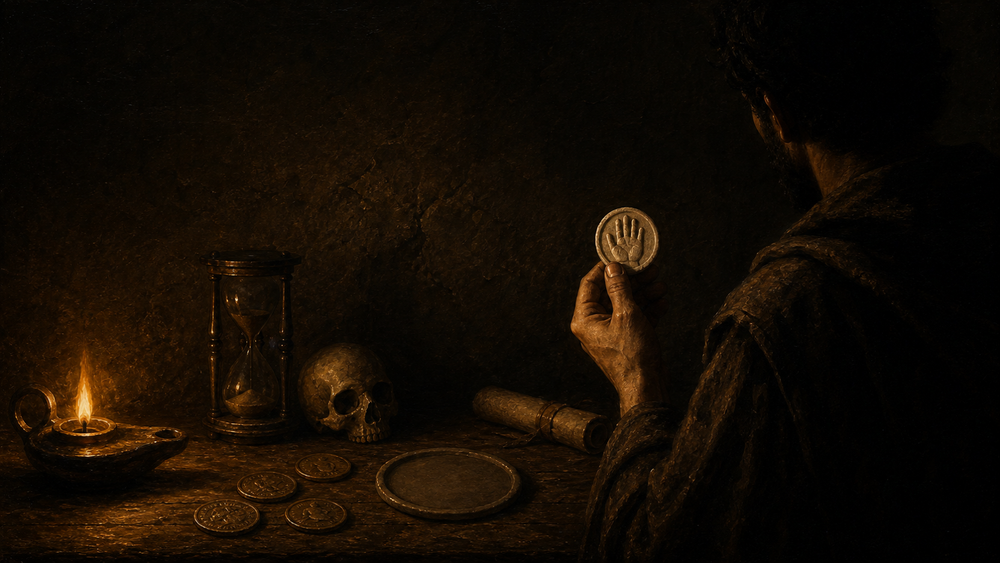
The surviving ancient sources do not give Stoicism an official crest, flag or single emblem.
That leaves us with a more useful question. Which images and phrases have a real connection to Stoic ideas, and which are modern decorations wearing a Roman costume?
The main symbols associated with Stoicism are amor fati, memento mori, the four virtues, the logos, sympatheia and Zeno's hand. None is an authorised badge of the school. Each can still work as a reminder, provided you know what it points to.
Amor fati: love of fate
Amor fati means "love of fate". It has become one of the most recognisable phrases in modern Stoicism, but the Latin expression is Nietzschean rather than ancient Stoic.
Nietzsche uses it explicitly in Ecce Homo, calling amor fati his formula for wanting nothing in life to be different. The closest ancient Stoic instruction is Epictetus, Enchiridion 8: stop demanding that events happen as you wish, and train yourself to wish that they happen as they do.
Those ideas overlap, but the traditions are not identical. Nietzsche was not quietly translating Epictetus into Latin. Treat the phrase as a modern label for a recognisably Stoic practice, not as a quotation from Marcus Aurelius.
Read the fuller guide to amor fati and what it actually means.
Memento mori: remember you must die
Memento mori means "remember you must die". It is often represented by a skull, hourglass or wilting flower.
The value lies in the practice rather than the object. Marcus Aurelius turns mortality into an immediate test in Meditations 2.11: because you may leave life at any moment, regulate your actions and thoughts accordingly.
A skull on a desk cannot do that work for you. Used properly, the reminder interrupts delay, petty resentment and the assumption that there will always be another chance. It asks whether the thing in front of you deserves a piece of a finite life.
Read more in the guide to memento mori.
The four cardinal virtues
Wisdom, justice, courage and temperance are sometimes represented by four columns, four words or four small marks.
There is a solid ancient source beneath that modern imagery. Diogenes Laertius 7.92–93 lists prudence, courage, justice and temperance as the primary virtues. The remaining virtues sit beneath them as subordinate forms.
The Stoics did not use the four as a personality quiz. They treated virtue as knowledge about how to live. Wisdom discerns what is good, bad or indifferent. Justice applies good judgement to what should be chosen and avoided in our dealings with others. Courage and temperance keep judgement intact under fear, pleasure and pressure.
The four Stoic virtues guide explains how to train them without turning them into four boxes to tick.
The logos: the order of the whole
The logos is an idea rather than an emblem. Modern designs sometimes represent it with fire, a circle or a connected pattern.
For the early Stoics, logos was the rational active principle running through the cosmos. Diogenes Laertius describes right reason as pervading everything and identifies it with Zeus, the ordering power of the whole. Living according to nature meant bringing human judgement and action into agreement with that larger order.
No mystical promise follows from this. You are a small rational part of a world that is not organised around your preferences.
Sympatheia: interconnection
Sympatheia refers to the connection between the parts of the cosmos. A web, linked circles or clasped hands sometimes represent it.
Marcus gives the clearest image in Meditations 6.38, where he asks himself to consider how things in the universe are connected and related. In Meditations 2.1, he brings the idea into human life: we are made for cooperation, like feet, hands and eyelids.
The practical consequence is ordinary. Your choices enter a shared world. Justice is not an optional extra added to private calm.
Zeno's hand: a map of knowledge
Zeno's hand is not a logo. It is one of the clearest surviving teaching images from the early Stoic school.
Cicero, Academica 2.145 reports the sequence:
- An open hand represents an impression.
- Fingers beginning to close represent assent.
- A clenched fist represents comprehension, or katalepsis.
- The other hand gripping that fist represents knowledge secure enough to belong to the sage.
This is a better emblem for Stoicism than most of the Roman warrior imagery attached to it online. The philosophy begins with what appears to you, then asks whether your judgement has earned the right to close around it.
So which is the real Stoic symbol?
There is no single real one.
Choose a reminder that sends you back to a practice. An hourglass can ask how you are spending today. Four marks can ask which virtue this situation demands. An open hand can remind you not to clutch the first impression that arrives.
If the object becomes a costume, it has failed. The symbol matters only when it helps close the gap between knowing and doing.
Try giving one symbol one job for seven days. Put an hourglass beside your phone and use it to interrupt one bout of pointless scrolling. Draw an open hand at the top of your notebook and use it to question the first angry judgement that arrives. At the end of the week, ask whether the reminder changed a choice. If it did not, put it away.
For a broader starting point, read the beginner's guide to Stoicism. If you want to begin practising, the free 7-Day Stoic Challenge gives you one short lesson and one exercise a day.
Frequently asked questions
Does Stoicism have an official symbol?
No surviving ancient source used here names an official Stoic crest, flag or single emblem. The phrases and images now associated with Stoicism work as reminders of particular teachings, not as authorised insignia.
What is the most common Stoic symbol?
In modern use, memento mori and amor fati are among the most recognisable. Skulls, hourglasses and four-part virtue designs are also common. Popularity does not make any of them official.
Is amor fati actually Stoic?
The phrase is Nietzschean. The practice has close Stoic parallels, especially Epictetus's instruction in Enchiridion 8 to wish events to happen as they do. Label it as modern terminology rather than an ancient Stoic quotation.
What does memento mori mean?
It means "remember you must die". For Stoic practice, mortality is a way to clarify priorities and act well now, not an invitation to brood over death.
Sources checked
- Epictetus, Enchiridion 8.
- Marcus Aurelius, Meditations 2.1, 2.11 and 6.38, translated by George Long.
- Diogenes Laertius, Lives of the Eminent Philosophers 7.88 and 7.92–93.
- Cicero, Academica 2.145.
- Nietzsche, Ecce Homo.