People come to Stoicism for the quotes and stay for the virtues. The quotes are the shop window. The four Stoic virtues, wisdom, courage, justice and temperance, are the machinery behind it, and the Stoics made a claim about them that still sounds radical two thousand years on: these four are the only things in life that are genuinely good. Not health. Not money. Not reputation. Just these.
That claim takes some chewing. This guide works through each virtue in turn: what it meant to the Stoics, what it looks like on an ordinary Tuesday, and how to start practising it without overhauling your life.
Listen to the podcast version
Reading about Stoicism is the easy part.
The free 7-Day Stoic Challenge gives you one short audio lesson and one exercise a day for a week. By day seven you'll have trained more than most people who have only read about it.
Start the challengeWhat is Stoicism?
A quick orientation if you are new here. Stoicism began in Athens around 300 BCE with Zeno of Citium, who taught from a painted porch, the stoa that gave the school its name. The core move of the philosophy: you cannot control most of what happens to you, but you can always control your judgement and your response. Marcus Aurelius ran the Roman Empire on this idea. Epictetus, born a slave, taught it to Rome's elite. Their books are still the best starting points, and both are free: the Meditations at Project Gutenberg and the Discourses at the Internet Classics Archive.
One correction worth making early. Stoicism is not about suppressing emotion, whatever the lowercase word "stoic" has come to mean. The Stoics wanted you to feel fewer of the destructive passions, not less of everything.
And the compass they used for every decision was virtue.
What are the 4 Stoic virtues?
The four Stoic virtues are wisdom, courage, justice, and temperance. Wisdom is seeing clearly what matters and what doesn't. Courage is acting on it despite fear. Justice is treating others fairly. Temperance is doing all of it in the right measure. The Stoics saw these four as the only true good, and everything else as merely preferred.
They are called cardinal virtues, from the Latin cardo, a hinge. Everything turns on them. Here is the summary table, and the rest of the article unpacks each row.
| Virtue | What it means | Key idea |
|---|---|---|
| Wisdom | Seeing reality clearly, focusing on what you control | Knowing what matters and making sound decisions |
| Courage | Acting rightly despite fear or adversity | Standing firm in tough situations |
| Justice | Treating others fairly and contributing to the common good | Acting with kindness and fairness to all |
| Temperance | Self-control and moderation in desires | Finding balance, avoiding excess |
1. Wisdom
The Greek word is phronesis, usually translated as practical wisdom. Not cleverness. Not knowledge for its own sake. Wisdom in the Stoic sense is the ability to sort: this is good (virtue), this is bad (vice), and this enormous third pile, wealth, fame, health, the opinion of strangers, is neither. The Stoics called that third pile the indifferents, and most human misery comes from filing things in the wrong pile.
Epictetus put the job description plainly:
"The chief task in life is simply this: to identify and separate matters so that I can say clearly to myself which are externals not under my control."
That sorting is the whole discipline. When a work deadline is bearing down on you, the deadline itself sits in the pile you don't control. Your effort, your attention, and whether you panic sit in the pile you do. Wisdom is noticing the difference before you react, not afterwards in the post-mortem.
A few ways to train it. Pause before reacting and ask one question: what here is actually mine to control? Review your decisions at night, briefly, without ceremony. And keep reading. Wisdom is not a level you reach. Marcus Aurelius, who had more practice than most, kept reminding himself of the basics until the end:
"If you are distressed by anything external, the pain is not due to the thing itself, but to your estimate of it; and this you have the power to revoke at any moment." (Meditations 8.47)
2. Courage
Andreia in Greek. The Stoics meant something wider than battlefield bravery: the strength to act on your principles while fear is shouting at you to do otherwise. Loss, failure, criticism, the risk of looking stupid. Courage is what keeps your behaviour aligned with your values when any of those show up.
Marcus, who spent years on a freezing frontier he never wanted to be on, was blunt about it:
"If it's endurable, then endure it. Stop complaining."
The training method the Stoics would recognise is graded exposure, though they didn't call it that. Afraid of public speaking? Speak up once in a small meeting. Afraid of a hard conversation? Have a smaller version of it first. You build courage the way you build any capacity, in increments, and each increment counts. As Epictetus said, "It's not the things that happen to us that upset us, but our interpretation of them." Courage is partly the willingness to test that interpretation against reality.
There is more on the classical background in this overview of the cardinal virtues.
3. Justice
Dikaiosyne. Marcus Aurelius called justice "the source of all the other virtues", which is a striking thing for an emperor to write in a private notebook. He did not mean courtroom justice. He meant the daily practice of treating other people fairly and contributing to the common good, because we are all bound together. The Stoics had a word for that interconnection, sympatheia:
"What injures the hive injures the bee."
In practice, justice is the least glamorous virtue and the most frequent. A coworker is struggling and you help rather than look away. You deal fairly when you could quietly take advantage. You listen to someone without preparing your reply. Marcus again: "Do what is just, with a kind heart." The kindness is not decoration. Justice done coldly, to feel superior, fails the test. The same pairing matters in Stoic parenting: resilience without kindness is not virtue.
There is a good piece on sympatheia at Modern Stoicism.
4. Temperance
Sophrosyne: self-control, moderation, knowing where enough is. Without it, the other three virtues don't get a say, because your impulses are driving. Anger, greed, the fourth episode at midnight when you meant to watch one.
Seneca, who was personally very rich and knew exactly how the trap worked, set the limit like this:
"You ask what is the proper limit to a person's wealth? First, having what is essential, and second, having what is enough."
Temperance is the one virtue where modern life has made the training harder, not easier. Every app, snack and feed is engineered against it. Which is also why it pays the fastest. Set a limit before you start (one episode, twenty minutes of social media, one helping) and treat keeping the limit as the win, separate from whatever the activity was. The Collector has a useful survey of all four cardinal virtues if you want the scholarly view.
Practising the four virtues daily
| Virtue | Daily practice |
|---|---|
| Wisdom | Pause before reacting; ask, "What can I control?" Reflect on decisions nightly |
| Courage | Do one thing that scares you, like speaking up or trying something new |
| Justice | Treat others fairly; do a small act of kindness, like helping a neighbour |
| Temperance | Set limits on habits (e.g. 20 minutes of social media); manage emotional reactions |
If you want to turn this table into something you actually do rather than nod at:
- Pick one virtue each morning. Not all four. Ask how you can act with that one virtue today, and where it is likely to get tested.
- Journal at night. Two or three sentences on how it went. Marcus's Meditations is exactly this, an emperor marking his own homework.
- Start small. Pausing before one decision is practice. Skipping one dessert is practice. The Stoics measured progress in repetitions, not breakthroughs.
The unity of the virtues
One idea that separates the Stoics from a generic list of nice qualities: the four Stoic virtues are not separate skills. You cannot fully have one without the others. Acting justly requires the wisdom to know what is fair, the courage to stand by it, and the temperance not to overdo it. They are one competence, virtue, viewed from four angles. Philosophy Break has a longer treatment of this idea.
Stoic virtues tattoo ideas
A lot of readers land here searching for Stoic virtues tattoo ideas, and I understand the impulse: a permanent reminder, on your own skin, of the standard you are trying to hold. If you are considering one, these are the symbols with genuine classical roots, virtue by virtue.
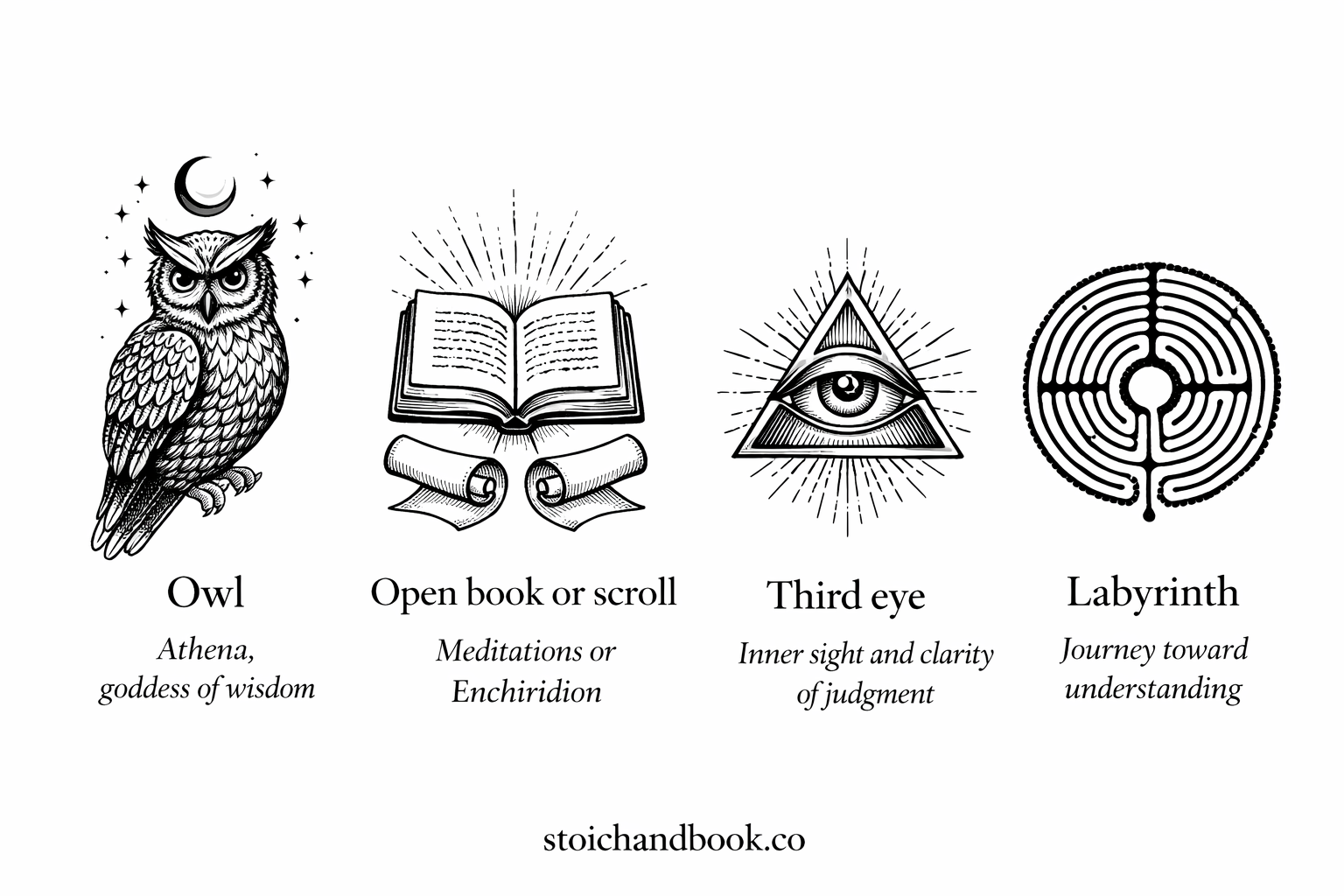
Wisdom tattoo symbols
- Owl: associated with Athena, goddess of wisdom
- Open book or scroll: the Meditations or Enchiridion
- Third eye: inner sight and clarity of judgement
- Labyrinth: the slow route to understanding
Courage tattoo symbols
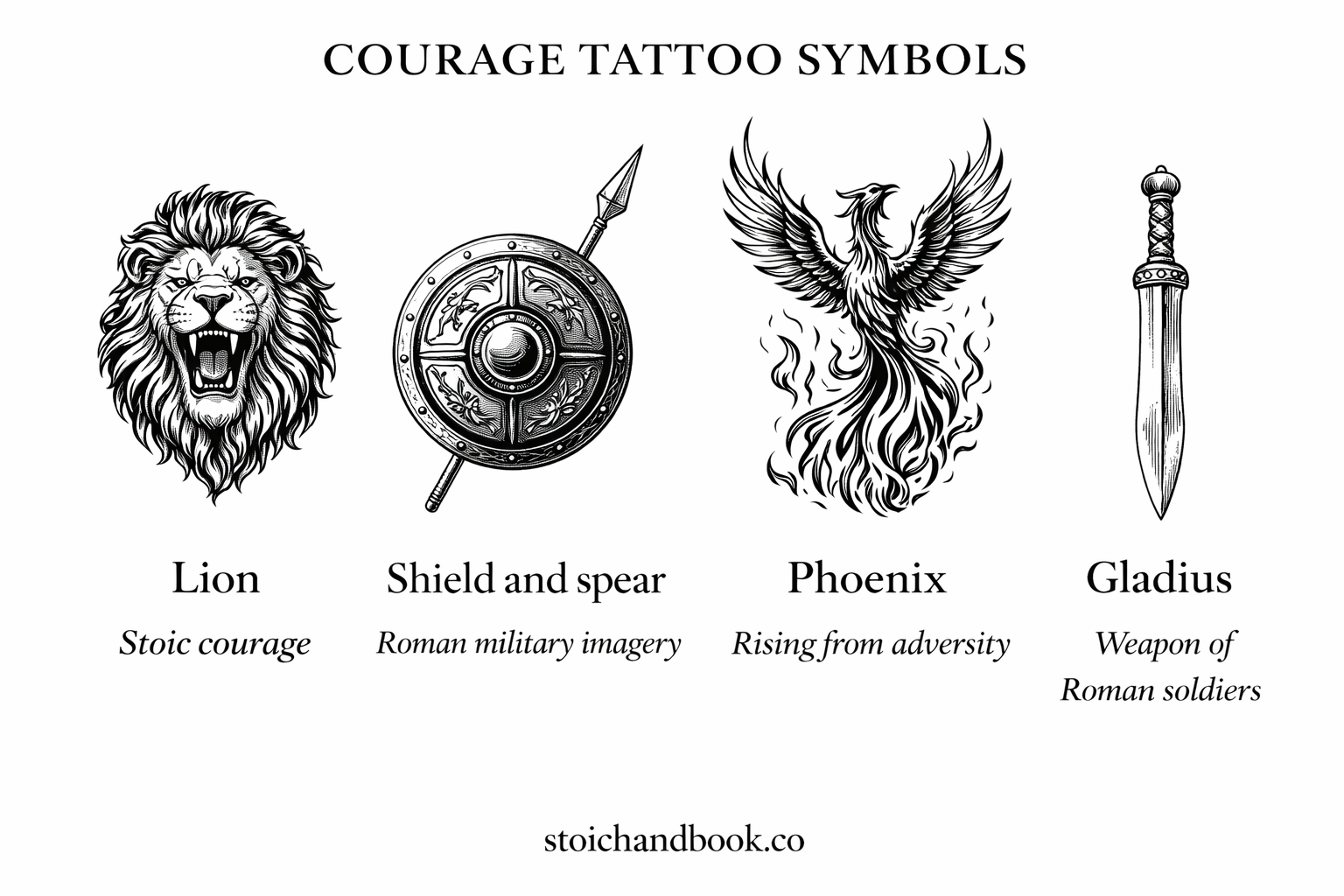
- Lion: the most popular choice for Stoic courage tattoos
- Shield and spear: Roman military imagery
- Phoenix: rising from adversity
- Gladius: the Roman soldier's sword
Justice tattoo symbols
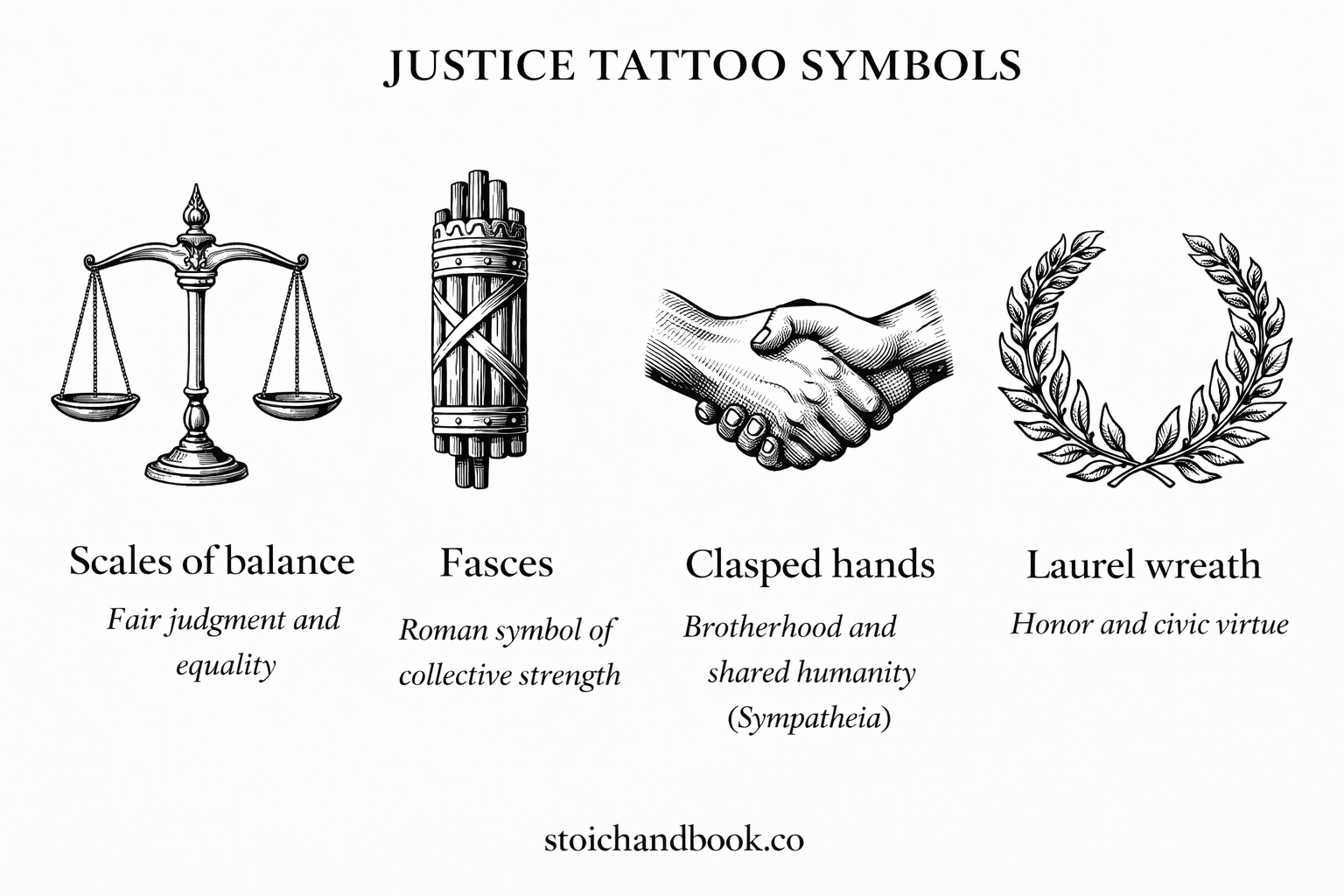
- Scales of balance: fair judgement and equality
- Fasces: Roman symbol of collective strength (without the axe)
- Clasped hands: shared humanity, sympatheia
- Laurel wreath: honour and civic virtue
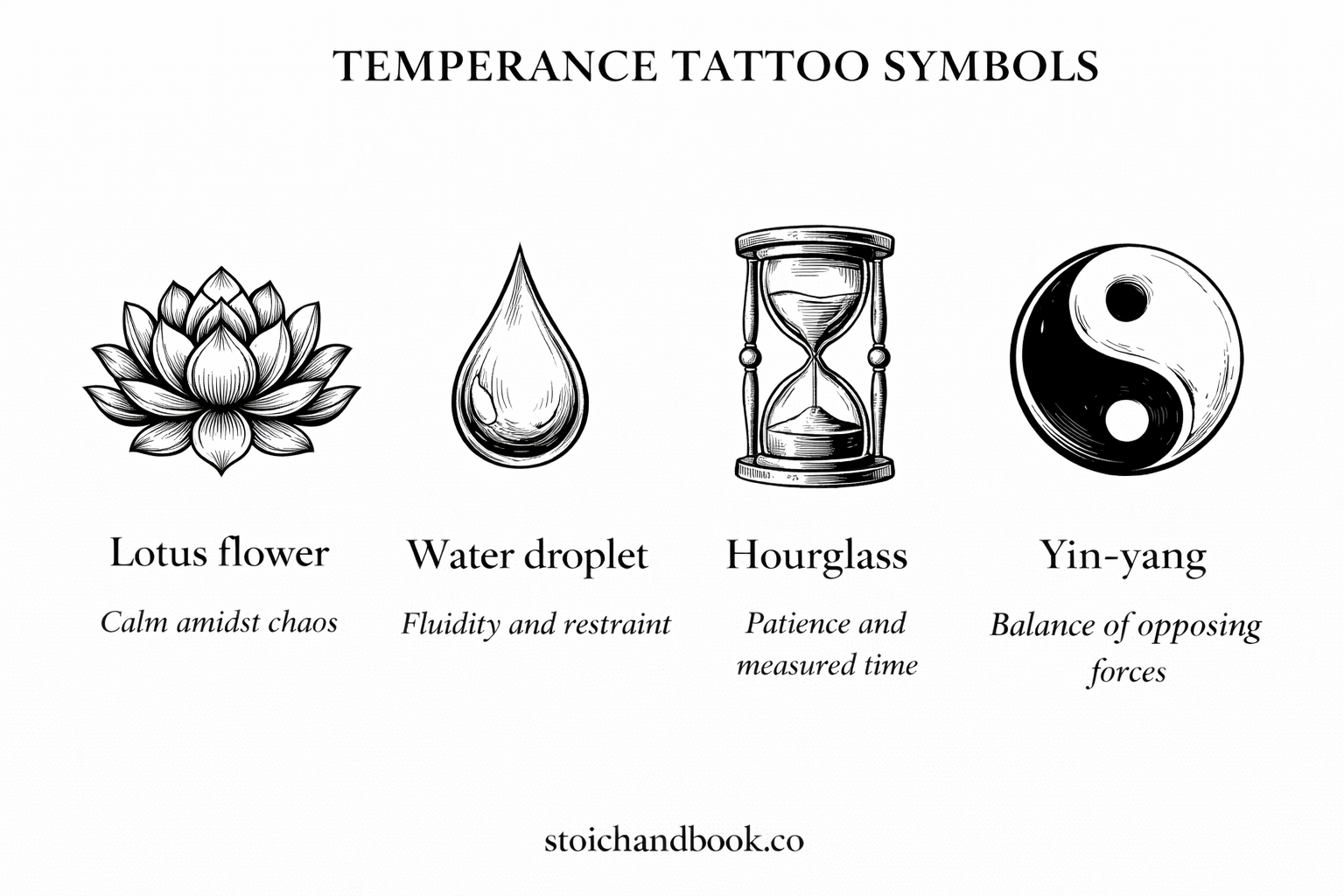
Temperance tattoo symbols
- Lotus flower: calm amidst chaos
- Water droplet: fluidity and restraint
- Hourglass: patience and measured time
- Yin-yang: balance of opposing forces
Marcus Aurelius tattoo quotes
Many people pair a virtue symbol with a line from Marcus himself:
| Quote | Translation/context | Best paired with |
|---|---|---|
| "Memento Mori" | "Remember you will die" | Skull, hourglass |
| "Amor Fati" | "Love of fate" | Phoenix, sun |
| "Waste no more time arguing what a good man should be. Be one." | Meditations 10.16 | Lion, Roman numerals |
| "The impediment to action advances action" | Meditations 5.20 | Obstacle/mountain |
Latin virtue names (Prudentia, Fortitudo, Iustitia, Temperantia) and the Roman numeral IV are the other common elements, and minimalist line work suits the Stoic aesthetic better than anything ornate. One genuinely Stoic piece of advice before you commit: wear a temporary version for thirty days first. The Stoics believed in testing attachments before binding yourself to them. A design that still means something after a month of daily exposure is one worth keeping.
A short guide to Stoic symbols
For the source-checked picture beyond the tattoos, read our guide to Stoic symbols and their meanings.
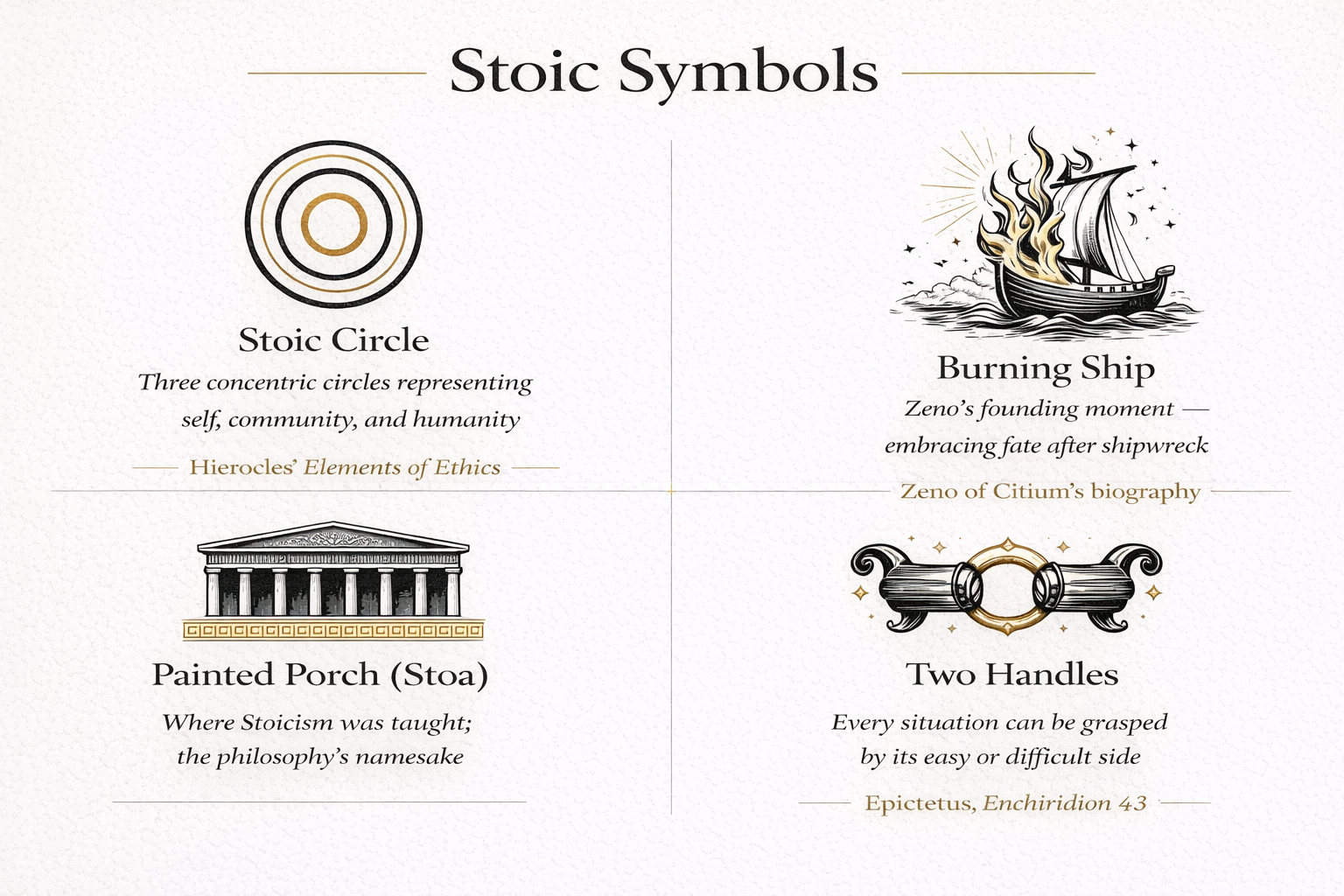
Beyond tattoos, a few symbols carry real weight in the tradition:
| Symbol | Meaning | Origin |
|---|---|---|
| Stoic Circle | Three concentric circles representing self, community, and humanity | Hierocles' Elements of Ethics |
| Burning Ship | Zeno's founding moment, embracing fate after shipwreck | Zeno of Citium's biography |
| Painted Porch (Stoa) | Where Stoicism was taught; the philosophy's namesake | Athens, ~300 BCE |
| Two Handles | Every situation can be grasped by its easy or difficult side | Epictetus, Enchiridion 43 |
The dichotomy of control gets drawn two ways: a dot inside a circle (the dot is what is up to you, the circle is everything that isn't), or the plain two-column list, In My Control and Not In My Control. The two-column version is less elegant and more useful.
Common Questions About the 4 Stoic Virtues
What Are the 4 Stoic Virtues?
The 4 Stoic virtues are wisdom, courage, justice, and temperance. They're the core principles of Stoicism, guiding us toward a virtuous and fulfilling life.
What Are the Four Stoic Virtues in Latin?
In Latin, often tied to Stoic texts, they're referred to as:
- Wisdom: Prudentia
- Courage: Fortitudo
- Justice: Iustitia
- Temperance: Temperantia
How Do They Fit into Stoicism's Bigger Picture?
Stoicism aims for eudaimonia, a flourishing life. The virtues are the means to that end, helping us align with nature and reason. Learn more about eudaimonia at Stanford Encyclopedia of Philosophy.
What symbols represent Stoicism?
Common Stoic symbols include the owl (wisdom), lion (courage), scales (justice), and lotus (temperance). The Stoic Circle, three concentric rings representing self, community, and humanity, is another powerful symbol. Many Stoics also use the two-column dichotomy of control as a visual reminder.
What is a good Stoic tattoo?
Good Stoic tattoos typically feature: Latin virtue words (Prudentia, Fortitudo, Iustitia, Temperantia), quotes from Marcus Aurelius or Epictetus, the Roman numeral IV representing the four virtues, or symbolic images like lions, owls, and scales. The best Stoic tattoo is one that serves as a genuine daily reminder of the principles you're trying to embody.
What are the 4 pillars of Stoicism?
The 4 pillars of Stoicism are the four cardinal virtues: Wisdom (understanding what's truly good), Courage (acting rightly despite fear), Justice (treating others fairly), and Temperance (exercising self-control). These virtues form the foundation of Stoic ethics and guide all decision-making.
What did Marcus Aurelius say about virtue?
Marcus Aurelius wrote extensively about virtue in his Meditations. His most famous statement is: "Waste no more time arguing what a good man should be. Be one." He also wrote that justice is "the source of all the other virtues."
Final thoughts
You will not master all four virtues. Nobody does. The Stoics themselves admitted the perfect sage was about as common as the phoenix. The work is smaller and more honest than that: pick the virtue you fail at most often, give it one test a day, and write down how it went.
Temperance, for the record, is the one I fail at most. A decade of practice and I still lose my temper at home more often than I would like. The virtues are a training programme, not a trophy cabinet, and I am still in training.
Marcus said it best, so let him close: "Waste no more time arguing what a good man should be. Be one."