
Stoicism Decoded: Essential Stoic Terms Explained for Modern Life
You've heard the quotes. You know Marcus Aurelius advised treating obstacles as fuel.
You've seen "some things are up to us, others are not" emblazoned on motivational Instagram posts. But when you crack open the Meditations or Epictetus's Enchiridion, you hit a wall of Greek terms that sound more like a philosophy exam than a practical guide to living well.
Arete. Apatheia. Prohairesis. Logos.
What the hell do these actually mean? And more importantly—how do they help you handle your anxiety, build resilience, or make better decisions today?
Here's the truth: Stoicism isn't complicated. The terminology makes it seem that way. Peel back the academic jargon, and you'll uncover a toolkit sharper than most self-help hacks—prefiguring CBT by two millennia and offering strategies more powerful than any fleeting trend.
When I work with coaching clients dealing with anxiety, the breakthrough almost always comes when they grasp the difference between phantasia (first impressions) and assent.
One client described it as “realizing I don’t have to believe the first thought my brain throws at me.” That single shift reduced his panic attacks more than any breathing technique.
This guide explains the most important Stoic philosophy terms—clearly, practically, and without academic fluff.
I want you to actually practice this philosophy rather than just admire it from afar.
Think of it as your Rosetta Stone for ancient wisdom—because understanding these core terms transforms Stoicism from interesting reading into life-changing practice.
Quick Guide: Core Stoic Terms Explained
- Eudaimonia – Flourishing, not pleasure
- Arete – Excellence of character
- Prohairesis – Your capacity to choose
- Phantasia – First impressions
- Sunkatathesis – Assent or agreement
- Apatheia – Tranquility, not apathy
- Logos – Rational order of nature
The Aim: What Stoicism Is Actually About
Flourishing (Eudaimonia)
Let's start with the end goal. Stoics aren't trying to become emotionless robots or achieve some zen-like detachment from reality. They're pursuing eudaimonia—a Greek word often translated as "happiness" but better understood as flourishing or living well.
This isn't the fleeting pleasure of a good meal or the dopamine hit of social media validation. It's the deep, sustainable well-being that comes from developing excellent character and living in harmony with your nature as a rational, social being.
Picture a plant thriving in ideal soil, water, and sun—realizing its full potential. That's you, cultivating wisdom, courage, justice, and temperance to realize yours.
Excellence of Character (Arete)
Only virtue is truly good. Everything else—health, wealth, status—is merely a "condition" that doesn't define your worth. A broke but honest person is more successful than a rich but corrupt one.
The engine of flourishing is arete—moral excellence or being the best version of yourself. Originally, arete just meant the excellence of anything: a sharp knife has arete, a fast horse has arete. For humans, it means excellence of character—the stable skill at choosing and doing what's right.
Here's the radical Stoic claim: arete is the only thing that's truly good. Health, wealth, reputation? Those are merely conditions—helpful or unhelpful externals that make virtue easier or harder to practice, but they don't determine your worth.
You can be broke but honest (living with arete), or rich but corrupt (lacking it). The Stoics insist that only the broke-but-honest person is genuinely successful in the ways that matter.
In today's terms: Ditch the external scorecard. Gauge success by your inner growth—wiser choices, braver stands, fairer actions, disciplined habits—all yours to build.
The Stoic Mind: How Your Psychology Actually Works
Impression → Assent → Experience
First-Takes (Phantasia)
Every moment, your mind generates impressions—first-takes on reality. Someone cuts you off in traffic: first-take is "That jerk disrespected me!" You see your bank balance: first-take is "I'm failing at life."
These phantasiai? Automatic gut reactions, tinted by fear, habit, or unchecked desire—not gospel truth.
That driver might be rushing to the hospital. Your bank balance is just a number, not a verdict on your worth. The impression is just your mind's first interpretation, often wildly inaccurate.
Chosen-Takes (Sunkatathesis)
Between impression and assent lies your freedom. That pause is where you reclaim control over your emotional life.
Here's where your power lives: assent (sunkatathesis). After an impression appears, you can agree with it or reject it. You can say "yes, that's true" or "no, that's just my anxiety talking."
That pause between impression and assent? It's everything—the space Frankl called our power to choose our response.
Epictetus insisted we should challenge impressions like a guard checking IDs: "Stop. Let me see what you are and where you come from." Does this thought serve me? Is it accurate? Am I assenting to something that will make me miserable for no good reason?
This is identical to cognitive-behavioral therapy's core insight: our thoughts about events, not the events themselves, create our emotional reactions. Change the thought (withhold assent from the false one, give it to a truer one), and you change your experience.
Core Agency (Prohairesis)
Your prohairesis is your capacity to choose—your moral will, your inner steering wheel. It's what the Stoics considered your true self: not your body, not your circumstances, but your ability to direct your judgments and intentions.
Here's why this matters: Your prohairesis is unimpeded. Nobody can force you to believe something, value something, or choose something against your will. A tyrant can imprison your body, but your prohairesis remains free.
Viktor Frankl, Nelson Mandela, Malala Yousafzai, James Stockdale—all demonstrated this truth. External freedom was stripped away, but they maintained inner freedom by governing their prohairesis: choosing their attitude, their values, their response.
You always have agency over your inner life—your interpretations, your commitments, your character. That's the one corner of the universe that's truly "up to you."
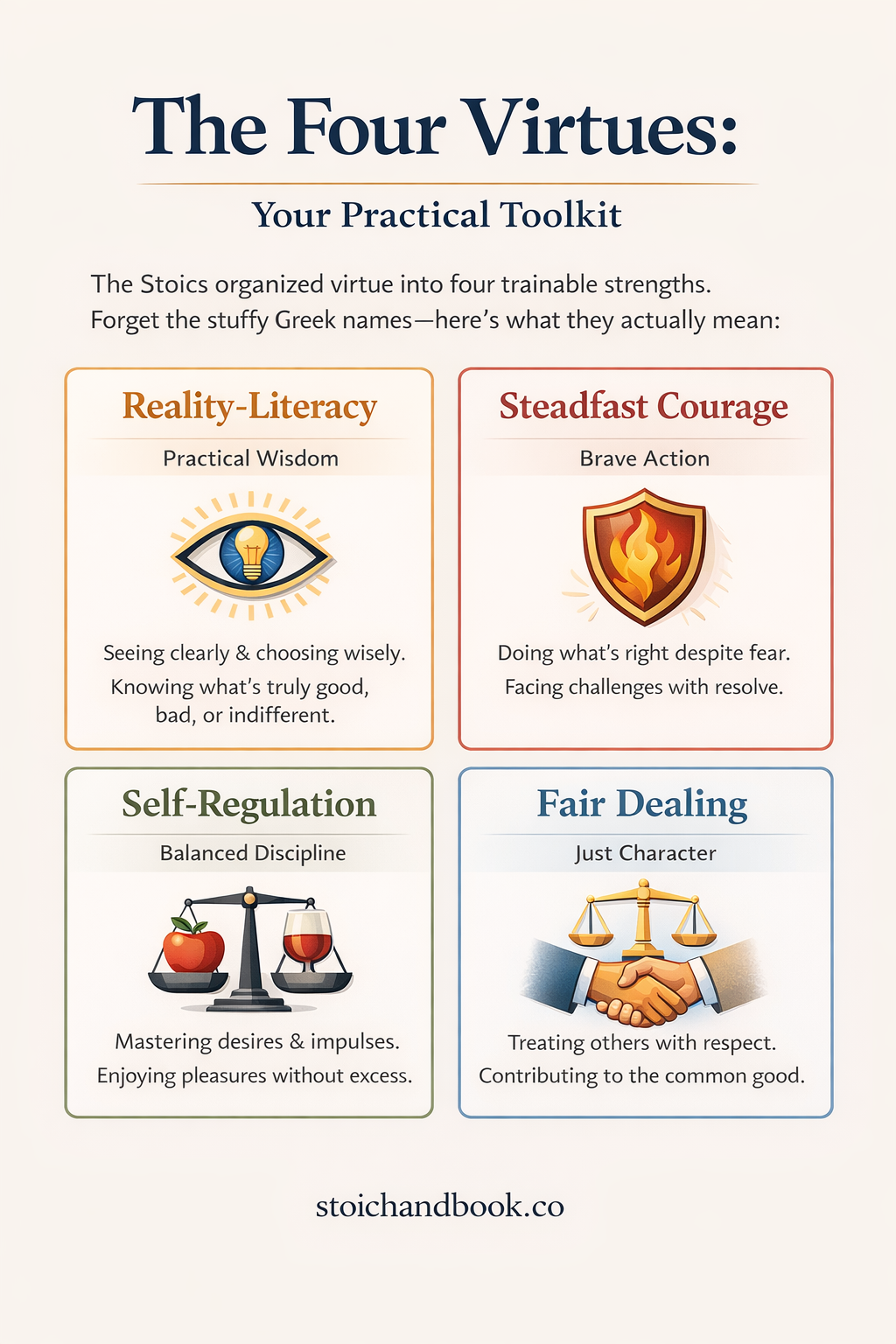
The Four Virtues: Your Practical Toolkit
The Stoics organized virtue into four trainable strengths. Forget the stuffy Greek names—here's what they actually mean:
Reality-Literacy (Phronesis)
Practical wisdom. The ability to see clearly and choose wisely. It's thinking without distortion—recognizing what's truly good (virtue), what's truly bad (vice), and what's indifferent (everything else). It's the skill of making sound decisions aligned with facts and values, not fantasy and fear.
Reality-literate people don't catastrophize minor setbacks or worship external achievements. They see things as they are and respond appropriately.
Steadfast Courage (Andreia)
The strength to act rightly even when it's risky or uncomfortable. Courage isn't just physical bravery—it's the willingness to face fear, difficulty, or social pressure to do what's right.
Speaking truth to power. Having hard conversations. Changing careers despite uncertainty. Calling out bias at work. Admitting you were wrong. All require courage.
Self-Regulation (Sophrosyne)
Measured desire. Ensuring pleasure and appetite serve reason rather than rule it. This isn't puritanical denial—it's balance. Enjoy food, sex, comfort, success—but don't let these run your life or compromise your integrity.
Self-regulation means you can enjoy a drink without needing it, pursue wealth without being enslaved to it, appreciate pleasure without being controlled by it.
Fair Dealing (Dikaiosyne)
Justice. Consistently respecting others and fulfilling your roles in social life. Treating people equitably. Contributing to the common good. Being someone others can count on.
The Stoics insisted we're fundamentally social creatures—like hands or feet working together. Fair dealing recognizes that your good and the common good aren't separate.
Emotions: Feeling Wisely, Not Suppressing Blindly
Here's where most people misunderstand Stoicism entirely. The philosophy is often caricatured as "don't feel anything"—be a cold, unfeeling rock. That's not just wrong; it's the opposite of what Stoics taught.
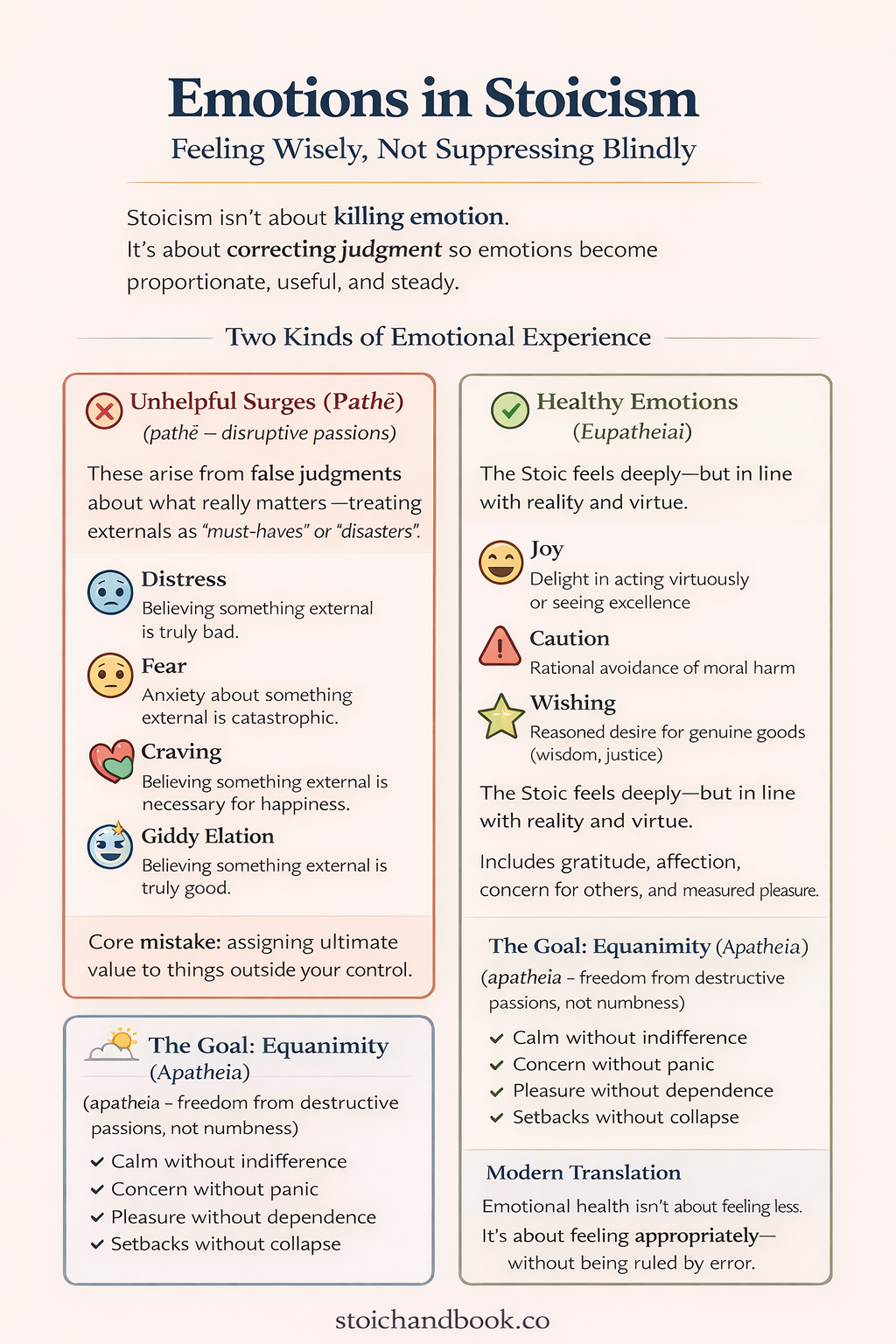
The Stoics distinguished between unhelpful surges (pathē) and healthy emotions (eupatheiai).
Unhelpful Surges (Pathē)
Rooted in faulty judgments about "must-haves" and "deal-breakers":
- Distress: Sadness about something you've falsely judged as truly bad
- Fear: Anxiety about something you've falsely judged as catastrophic
- Craving: Obsessive desire for something you've falsely judged as necessary for happiness
- Giddy Elation: Excessive joy about something you've falsely judged as truly good
The key word: falsely judged. These emotions arise when you assign ultimate value to externals—when you believe losing your job is genuinely terrible (rather than inconvenient), or getting promoted is genuinely wonderful (rather than preferred).
The Stoic sage eliminates these because they're based on mistakes. If you truly understand that only virtue is good and only vice is bad, you won't be devastated by job loss (you haven't lost your capacity for virtue) or euphoric about promotion (it doesn't make you more virtuous).
Healthy Emotions (Eupatheiai)
But the sage feels deeply—just rationally, proportionately:
- Joy: Delight in what's truly good (acting with virtue, witnessing others' excellence)
- Caution: Rational avoidance of true evil (vice, moral corruption)
- Wishing: Well-reasoned desire for genuine goods (wisdom, justice for all)
Plus natural affection, gratitude, appropriate concern for others, and measured enjoyment of life's pleasures.
Equanimity (Apatheia)
This is the state Stoics aim for: tranquility, not apathy. It's steady inner peace: concern without chaos, pleasure without possession, setbacks without self-doubt.
The mind isn't disturbed or thrown off balance by circumstances. You feel concern without panic, pleasure without addiction, disappointment without despair.
Modern translation: Emotional health isn't suppression. It's using feeling in service of right judgment—experiencing appropriate emotions while not being controlled by destructive ones.
Apatheia ≠ Apathy. Stoics don't suppress emotions—they cultivate healthy ones while eliminating destructive ones based on false judgments.
Living According to Nature: Your Cosmic Context
Universal Reason (Logos)
The Stoics believed the cosmos is ordered by logos—rational principle or divine intelligence. Not a bearded deity micromanaging creation, but the inherent rationality, causality, and order of nature itself.
Everything happens according to logos. Causes produce effects. Patterns repeat. The universe is intelligible, not chaotic.
And here's the key: your rational mind is a fragment of that cosmic logos. You share in the universe's rationality. When you use reason well, you're participating in the divine order.
Circle-Growing (Oikeiosis)
The Stoics observed something profound: we naturally start caring about ourselves, then expand that care outward—family, friends, community, eventually all humanity.
This process—oikeiosis or circle-growing—is nature's design. We're meant to progressively realize that others aren't strangers but fellow expressions of logos, parts of one larger human family.
Hierocles illustrated this as concentric circles: you at the center, immediate family in the next ring, extended family, neighbors, fellow citizens, all humanity in the outermost circle. Stoic practice involves drawing those outer circles closer—treating distant others with more of the care you naturally give to kin.
Shared Connection (Sympatheia)
Everything is interconnected. The doctrine of sympatheia reminds us that we're all part of one whole—the cosmos, humanity, nature. Your private good isn't separate from the common good.
This isn't mystical woo-woo. It's recognizing that your wellbeing depends on functioning systems—ecological, social, economic. Climate anxiety, social division, economic uncertainty—these remind us we can't truly flourish while the world fractures around us. Your virtue finds expression in contributing to the whole.
Making It Real: Stoic Practices
Understanding the vocabulary means nothing without practice. Here are core exercises to embody these concepts:
Setback Rehearsal (Premeditatio Malorum)
Imagine potential obstacles before they occur. Not to be pessimistic, but to mentally prepare virtuous responses. If you lose your job, how will you respond with courage and wisdom? If a relationship ends, how will you maintain equanimity?
By rehearsing difficulties, you rob them of their power to shock you. You've already developed a plan to meet them virtuously.
Daily Review
Morning: Preview the day. What challenges might arise? How can I meet them with virtue?
Evening: Review what happened. Where did I act with arete? Where did I fall short? What will I do better tomorrow?
This practice builds self-awareness and continuous improvement—the foundation of character development.
Label–Loosen–Replace
Anxiety whispers: "This pitch? Total flop."
Label it: "Just a fear-fueled phantasia."
Challenge: "Evidence, or exaggeration?"
Reframe: "I've prepped; imperfections build grit."
Notice a troublesome thought. Label it as just an impression, not reality. Loosen its grip by questioning it. Replace it with a truer, more helpful interpretation.
Plan with Flex (Hupexhairesis)
Pursue goals with the internal reservation: "If nothing prevents it." Make plans, work hard—but acknowledge outcomes depend on more than your will alone.
"I'll launch this business, if fate allows." You commit fully to the process while maintaining equanimity about results. This prevents both defeatism and crushing disappointment.
The Bottom Line: Why This Vocabulary Matters
These aren't just fancy Greek words to impress people at parties. Each term represents a precise concept that, properly understood, transforms how you navigate life.
When you grasp that arete is the only true good, you stop wasting energy on status games and external validation. You refocus on what's actually within your control—your character.
When you practice distinguishing phantasia from sunkatathesis, you gain the power to not be jerked around by every anxious thought or angry impulse. You become the master of your inner life.
When you cultivate apatheia (tranquility, not apathy), you develop the emotional resilience to handle whatever life throws at you without losing your center.
Grow your oikeiosis, and self-interest expands into shared humanity—deeper purpose amid division.
This is Stoicism: a coherent system for living well, grounded in understanding reality clearly, developing excellent character, managing emotions wisely, and recognizing your place in the larger whole.
The ancient Greeks used these specific terms because precision matters. Conflating apatheia with modern "apathy" leads to the misconception that Stoics are cold and unfeeling. Understanding it as "tranquility" or "freedom from destructive passions" reveals the truth: Stoics aim for emotional health, not emotional death.
So learn these terms. Not to sound smart, but to think clearly. Not to join an elite club, but to access tools that work.
Because ultimately, Stoicism offers what everyone wants: a way to live with less anxiety, more resilience, clearer purpose, and deeper peace—regardless of what fortune throws your way.
And that begins with understanding the vocabulary that unlocks the practice.
Now you have the lexicon. Time to use it.
Ready for more? Dive into the podcast episode for audio breakdowns, real-life scenarios, and starter challenges. Ancient gold, modern polish—your resilient life awaits.