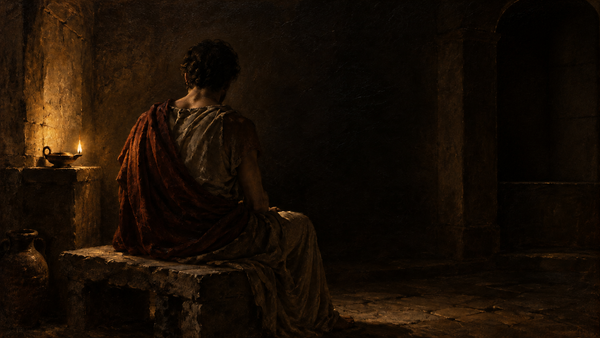
Before the first message or headline, this seven-minute guided practice gives you somewhere to begin: sound, the feeling of your body, then the breath. When your mind wanders, name where it went and return. The exercise is a modern way of practising attention, drawing on the Stoic concern with how we judge and act.
Listen in a comfortable position. Keep your eyes open if you prefer, and let your breathing stay easy. You can attend to sounds or your feet instead of the breath, or stop if the exercise feels uncomfortable.
Notice the return
You sit down for a quiet few minutes and find yourself rehearsing a conversation. The conversation hasn't happened. But there you are, halfway through your reply.
The recording asks you to catch that moment without adding a telling-off. Name it in one word, such as planning or worrying, then come back to the breath. There is no need to finish the imagined conversation first.
Sound gives you an easy place to start. A boiler, traffic outside, someone moving in another room. Then notice the contact between your body and the chair. The sequence gives attention something ordinary to return to when a thought carries it away.
Carry attention into what you do
Prosochē means attention. In Stoic practice, that includes noticing the judgements you accept and the actions that follow. A few minutes listening to sounds can be a starting exercise, but the question continues when you stand up: what am I agreeing to, and how am I about to act?
Marcus Aurelius's reminder to stay with the present belongs to that wider work. The sound, body, breath and labelling sequence here is my modern guided adaptation. It is not a surviving ancient meditation script.
The recording ends by encouraging daily repetition. Treat its prediction that you will begin catching your mind automatically as encouragement to practise, not a guaranteed result. And when the recording describes the mind as rehearsing things that are not happening, that does not make every concern imaginary. Some concerns need a practical response. For now, notice one return without demanding a particular feeling from it.
For the wider philosophical practice, read Prosochē: the Stoic practice of attention. If sitting down is the part you keep putting off, try the six-step preparation for meditation.
Sources: Marcus Aurelius, Meditations, in George Long's translation, supports the reminder to stay with the present. The recording modernises the wording. Epictetus's chapter on attention supplies the wider context of judgement and conduct; it is supporting reading, not an additional quotation in the recording.
Full transcript
Lightly edited for readability.
Before you pick up your phone, before the first message, the first headline, the first demand on your attention, a few minutes before any of that, these are precious moments that belong to you.
Okay, so sit however you like, eyes closed or open, resting on one spot on the floor or in a chair, and take three slow breaths to arrive. In and out. In and out. In and out.
The Stoics had a word for this, prosochē or attention. It was not a technique that they did for ten minutes and then forgot about. It was very important, a key part of Stoic practice. A continuous watchfulness over where your mind has gone, and a continuous bringing of it back.
Marcus had a few words that he used to remind himself of the importance of prosochē. Confine yourself to the present, he said. Not because the future does not matter, but because the present is the only place where you have any power. Everything you can actually do can only ever be done here.
So I'm not asking you to just relax. I'm asking you right now to train. You're going to be practising in a form of mental training. You're going to be practising the return.
Start with sound. Listen to whatever is around you. Traffic, a boiler, birds, someone moving in another room, the hum of electronics, your own breathing. You don't need to name them or judge them. Just let them arrive and go.
Feel the weight of yourself pressing down, the temperature of the air on your hands and face, the pressure where your body meets the chair on the floor. Nothing to change, just contact.
Now the breath: the cool air coming in. The slight warmth going out. The small pause at the top and the bottom. You were not breathing deliberately. You were just noticing something that was happening anyway. That's fine, that's what this practice is, that is the rep. A mind that never wanders gives you nothing to practise with.
When you notice you have gone, just try this. Name where you went in one word. Planning, remembering, worrying, rehearsing. Then just come back to the breath. No irritation about it. The noticing is the practice. The wandering is just what made the noticing possible.
Most of what pulls you out of this moment is not happening, it's just your mind rehearsing for something. Come back once more now. This is the point. You could be waiting for the kettle or standing in a queue that thirty seconds before you walk into a room that you're dreading to enter. One breath. Notice you are here. This is the practice.
So take one last breath now. Take it deliberately. Notice your fingers and toes, and open your eyes slowly.
The noise is still out there. This practice compounds, so do it tomorrow again, the day after, and you'll start catching your mind mid-wander at all different times of the day without even meaning to. Go well.
Go deeper
If you want structured practice, the 7-Day Stoic Challenge is free. Nine audio lessons and a 42-page workbook.