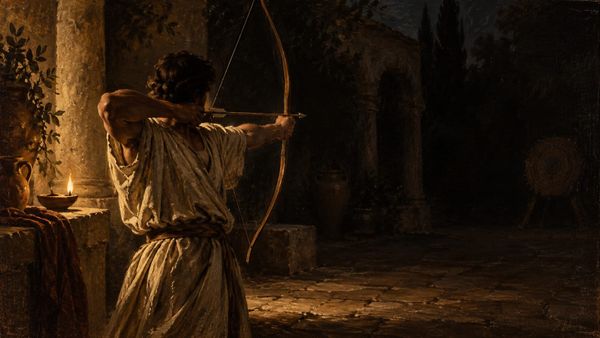
This seven-minute guided Stoic practice prepares you for a presentation, interview, difficult meeting or test. Rehearse one realistic setback, separate your preparation and conduct from another person’s response, and choose how you want to act. The episode draws on premeditation of adversity, Epictetus and Cicero’s image of the archer.
Practice note: choose an ordinary, manageable setback. You can keep your eyes open, breathe comfortably without following the count, or skip the visualisation. If it increases distress or becomes repetitive worry, stop and return your attention to the room. This recording is not a trauma exercise or a treatment for anxiety.
Rehearse a response to one setback
A question you did not prepare for. A silence after you finish speaking. Someone who looks unimpressed. These are the kinds of difficulty used in the recording.
Bring one of them to mind, then rehearse what you could do: take a breath, ask for a moment to think, or answer the part you can answer. Keep the exercise brief. Replaying increasingly frightening possibilities would take it away from the practical preparation intended here.
Separate your part from the result
Epictetus distinguishes what is up to us from what is not. This practice applies that distinction to an approaching event. You can consider how to prepare and how to respond; you cannot guarantee another person’s decision.
The recording uses broad language about preparation being completely within your control. In practice, your time, health and circumstances can constrain preparation too. Focus on the choice available to you now. Cicero’s archer image makes a related point: aim as well as you can, while recognising that hitting the mark is not wholly yours to determine.
Take one sentence into the day
The recording offers this reminder: “I have prepared. I will do my part. The rest is not mine.” Use it after choosing a concrete response to the setback you rehearsed.
You may still feel nervous. The exercise does not establish that fear is mostly surprise, that a longer exhale is the best way to settle everyone’s nervous system, or that a difficult event cannot cause real harm. Those are broader claims in the spoken recording, preserved below for fidelity. Keep breathing comfortable and unforced; the NHS breathing guidance takes that approach. Stop if the exercise makes things worse.
For the wider practice, read premeditation of adversity. For the distinction used to sort your concerns, read the dichotomy of control.
Sources: Epictetus, Enchiridion, on what is up to us and preparing for ordinary obstacles; Cicero, On Ends, for the archer comparison. The guided rehearsal is a modern application, not a surviving ancient script.
Full transcript
Lightly edited for readability.
Today has something in it that matters to you. It could be a room that you have to walk into, possibly a conversation that you've been turning over in your mind since last week. Or there's something in your life where there's an outcome attached. Your body already knows this, and that's where the tightness comes from.
Sit upright, feet flat if you can, and just take three breaths in. Make the exhale longer than the inhale each time. That is the part that settles your nervous system the most. So in two, three, four, out, two, three, four, five, six, and again. And once more.
So most modern advice says picture things going well, right? Picture them going perfectly. Manifest it. Whereas the Stoics said, picture it going wrong on purpose while you're in a calm state. Premeditatio malorum, rehearsing the difficulty in advance. And the logic is simple. Fear is mostly the fear of being caught out, being surprised. And if you've already met the bad version that you're worrying about in your head, but you do it in a calm, contemplative way, it doesn't surprise you when it happens. It doesn't ambush you.
The second half is also really important. Epictetus separated everything into what is ours and what is not ours. Your preparation is completely within your control. Your conduct in any room is yours. It's your responsibility. Whether another person says yes is not within your control. Whether the external world bends to your will is not within your control.
The Stoic image for this was that of an archer. We control the draw, we control the aim, we control the release. But once the arrow leaves, the wind, the temperature, the humidity, the universe has its say. Today we are going to just focus on aiming well and then just let go of the arrow.
Bring the moment to mind where you will be and who is there and what is at stake. Now let something go wrong on purpose. The question that you didn't prepare for, the silence after you finish, the person who is unimpressed or the moment your mind goes blank, whatever it is, don't soften it, but let it be the version that you've been quietly dreading.
And now watch yourself in it. I don't want you to perform brilliantly, but just watch yourself in the experience. You take a breath and you say honestly that you would like a moment to think. You answer the part you can answer. You stay in your own body while everything happens around you. Notice that in this version, nothing catastrophic has occurred. It went badly, and you were still there. That is usually what happens in reality.
Now, let's sort out what is yours versus what is not yours. Name one thing about today that is entirely within your control. Now name one thing that is not: their decision or their mood, the comparison to whoever went before you. Hold that second thing for a moment, and then just set it down, not because it doesn't matter, but because carrying it will not move anything, and it's just going to cost you the attention you need for the things that are within your control.
The measure of today is not the result. It's whether you brought what you had.
Take a full breath and feel where you're holding any tension: jaw, shoulders, hands, and let each one gently relax a little bit more.
If it helps, you can take this with you today. I have prepared, I will do my part, the rest is not mine.
Nerves may still be there when you walk in, and that's fine. Nerves are the body making energy available. They're not a sign that anything has gone wrong.
Roll your shoulders back, move your hands and open your eyes. You have already done the hardest part of today, which is meeting the worst version of it while being calm. However this goes, try to come back tomorrow morning. The archer practises on ordinary days, as well as difficult days and pleasant days. Go well.
Go deeper
If you want structured practice, the 7-Day Stoic Challenge is free. Nine audio lessons and a 42-page workbook.