If you are still going over the day in bed, this quiet Stoic practice gives the review somewhere to end. Settle into the bed and listen to a few short lines about having enough for tonight. There is nothing to repeat, and you need not stay awake to hear the last one.
When the review is over
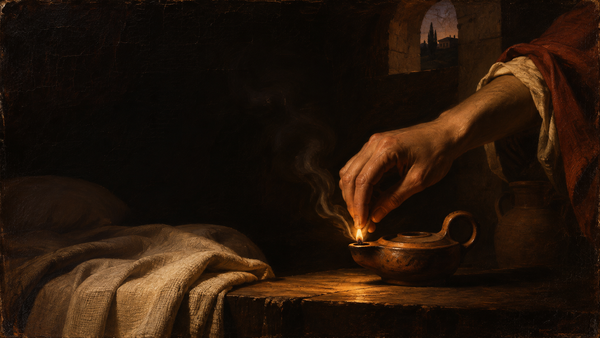
Seneca describes looking back over his conduct when the lamp is out. He is quite willing to notice where he went wrong. What interests me here is what happens afterwards: he goes to sleep. If you have already seen what you would do differently, lying there having the argument again adds very little.
Let the lines go past
Leave the phone down. Feel the bed taking your weight. There is a long space between each affirmation so that you can miss a line without losing your place. If one catches your attention, fine. You do not have to test whether you believe it or try to bring it back when it goes.
For a practice with questions to ask before bed, try the Stoic evening meditation. For the distinction between what has happened and how you act now, see the dichotomy of control.
Source: Seneca describes his evening review in On Anger. The affirmations in the recording are modern lines for listening at bedtime.
Full transcript
Lightly edited for readability.
Lights off, phone down, the day has closed. Settle in and let the bed take you. Breathe in and out, slowly. Once more, in and out. In a moment, you will hear a series of short lines. You do not have to repeat them or concentrate on them. Let them go past you like something heard through a wall. If you fall asleep halfway through, the track has actually worked.
Before the lines, one thing. Seneca examined his day every night, not to punish himself. He looked at what he had done, hid nothing from himself, and then he slept. That second part is the part most of us skip. We do the examining and then lie there doing it again and again. So set the day down now. You looked at it or you did not, and either way it is finished. Take a breath and let the shoulders go with it. Here are the lines.
I have enough tonight. What I did today was what I had. Tomorrow I get more. I cannot change what has happened. I can meet what comes. My worth is in how I act, not in what I produced today. The things I am worrying about are mostly not happening. I am warm. I am safe. Nothing is required of me for the next eight hours. I forgive myself for today, honestly, and then completely. Rest is not laziness. It is how the work becomes possible. This bed. This breath. This is enough. I am allowed to stop now.
Let the lines settle wherever they have landed. You do not need to remember them. They will be here tomorrow night. Heavy now, slow. Enough for today. Sleep well.
Go deeper
If you want structured practice, the 7-Day Stoic Challenge is free. Nine audio lessons and a 42-page workbook.