📺 Watch the full interview:
My notes on this conversation
The Stoics did not treat philosophy as something to have opinions about. They treated it as training, with exercises, and they expected the training to change how they handled a bad day.
Who is Donald Robertson?
Donald Robertson is a cognitive behavioural therapist and the author of several books on Stoicism, including:
- How to Think Like a Roman Emperor – on the life and philosophy of Marcus Aurelius.
- The Philosophy of Cognitive-Behavioural Therapy – on the connections between Stoicism and modern psychology.
More than most, he has pushed modern Stoicism back towards something you do rather than something you read about.
The forgotten truth about Stoicism
Stoicism was never meant to be just a philosophy
Donald made a point in our conversation that I had not expected. For a long stretch, the people who knew the Stoic texts best were academics who had no intention of living by them. They read the texts closely. They argued about the ideas. Practising them was not the job.
Which is strange, because none of the surviving Stoics were writing for readers in that sense. Marcus was writing to himself. Epictetus was being transcribed by a student in a classroom. Seneca was writing letters to one man about how to live.
On no occasion call yourself a philosopher, nor talk at large of your principles among the multitude, but act on your principles… For sheep do not bring grass to their shepherds and show them how much they have eaten, but they digest their fodder and then produce it in the form of wool and milk.
— Epictetus, Enchiridion 46
That has changed. Most people who come to Stoicism now are trying to use it. The problem is that almost nobody tells them what using it actually involves on a Tuesday morning.
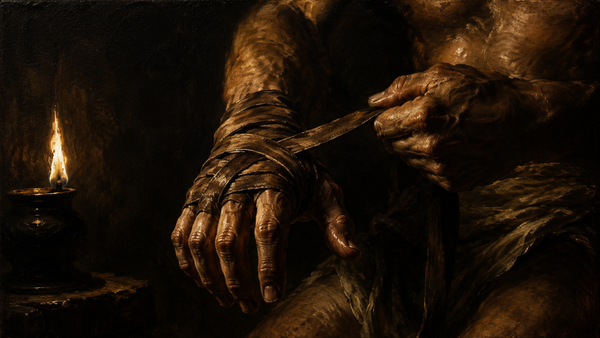
Stoicism needs training, like weightlifting for the mind
Donald's comparison is the gym. Nobody thinks reading about squats will make them stronger, and nobody thinks reading about meditation will make them calm. Stoicism gets a pass on this that it has not earned.
The ancient exercises were specific. The view from above zooms out until your problem sits against the scale of the world. Examining your impressions, which cognitive therapists now call cognitive distancing, means catching a judgement as it forms and asking whether it is actually true. Memento mori keeps death close enough to sort what matters from what does not.
The most overlooked practice: the view from above
The simplest of these is the one usually called the view from above.
Marcus returns to it repeatedly in the Meditations, and he credits the idea to Plato: someone discussing human affairs should look at earthly things “as if looking down from somewhere above” (7.48). He comes back to it at 9.30, and again at 12.24, where the image is being lifted suddenly into the air and seeing how short-lived all of it is.
Think of yourself as dead. You have lived your life. Now take what's left and live it properly.
— Marcus Aurelius, Meditations 7.56 (trans. Hays)
How to practise it (two minutes)
The steps below are a modern reconstruction, not an ancient script. Marcus describes a single lift rather than a graduated climb, but the ladder makes it easier to learn.
- Close your eyes and picture yourself from just above where you are sitting.
- Widen it out to the whole town, then the country.
- Keep going until the Earth is one object among others.
- Now look again at the thing you were worrying about.
- Open your eyes.
Two minutes of this is usually enough to change the size of the thing, which is all it is for. It does not solve anything.
What this actually asks of you
Reading Stoicism feels good, and feeling good is the trap. The test is whether any of it survives contact with the next thing that irritates you.
👉 Watch the full conversation here:
What's one Stoic practice you actually use? Let me know in the comments.
Further reading
📖 How to Think Like a Roman Emperor – Donald Robertson
📖 Meditations – Marcus Aurelius
📖 The Discourses – Epictetus