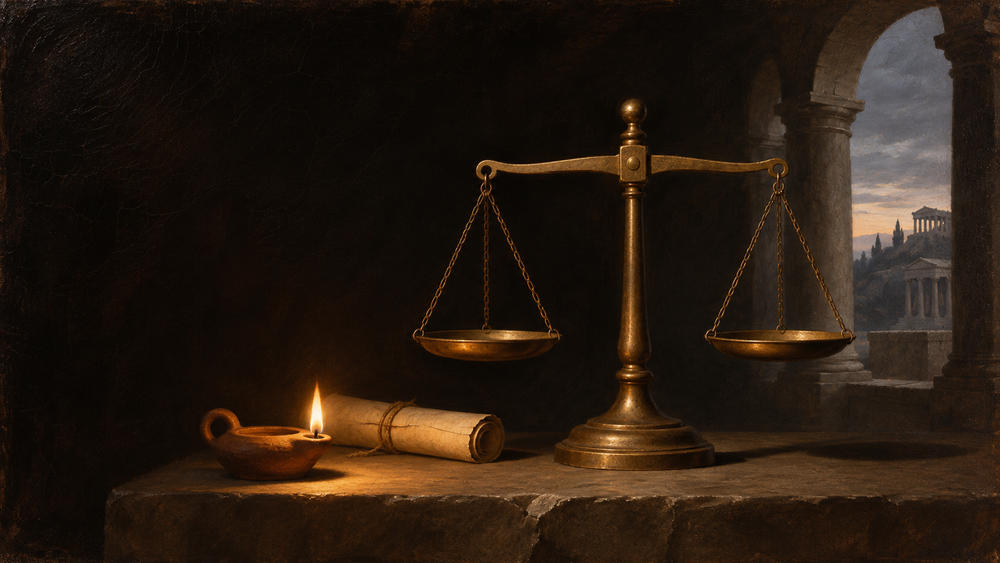
For the Stoics, justice is the virtue that governs how you treat other people. Marcus Aurelius went further and made it the ground the other virtues stand on. The passages below show what that meant in practice: justice rests on the idea that people are made for one another, injustice has two forms (doing harm and failing to prevent it), and your role in a relationship sets what you owe. Every quotation is checked against a named translation, and a closing section covers where these writers stop short. It is one of the four Stoic virtues, and the more general collection is on the Stoic quotes page.
Why Marcus puts justice first
Marcus gives justice the most weight. In a passage about the order of nature, he argues that the other virtues depend on it.
hence is the origin of justice, and in justice the other virtues have their foundation: for justice will not be observed, if we either care for middle things [things indifferent], or are easily deceived and careless and changeable
Marcus Aurelius, Meditations 11.10, trans. George Long
The reasoning is that someone who cares too much about things that do not matter, or who is easily fooled, will not keep fair dealing steady. This is Marcus's own position, and it differs from some readings that treat wisdom as the master virtue. Elsewhere he describes the two things every rational being shares.
These two things are common both to the soul of God and to the soul of man, and to the soul of every rational being: not to be hindered by another; and to hold good to consist in the disposition to justice and the practice of it, and in this to let thy desire find its termination.
Marcus Aurelius, Meditations 5.34, trans. George Long
He also keeps returning to justice as a working rule for ordinary moments.
Do not be whirled about, but in every movement have respect to justice
Marcus Aurelius, Meditations 4.22, trans. George Long
Thou must turn to profit the present by the aid of reason and justice.
Marcus Aurelius, Meditations 4.26, trans. George Long
We are parts of one body
The Stoic case for justice starts from a claim about human nature: people are made for one another. Seneca puts it in a letter on how to deal with other people.
What a little thing it is not to harm one whom you ought to help
Seneca, Letters 95.51, trans. Richard Mott Gummere
we are the parts of one great body
Seneca, Letters 95.52, trans. Richard Mott Gummere
She established fairness and justice; according to her ruling, it is more wretched to commit than to suffer injury.
Seneca, Letters 95.52, trans. Richard Mott Gummere. "She" is Nature, who in the preceding lines made human beings related to one another.
Marcus uses a plainer picture, a branch and a tree.
A branch cut off from the adjacent branch must of necessity be cut off from the whole tree also. So too a man when he is separated from another man has fallen off from the whole social community.
Marcus Aurelius, Meditations 11.8, trans. George Long
As thou thyself art a component part of a social system, so let every act of thine be a component part of social life.
Marcus Aurelius, Meditations 9.23, trans. George Long
Seneca says the same about the school as a whole, in the book he wrote for the young Nero.
our own sect, which regards man as a social animal, born for the good of the whole community
Seneca, On Clemency 1.3, trans. Aubrey Stewart
For another of the four virtues told through quotations, see the Stoic quotes on courage.
Injustice is doing harm, and also not helping
Marcus treats injustice as a failure towards nature itself.
He who acts unjustly acts impiously. For since the universal nature has made rational animals for the sake of one another, to help one another according to their deserts, but in no way to injure one another, he who transgresses her will is clearly guilty of impiety towards the highest divinity.
Marcus Aurelius, Meditations 9.1, trans. George Long
He also says the wrongdoer is the first person harmed, and that leaving something undone counts.
He who does wrong does wrong against himself. He who acts unjustly acts unjustly to himself, because he makes himself bad.
Marcus Aurelius, Meditations 9.4, trans. George Long
He often acts unjustly who does not do a certain thing; not only he who does a certain thing.
Marcus Aurelius, Meditations 9.5, trans. George Long
Cicero spells the two forms out in On Duties. Cicero was not a Stoic himself, and this book follows the Stoic Panaetius, so read these as a Roman statement of a Stoic-influenced view.
he who does not prevent or oppose wrong, if he can, is just as guilty of wrong as if he deserted his parents or his friends or his country.
Cicero, On Duties 1.23, trans. Walter Miller
they are traitors to social life, for they contribute to it none of their interest, none of their effort, none of their means.
Cicero, On Duties 1.29, trans. Walter Miller
What justice asks in practice
Diogenes Laertius, summarising the early Stoics, files fairness under justice and describes a person who has virtue as someone who can find the right act for each situation.
to justice, equality and fair-mindedness
Diogenes Laertius, Lives of the Eminent Philosophers 7.126, trans. R. D. Hicks
if a man does some things by intelligent choice, some things with fortitude, some things by way of just distribution, and some steadily, he is at once wise, courageous, just, and temperate.
Diogenes Laertius, Lives of the Eminent Philosophers 7.126, trans. R. D. Hicks
Epictetus turns this into a test you can run on any relationship: what does the role require of you, whatever the other person does?
Appropriate acts are in general measured by the relations they are concerned with.
Epictetus, Enchiridion 30, trans. P. E. Matheson
Be careful then to maintain the relation you hold to him, and do not consider what he does, but what you must do if your purpose is to keep in accord with nature.
Epictetus, Enchiridion 30, trans. P. E. Matheson
Cicero gives the first two jobs of justice in plain terms.
The first office of justice is to keep one man from doing harm to another, unless provoked by wrong; and the next is to lead men to use common possessions for the common interests, private property for their own.
Cicero, On Duties 1, chapter 7, trans. Walter Miller
The foundation of justice, moreover, is good faith
Cicero, On Duties 1.23, trans. Walter Miller
Where Stoic justice stops short
A sceptic should ask three things of these texts. First, the argument rests on a premise, that humans are social by nature, and the passages assert it more than they prove it. Second, the writers lived inside a society that held slaves, and their idea of fairness often sits inside a ranking of people. Seneca's own advice on how to treat slaves shows both the kindness and the limit.
not to treat them with scornful brutality as human chattels, but as persons somewhat below ourselves in station
Seneca, On Clemency 1.18, trans. Aubrey Stewart
Third, none of this is a political programme. Marcus's "according to their deserts" in 9.1 leaves open who decides what people deserve. Seneca's own record as an adviser to Nero is a standing test of the gap between the words and the life, and it is covered on the Seneca and Nero page. For the neighbouring question of what to do when someone has wronged you, see the Stoic quotes on forgiveness.
A small exercise
This one is a modern adaptation, not an ancient exercise. Pick one relationship where you feel you are owed something. Write down what the role asks of you, as Epictetus does in Enchiridion 30. Then write down one thing you have left undone for someone, as in Marcus's line at 9.5. Decide whether either one is yours to do, and do it, or leave it. The aim is to check your own conduct, not to settle the other person's.
Sources
Marcus Aurelius, Meditations, trans. George Long (1862). Seneca, Letters from a Stoic, trans. Richard Mott Gummere (three short quotations only, because this translation is still in copyright in the UK). Seneca, On Clemency, trans. Aubrey Stewart. Epictetus, Enchiridion, trans. P. E. Matheson. Diogenes Laertius, Lives of the Eminent Philosophers Book 7, trans. R. D. Hicks. Cicero, On Duties Book 1, trans. Walter Miller (Loeb, 1913).
If you want structured practice, the 7-Day Stoic Challenge is free. Seven daily audio lessons and a workbook.