You've heard the quotes. You know Marcus Aurelius advised treating obstacles as fuel.
You've seen "some things are up to us, others are not" on motivational Instagram posts. But when you open the Meditations or Epictetus's Enchiridion, you hit a wall of Greek terms that sound more like a philosophy exam than a guide to living.
Arete. Apatheia. Prohairesis. Logos.
What do they actually mean, and how do they help you handle anxiety or make a better decision today?
Stoicism is not complicated. The terminology makes it look that way. Underneath the vocabulary is a working method for handling your own judgements, and it is the method Albert Ellis and Aaron Beck drew on when they built cognitive therapy. They said so in print.
This guide explains the most important Stoic terms in plain English, with the practice attached to each one.
I want you practising this, not admiring it.
Quick Guide: Core Stoic Terms Explained
- Eudaimonia – Flourishing, not pleasure
- Arete – Excellence of character
- Prohairesis – Your capacity to choose
- Phantasia – First impressions
- Sunkatathesis – Assent or agreement
- Apatheia – Tranquillity, not apathy
- Logos – Rational order of nature
The Aim: What Stoicism Is Actually About
Flourishing (Eudaimonia)
Start with the goal. Stoics are not trying to become emotionless robots or detach from reality. They are after eudaimonia, a Greek word usually translated as "happiness" and better understood as flourishing or living well.
Not the pleasure of a good meal or the hit of a notification. Eudaimonia is the durable well-being that comes from good character and from living in line with your nature as a rational, social animal.
Think of a plant in good soil with enough water and light, realising what it was capable of. Cultivating wisdom, courage, justice and temperance does the same job for you.
Excellence of Character (Arete)
Only virtue is truly good. Everything else, health and wealth and status included, is a "condition" that does not define your worth. A broke but honest person is doing better than a rich but corrupt one.
The engine of flourishing is arete, moral excellence. Originally the word meant the excellence of anything at all: a sharp knife has arete, a fast horse has arete. In a person it means excellence of character, the stable skill of choosing well and then doing it.
The radical Stoic claim is that arete is the only thing that is truly good. Health, wealth and reputation are conditions. They make virtue easier or harder to practise. They do not decide your worth.
You can be broke but honest, which is living with arete, or rich but corrupt, which is not. The Stoics hold that only the first person is doing well in the sense that matters.
In today's terms: the useful measure is the quality of your choices. Wiser calls, braver stands, fairer dealing, steadier habits. All of them are yours to build.
The Stoic Mind: How Your Psychology Actually Works
Impression → Assent → Experience
First-Takes (Phantasia)
Your mind produces impressions all day long, first-takes on what is happening. Someone cuts you off in traffic and the first-take is "that idiot disrespected me". You check your bank balance and the first-take is "I'm failing at life".
A phantasia is an automatic reaction, coloured by fear, habit or appetite. It arrives before you have decided anything, and it arrives already carrying a verdict.
The driver might be on the way to a hospital. The balance is a number. The impression is your mind's first interpretation, and it is often wrong.
Chosen-Takes (Sunkatathesis)
Between impression and assent lies your freedom. That pause is where you reclaim control over your emotional life.
Then comes assent (sunkatathesis). Once the impression is there, you can agree with it or decline. You can say "yes, that is true", or "no, that is my anxiety talking".
The gap between the impression arriving and you signing it off is where the freedom sits, and it is Epictetus who puts it there, not any modern writer. He gives the student a line to meet a jarring impression with: "You are just an appearance and in no way the real thing" (Enchiridion 1).
He also gives the working image. Test each impression the way a money changer tests a coin, dropping it to hear whether it rings true, and never on the first listen (Discourses 1.20 and 3.12). Does this hold up? Is it accurate? Am I about to agree to something that will make me miserable for no good reason?
This is the insight Albert Ellis and Aaron Beck built cognitive therapy on, and they said so in print. Both opened with the same line of Epictetus: people are disturbed not by things, but by the views they take of them. Withhold assent from the false judgement, give it to a truer one, and the feeling changes with it.
Core Agency (Prohairesis)
Your prohairesis is your capacity to choose: your moral will, the part of you that decides. The Stoics treated it as your true self, ahead of your body and your circumstances, because it is where your judgements and intentions are formed.
It is also unimpeded. Epictetus makes the argument by elimination in Discourses 4.1. Can anyone make you assent to something you believe is false? No. Your body can be chained, your property taken, your plans blocked. Your agreement cannot be extracted.
Viktor Frankl, Nelson Mandela, Malala Yousafzai and James Stockdale all lived that out. Their external freedom was taken. They kept the internal kind by governing their prohairesis, choosing their attitude and their response.
For a source-led explanation of Epictetus's account of choice and freedom, read the full guide to prohairesis.
You always have agency over your inner life: your interpretations, your commitments, your character. That is the one corner of the universe that is truly "up to you."
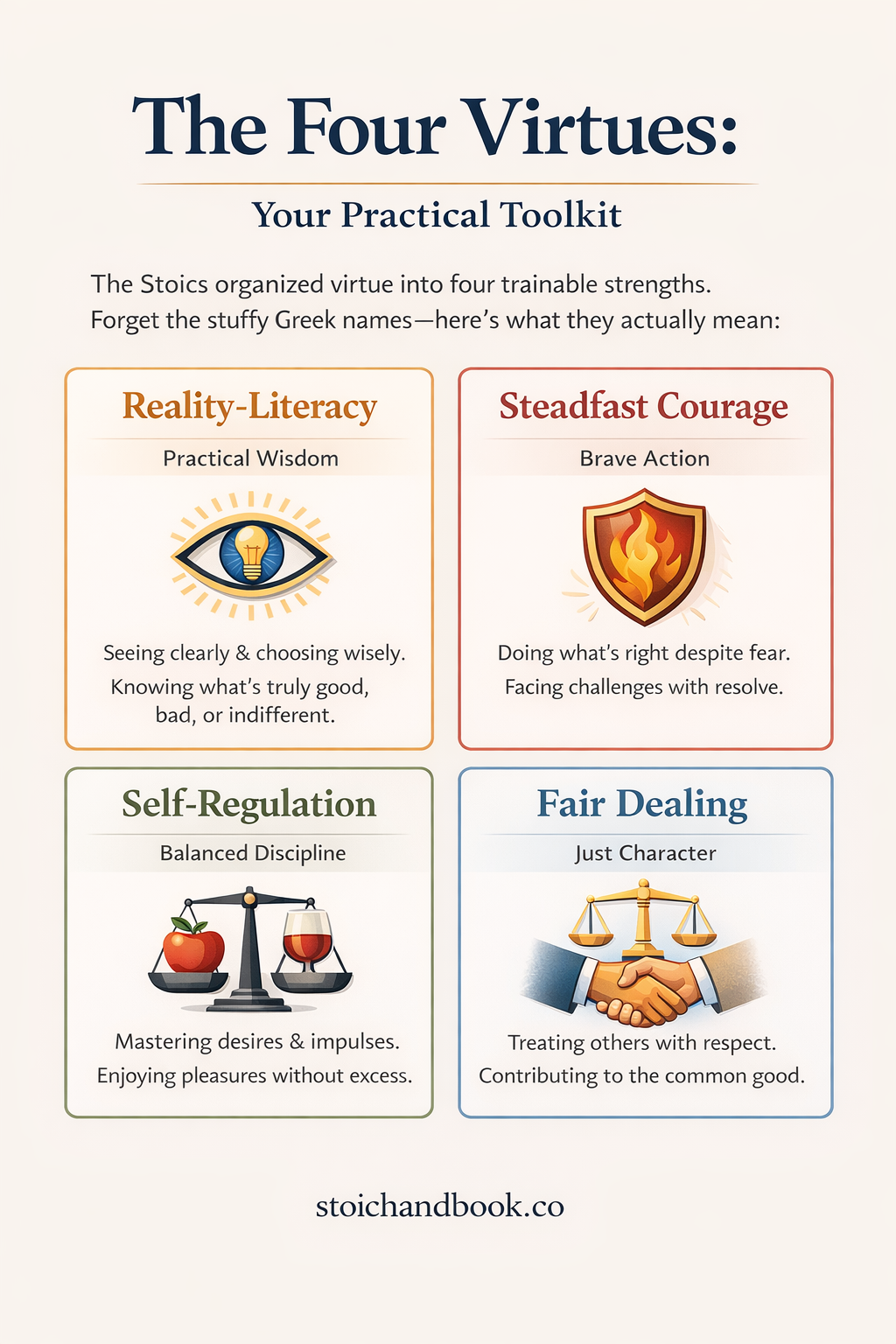
The Four Virtues: Your Practical Toolkit
The Stoics organised virtue into four trainable strengths. The Greek names matter less than what each one asks of you.
Reality-Literacy (Phronesis)
Practical wisdom: seeing clearly and choosing well. It is thinking without distortion, which means telling apart what is truly good (virtue), what is truly bad (vice), and what is indifferent (everything else). It is the skill of deciding on the facts in front of you rather than on the story fear is telling.
Reality-literate people do not catastrophise a minor setback, and they do not worship an external achievement either. They see the thing as it is and respond to that.
Steadfast Courage (Andreia)
The strength to act rightly when it is risky or uncomfortable. Courage is wider than physical bravery. It covers facing fear, difficulty or social pressure in order to do the right thing.
Having the hard conversation. Changing career without a guarantee. Saying the unpopular thing in a meeting. Admitting you were wrong. Each of those takes courage.
Self-Regulation (Sophrosyne)
Measured desire. Pleasure and appetite serve reason instead of ruling it. This is not puritanical denial. Enjoy food, sex, comfort and success. Just do not let any of them run your life or cost you your integrity.
In practice it means you can have the drink without needing it, and pursue money without being owned by it.
Fair Dealing (Dikaiosyne)
Justice. Respecting other people and doing the jobs your roles actually require. Treating people fairly. Being someone others can rely on.
The Stoics held that we are social animals by design, built to work together the way hands and feet do. Fair dealing is the recognition that your good and the common good are the same good.
Emotions: Feeling Wisely, Not Suppressing Blindly
This is where most people misread Stoicism. The philosophy gets caricatured as "feel nothing", a cold unmoved rock. That is the opposite of what the Stoics taught.
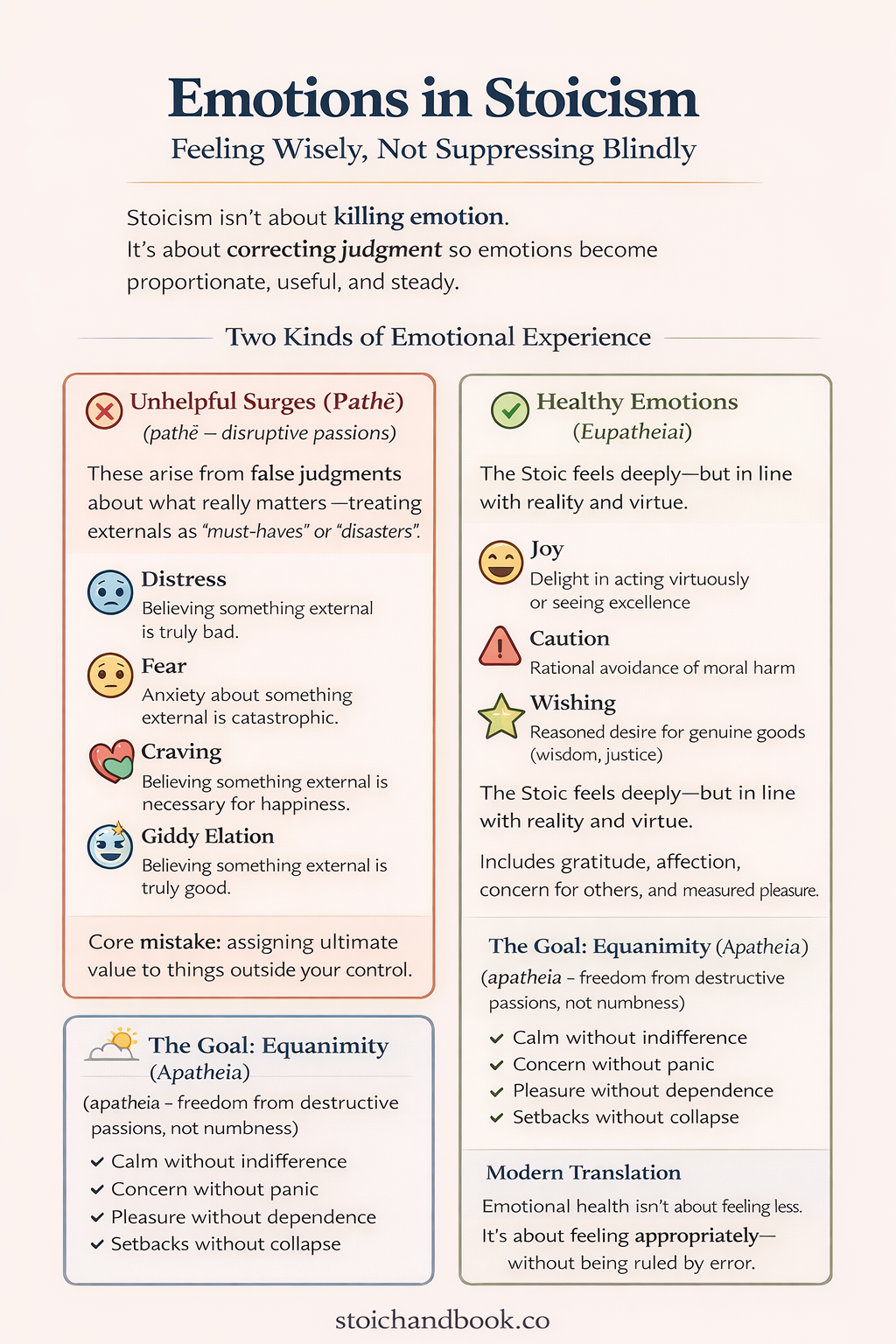
The Stoics distinguished between unhelpful surges (pathē) and healthy emotions (eupatheiai).
Unhelpful Surges (Pathē)
These rest on faulty judgements about what you must have and what you cannot bear:
- Distress: sadness about something you have falsely judged to be truly bad
- Fear: anxiety about something you have falsely judged to be catastrophic
- Craving: obsessive desire for something you have falsely judged necessary for happiness
- Giddy Elation: excessive joy about something you have falsely judged to be truly good
The load-bearing words are falsely judged. These emotions arrive when you hand ultimate value to an external: when you decide that losing the job is terrible rather than inconvenient, or that the promotion is wonderful rather than preferred.
The sage is free of them because they are built on a mistake. If you hold that only virtue is good and only vice is bad, redundancy does not destroy you, because your capacity for virtue is untouched. Promotion does not elate you either, because it has not made you better.
Healthy Emotions (Eupatheiai)
The sage still feels, and feels deeply. The difference is that the feeling rests on a true judgement:
- Joy: delight in what is truly good, such as acting with virtue or watching someone else do it
- Caution: reasoned avoidance of true evil, meaning vice and moral corruption
- Wishing: well-founded desire for real goods, such as wisdom and justice
Three, not four. The Stoics leave the "present evil" slot deliberately empty, because the only present evil is your own bad judgement, and that is the one thing you can always decline to make.
Alongside these sit natural affection, gratitude, concern for other people and a measured enjoyment of ordinary pleasures.
Equanimity (Apatheia)
Equanimity is the state the Stoics aim at: tranquillity, not apathy. The mind is not thrown off balance by circumstances.
You can feel concern without panic and disappointment without despair. The feeling is still there. It has stopped running the show.
Modern translation: emotional health is not suppression. It is feeling in the service of a sound judgement, so the appropriate emotions get through and the destructive ones do not take the wheel.
Apatheia ≠ Apathy. Stoics do not suppress emotion. They cultivate the healthy emotions and clear out the destructive ones built on false judgements.
Living According to Nature: Your Cosmic Context
Universal Reason (Logos)
The Stoics held that the cosmos is ordered by logos, meaning rational principle or divine intelligence. Not a bearded deity micromanaging creation. The rationality, causality and order built into nature itself.
Everything happens according to logos. Causes produce effects. Patterns repeat. The universe can be understood.
Your own rational mind is a fragment of that cosmic logos. You share in the universe's rationality, and when you reason well you are taking part in the order of the whole.
Circle-Growing (Oikeiosis)
We start out caring about ourselves, then extend that care outward: family, friends, community, eventually everyone.
That process is oikeiosis, circle-growing, and the Stoics treat it as how a human being is built. Other people are not strangers to you. They are fellow expressions of logos, and part of the same family.
Hierocles drew it as concentric circles, with you at the centre, immediate family in the next ring, then extended family, neighbours, fellow citizens, and all humanity in the outermost. The practice is to pull the outer circles inward, and to treat people far from you with more of the care you give without thinking to your own.
Shared Connection (Sympatheia)
Everything is connected. The doctrine of sympatheia holds that we are parts of one whole: the cosmos, humanity, nature. Your private good is not separable from the common good.
The practical version of that is unglamorous. Your own well-being runs on systems you did not build and cannot hold up alone, and your virtue shows in what you contribute to them.
Making It Real: Stoic Practices
Knowing the words is the easy half. Four exercises that close the gap between knowing and doing:
Setback Rehearsal (Praemeditatio Malorum)
Picture the obstacle before it arrives. The point is preparation, not pessimism. If you lose the job, what does a courageous and clear-headed response look like? If the relationship ends, how do you hold your balance?
Rehearsing a difficulty takes away its power to shock you, because you have already decided how you intend to meet it.
Daily Review
Morning: preview the day. What is likely to be difficult, and how do I want to meet it?
Evening: go back over what happened. Where did I act with arete? Where did I fall short? What do I do differently tomorrow?
Seneca describes running that audit on himself every night. Done regularly, it is how character actually gets built.
Label–Loosen–Replace
Anxiety says: "This pitch is going to be a disaster."
Label it: "That is a fear-driven phantasia, not a fact."
Loosen it: "What is the evidence, and where am I exaggerating?"
Replace it: "I have prepared. It does not have to be perfect to be worth doing."
Catch the thought. Name it as an impression rather than reality. Loosen its grip by questioning it. Then put a truer reading in its place.
Plan with Flex (Hupexhairesis)
Pursue the goal with a reservation attached: "if nothing prevents it." Make the plan and work hard, and hold in mind that the outcome depends on more than your effort.
"I'll launch the business, fate permitting." You commit fully to the part you control and stay level about the part you do not. The Stoics call this the reserve clause, and it heads off both defeatism and crushing disappointment.
The Bottom Line: Why This Vocabulary Matters
These are not party-trick words. Each one names a specific move: arete tells you what to measure, and phantasia and sunkatathesis tell you where the work happens.
Precision matters here. Read apatheia as "apathy" and you get the cold, unfeeling caricature. Read it as freedom from destructive passions and you get what the Stoics were actually after, which is emotional health rather than emotional death.
Keep this page open the next time one of these words comes up in your reading.
Ready for more? Dive into the podcast episode for audio breakdowns, real-life scenarios, and starter challenges. Ancient gold, modern polish: your resilient life awaits.