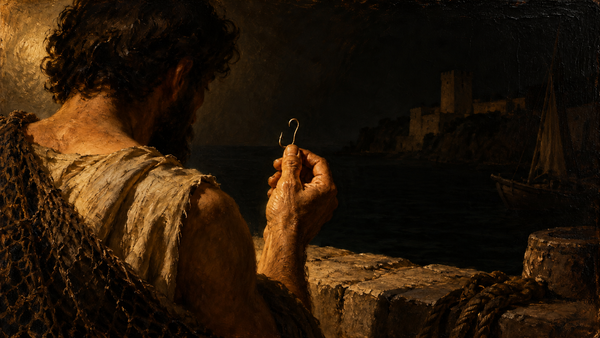
You look up from your phone and twenty minutes have gone. This episode brings Stoic attention to that moment: notice the judgement a post has invited you to accept. Name the Hook is a small exercise for identifying what caught you, in one word, before you decide whether to keep scrolling.
What did you just agree to?
A post can ask for more than your time. It can invite you to believe that someone else's success proves you are behind, or that an argument deserves the rest of your evening.
The episode uses prosochē, Stoic attention, to look at those judgements while they are happening. The question is what you have started to accept as true or important. You can inspect that without blaming yourself for the first feeling that appeared.
Name the Hook
When you notice you have drifted into a scroll you never chose, look at the item on the screen. Name what caught you in one word. Outrage, perhaps. Or envy.
One noticed hook counts as a rep. You can put the phone down or carry on, but first recognise what is pulling you. If you want a record, keep a tally or write down the word. Look back after a week and see whether the same things keep catching you.
That record is a prompt for reflection. It cannot tell you your whole personality, and noticing a hook does not guarantee it will lose its pull. App limits and changes to your surroundings can still help. If the exercise becomes another reason to monitor or criticise yourself constantly, stop the tally and return to something outside the screen.
The broader guide to prosochē explains attention and assent. For a separate guided sitting practice, try Return Before the Noise.
Sources: Epictetus's Discourses, Marcus Aurelius's Meditations, and Ward Farnsworth's The Practicing Stoic. The quotations in the recording use Farnsworth's wording. Jon also compares the exercise with Buddhist noting.
Source note: Name the Hook is a modern application, not a surviving ancient exercise. The night-guard comparison is the episode's metaphor. The claims about angry feeds and personality tests are rhetorical observations, not measured findings or a treatment claim. Stoic attention includes ethical judgement; naming a feeling alone is only a starting point.
Full transcript
Lightly edited for readability.
You looked up and twenty minutes go by. You didn't decide to spend them, and there was no moment where you sat down and thought, I will now give twenty minutes to a stranger's argument and a video I've already seen. The minutes seem to just disappear. It's almost as if they're taken quietly the way a pickpocket would steal from you. And what tells you that something is off isn't just the lost time, it's the taste that it leaves when it's gone. That slightly ashamed, slightly scattered feeling on surfacing when you wake up to realise.
Most advice at this point goes after the phone. Delete the app, grey the screen, buy the little lockbox. Some of that helps, definitely. But the Stoics would say you're guarding the wrong door here. What would the Stoics say? They had a skill, and more specifically, a word for that skill that I want to talk about. Prosochē. It means attention. But they didn't mean concentration, the thing that you use when you sit down to finish a report or finalise a difficult document. They meant a standing watchfulness over what your mind is doing moment by moment, what it's about to agree to, what it's about to chase. Attention not to the world, but to your verdicts on the world.
Epictetus, in the wording Ward Farnsworth uses, quote, pay attention to your impressions, watch over them without sleeping, for what you guard is no small thing, self-respect and fidelity, and self-possession, a mind free from emotion, pain, fear, disturbance. In a word, freedom. End quote.
Watch over them without sleeping. He talks like a man describing a night guard on a wall. And notice what's being guarded specifically. It's not your time. It's not your productivity. It's your freedom.
And this is why this matters. The feed that you're scrolling on is not really competing for your eyes. It's competing for your assent, for your yes. Every item you pass is a small pitch. This is urgent. This is outrageous. This concerns you. You are behind. This matters. You are in danger. The scroll continues, not because your thumb is moving, but because dozens of times a minute, some part of you keeps agreeing, keeps signing for parcels you didn't really order. They just keep showing up.
The phone is new, but the mechanism that makes the phone so addictive is not. Two thousand years ago, the pictures came from the forum, the dinner party, the neighbour's new horse. Marcus Aurelius, again in Farnsworth's wording, says the character of those things you often think about will be the character of your understanding, for the mind is dyed by its thoughts.
Dyed. Like wool in a vat. Not painted, where you can strip it later, but dyed, where the colour becomes the material. An hour in an angry feed doesn't inform you about angry people. It dyes you faintly angrier. You felt this. Everyone has, myself included. You come off a long scroll, someone asks you a simple question, and there's a static in your reply that wasn't there an hour before. A tension. Something sinking in the pit of your stomach. Anyone who has checked the news last thing at night and then wondered why sleep wouldn't come has run this experiment already.
Now the obvious objection, if attention is a skill isn't the answer, just to try harder. Grit your teeth, watch your mind, stay vigilant every waking minute. No one can do that. The Stoics knew no one can do that. Their own name for the person doing this work wasn't the sage, which is the finished article, it was the one making progress. That was the whole job title. The tradition assumes your watch will fail daily, and it builds for recovery rather than perfection.
So the practice I'm going to give you is small, but that's intentional. You don't have to win the war with a feed tonight. You have to start seeing the individual pitches. That's all. Seen clearly, most of them will lose their grip on their own. You cannot unnotice a bad trade once you've noticed it.
So the move is this: it's called name the hook. The trigger is precise. It's the moment you surface mid-scroll and realise you never chose this. That little jolt of waking up, of coming to your senses. You already get it several times a day, until now it's typically been the cue for shame. But here we're repurposing it.
At that moment, before you put the phone down, look at the thing that's actually on the screen and name what it caught you with. A single word said in your head or out loud. It could be outrage, envy, fear, gossip, shiny.
Then you're free to keep scrolling or to stop. And that's the practice. You're not required to be better. You're required to see the hook. Once a day counts as done.
It's sort of like the Buddhist technique of noting when you're meditating. So you have a certain emotion come up and you go, oh. Emotion. You have a certain thought. You go, oh, thought. And you just label it. You don't think too much more about it. You just label it and move on with your day. You're doing the same thing here, but with the things that hijack your attention in the external world.
If you want to keep a trace, you can use a tally, a pen mark on the back of your hand, a note with a word on it. And at the end of the week, you can list all of your hooks. And that will be a way more accurate map of who you are than many personality tests you'll find online.
Epictetus said the thing under guard is freedom. He'd never seen a smartphone or the internet or screens, but he had seen people and minds. And what happens to a mind that agrees with everything put in front of it is what happens to our minds when we're endlessly scrolling on social media.
The feed will pitch you a thousand times tomorrow. It only needs you to sleep on watch. You only need to catch it once and then name it. Once is practice. So start there.
Go deeper
If you want structured practice, the 7-Day Stoic Challenge is free. Nine audio lessons and a 42-page workbook.