
Amor fati means “love of fate”. The Latin phrase is associated with Nietzsche, while the ancient Stoic practice is to meet what has happened and choose a fitting response. It is stronger than passive resignation: you still act, but you stop requiring reality to have arrived differently. Amor fati is the Stoic idea everyone quotes and almost nobody means.
"Love your fate." It looks clean on a tattoo and sounds noble in a YouTube essay. Then your week actually goes wrong, the diagnosis, the redundancy, the message you didn't want, and loving your fate stops being an aesthetic and becomes the hardest assignment in the whole philosophy. That gap, between admiring the phrase and living it, is what this guide is about.
Amor fati meaning: definition and translation
Amor fati is Latin for "love of fate" or "love of one's fate". Amor is love; fati is the genitive of fatum, fate. You'll sometimes see it misspelled "amore fati" or "amour fati", but the correct Latin is amor fati.
Pronunciation: ah-MORE FAH-tee. Classical Latin says "AH-mor FAH-tee"; most English speakers land on "uh-MORE FAH-tee". Nobody worth listening to will correct you either way.
In one sentence: amor fati means treating everything that happens to you, wanted and unwanted, as something to work with rather than something to resent. Not merely tolerating your life. Wanting it.
That last step is the radical part. Plenty of philosophies teach acceptance. This one asks for affection.
Reading about loving fate is one thing. To begin a daily practice, try the free 7-Day Stoic Challenge: one short audio lesson and one exercise a day for a week.
What loving your fate actually asks of you
The standard self-help reading of amor fati is "stay positive when things go wrong", and it is wrong in a way that matters. The Stoics were not asking you to feel pleased about a bereavement. They were making a harder, stranger claim: that resenting reality is a category error, because reality does not take requests. The event has already happened. The only live question is what you build with it.
I learned the difference the slow way. At twenty I went through a breakup that took the floor out of my life. If you had told me then to love my fate I would have laughed at you, or worse. But that collapse is the single event my adult life grew out of: the self-work, the meditation, the reading that eventually led me here. I would not undo it now for anything, and I spent two years wishing it had never happened. Amor fati is the practice of closing that two-year gap. Ideally to two days. Eventually, the Stoics suggest, to zero.
Nietzsche put the target with typical immodesty:
"My formula for greatness in a human being is amor fati: that one wants nothing to be different, not forward, not backward, not in all eternity. Not merely bear what is necessary... but love it."
The Stoic origins of amor fati
Nietzsche coined the phrase, but the practice is ancient. Three Stoics built it.
Marcus Aurelius: fate as the cosmic order
The emperor's Meditations returns to the theme constantly: "Whatever happens to you has been waiting to happen since the beginning of time." For Marcus, what happens to you is woven into the same web as everything else; tearing at your own thread just unravels you. He had a plague, a war and a treacherous general to practise on. This was not armchair material.
Epictetus: the man with the strongest claim
Epictetus was born a slave and walked with a damaged leg, possibly at his master's hands. When he teaches fate, he has standing. In the Enchiridion he gives the instruction at its most direct: "Do not seek for things to happen the way you want; rather, wish that what happens happens the way it happens: then you will be happy."
Read that twice. He is not saying lower your expectations. He is saying retrain your wanting.
Seneca: adversity as the test
Seneca's On Providence argues that hardship is how character gets proven: "The bravest sight in the world is to see a great man struggling against adversity." His position is the easiest to misuse, nobody welcomes your suffering on your behalf, but as a frame for your own difficulties, it holds.
Nietzsche's version, and where it differs
Nietzsche found the Stoic idea and turned the volume up. His thought experiment of eternal recurrence asks: if you had to live this exact life again, every detail, infinitely, would the thought crush you or would you say yes to it? In The Gay Science he wrote: "I want to learn more and more to see as beautiful what is necessary in things; then I shall be one of those who makes things beautiful."
The Stoics taught acceptance in service of tranquility. Nietzsche demanded celebration in service of vitality. The Stoic version is the more liveable of the two, and the one this site teaches. But Nietzsche's test is a useful sharpening stone: "I accept it" can hide a lot of quiet resentment. "I would choose it again" cannot.
Amor fati vs memento mori
Two Latin phrases dominate modern Stoicism, and they work as a pair.
| Concept | Meaning | Focus | Practice |
|---|---|---|---|
| Amor fati | "Love of fate" | Embracing what happens | Accept and love all events |
| Memento mori | "Remember you will die" | Awareness of mortality | Contemplate death daily |
Memento mori supplies the deadline: your time is finite, so spending it at war with what has already happened is the one luxury you cannot afford. Amor fati is what you do with that information. Marcus practised both in the same notebook.
Is amor fati Stoic or Nietzschean?
Both, honestly divided: the Stoics created the concept, Nietzsche created the phrase. The exact words "amor fati" appear nowhere in the ancient texts; Nietzsche introduced them in The Gay Science (1882) and Ecce Homo (1888). The Stoics taught the idea in Greek and got there seventeen centuries earlier. If you want the practice, read Epictetus. If you want the fire, read Nietzsche.
Real lives that show the shape of it
Epictetus is the founding case: a slave who turned the worst hand in Rome into a body of teaching that still runs people's lives today.
Viktor Frankl watched everything be taken from him in the camps and concluded that the last human freedom, choosing your stance toward what happens, can never be taken. Man's Search for Meaning is amor fati written in the hardest possible ink.
Nelson Mandela used 27 years of imprisonment as preparation rather than ruin, and came out ready to reconcile a country instead of burn it.
Michael J. Fox, diagnosed with Parkinson's at 29, has spent decades calling the disease a gift he would not return, and built a foundation that has raised over a billion dollars for research.
A caution that belongs next to these names: every one of them would tell you the loving came later. In the first hours of a catastrophe, amor fati is not the tool. Survival is. The practice is for what comes after.
Amor fati quotes
Marcus Aurelius: "Accept the things to which fate binds you, and love the people with whom fate brings you together, and do so with all your heart." · "Whatever happens to you has been waiting to happen since the beginning of time." · "Never let the future disturb you. You will meet it, if you have to, with the same weapons of reason which today arm you against the present."
Epictetus: "Do not seek for things to happen the way you want them; rather, wish that what happens happens the way it happens: then you will be happy." · "Make the best use of what is in your power, and take the rest as it happens." · The famous line "It's not what happens to you, but how you react to it that matters" is a modern paraphrase of Enchiridion 5 rather than a translation; the idea is genuinely his, the wording is not.
Seneca: "The bravest sight in the world is to see a great man struggling against adversity." · "Difficulties strengthen the mind, as labour does the body." · "It is not that we have a short time to live, but that we waste a lot of it."
Nietzsche: "My formula for greatness in a human being is amor fati: that one wants nothing to be different, not forward, not backward, not in all eternity." · "I want to learn more and more to see as beautiful what is necessary in things; then I shall be one of those who makes things beautiful."
How to practise amor fati
Not three inspirational principles. One drill, run at three sizes.
Small (daily): when a minor friction lands, the rain, the queue, the cancelled plan, say inwardly: this is part of today's course. Not "this is fine". Just: this is the actual terrain, and the version of today where it didn't happen is not on offer. Then act. This sounds trivial. It is a rep, and reps are the point.
Medium (weekly, in a journal): take one current difficulty and write two honest answers. What has this already cost me? What could this make possible that comfort would not? Both columns must be real. Amor fati that skips the first question is just denial with a Latin name.
Large (rarely, deliberately): take the worst thing that has ever happened to you, one with some years on it, and trace what grew from it that you now value. Most people find at least one load-bearing beam of their life resting on their worst day. You do not have to call the day good. You only have to notice that you have already built on it. That noticing is the seed of the whole practice.
The dichotomy of control is the sorting tool underneath all three: amor fati applies to the column you cannot control. The other column still wants your effort.
The honest criticism
The standard objection: doesn't loving fate breed passivity? If everything is to be embraced, why fight injustice, why treat the illness, why leave the bad situation?
The Stoic answer is that amor fati addresses the past and the unchangeable present, not the open future. The diagnosis is fate; the treatment plan is choice. The years in prison were fate; what Mandela did with year 28 was not. You love what has happened. What happens next is still your job. Anyone using amor fati to excuse inaction has the direction of the tool backwards.
Amor fati tattoo ideas and meaning
Amor fati has become one of the most popular Stoic tattoo choices, usually as a daily-visibility reminder to stop resisting what cannot be changed.
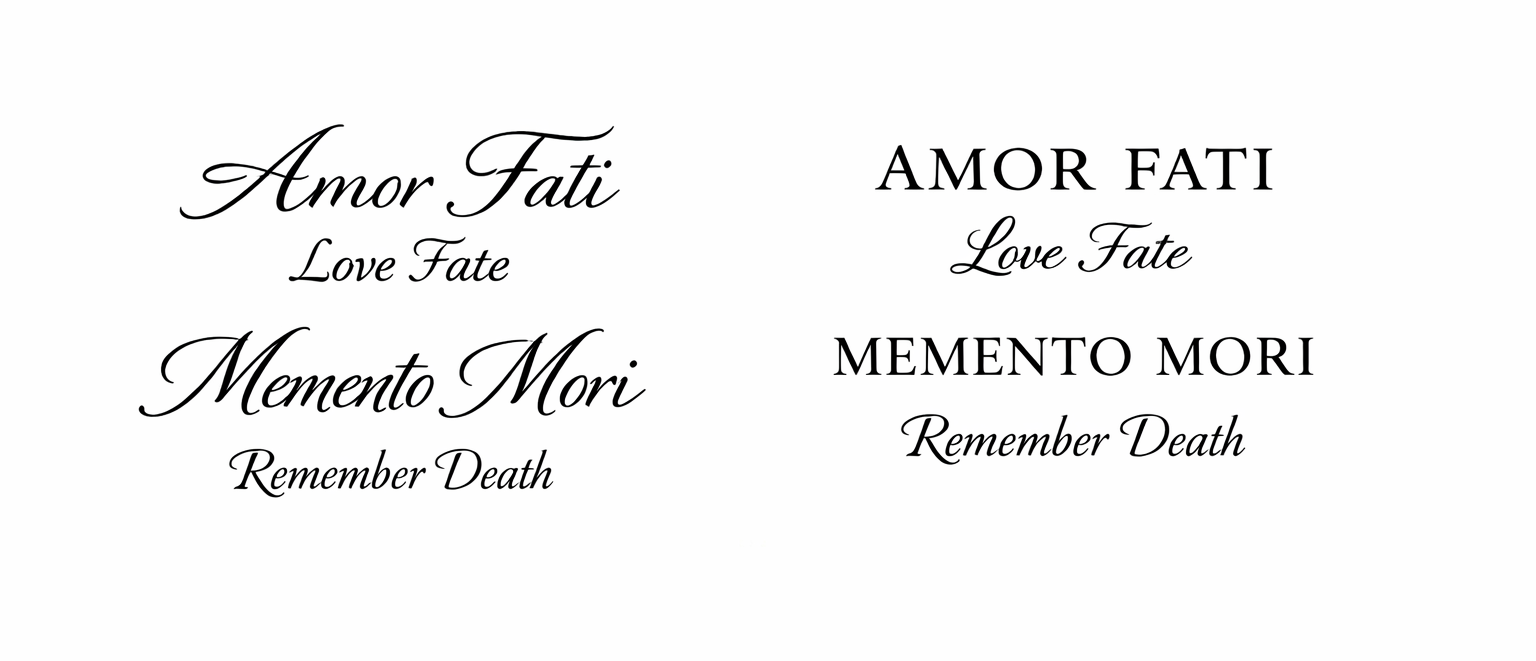
The common text treatments: plain "Amor Fati" in a serif or script face, the Latin with the English underneath, or paired with "Memento Mori" as a two-line set.
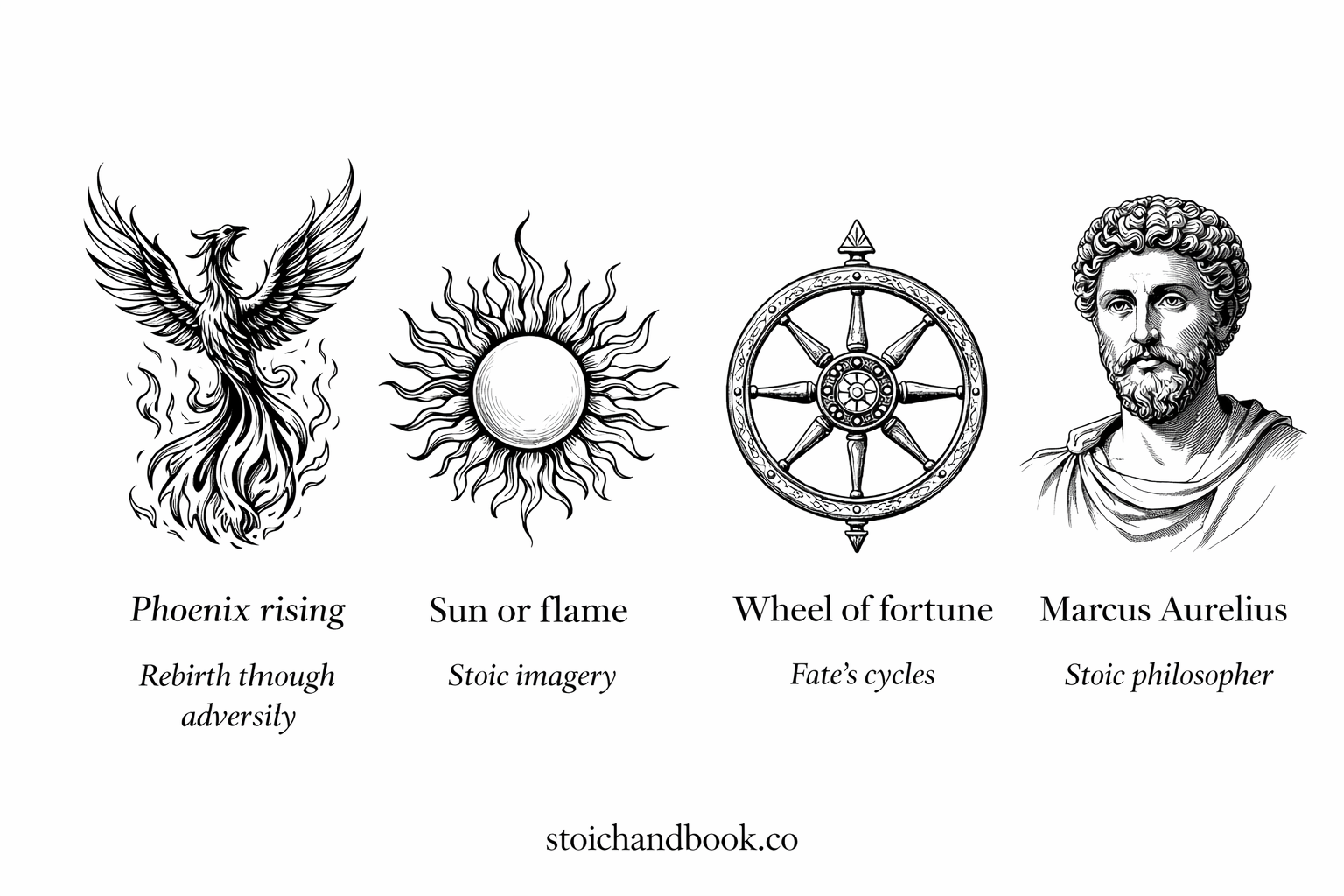
Symbol pairings people choose: a phoenix (rebuilding from the worst day), a flame or sun, the wheel of fortune, or a Marcus Aurelius portrait. Placement tends to follow function: inner forearm if you want to see it daily, wrist for something quieter, chest or ribs for a private commitment. Some people add a date, the day the worst thing happened, which is about as literal as amor fati gets.
One thought before the needle: the phrase is a practice, not a possession. The ink is the reminder. The reps are the thing.
Frequently Asked Questions About Amor Fati
What does amor fati mean in English?
Amor fati translates to "love of fate" in English. It means embracing and accepting everything that happens in life — both good and bad — as necessary and even desirable.
How do you pronounce amor fati?
Amor fati is pronounced "ah-MORE FAH-tee" or "uh-MORE FAH-tee." The emphasis falls on the second syllable of each word.
Is amor fati Stoic or Nietzsche?
Both. The concept originated with ancient Stoics like Marcus Aurelius and Epictetus, but the exact Latin phrase "amor fati" was coined by Friedrich Nietzsche in the 19th century. The Stoics taught the idea; Nietzsche named it.
What is the difference between amor fati and memento mori?
Amor fati means "love of fate" — accepting and embracing what happens. Memento mori means "remember you will die" — awareness of mortality. They're complementary: memento mori reminds us life is short, which makes amor fati (accepting our fate) more urgent.
Is amor fati passive or active?
Amor fati is active, not passive. It's not about giving up or being complacent. It's about choosing your response to events. You still take action and pursue goals — but you accept outcomes without resistance or bitterness.
How do I practice amor fati when something terrible happens?
Start by acknowledging the event without judgment. Then ask: "What can I learn from this? How might this make me stronger?" Focus only on what you can control — your response — and release attachment to what you cannot. This takes practice; start with small frustrations before applying it to major adversity.
What is an example of amor fati?
Nelson Mandela spent 27 years in prison. Rather than becoming bitter, he used the time to develop wisdom and prepare for leadership. When released, he led South Africa through reconciliation rather than revenge. He transformed his fate into his purpose — a perfect example of amor fati.
Did Marcus Aurelius say amor fati?
Marcus Aurelius taught the concept but didn't use those exact words. He wrote in Greek, not Latin. His Meditations contains passages like "Accept the things to which fate binds you, and love the people with whom fate brings you together" — the same idea expressed differently.
Going deeper
The primary texts: Marcus Aurelius's Meditations, Epictetus's Discourses and Selected Writings, and Nietzsche's Thus Spoke Zarathustra. On this site, the Meditations summary maps the source book, and premeditatio malorum is the companion practice: rehearsing fate before it arrives makes it considerably easier to love afterwards.